

clearout
  • Products
    • Email Verifier Verify emails addresses individually, in bulk or through API, with 99% accuracy
    • Email Finder Find individual or bulk emails by entering the person & company name or domain
    • Form Guard IconForm Guard Protect your forms from spam, bots, and invalid submissions with real-time email, phone, and name verification.
    • Prospect SQL/MQL list building with high levels of personalization, real-time data enrichment and prospect search
    • Clearout For SheetsVerify email addresses directly on Google Sheets with Clearout for sheets add-on
    • Prospect – LinkedIn Chrome ExtensionBuild verified, targeted prospect lists directly from LinkedIn profiles
    • ClearoutPhoneValidate phone numbers across 240+ countries in bulk, quick or real time validation
    • Free Tools
    • Disposable Email Checker
    • Reverse LinkedIn Profile Lookup Tool
    • Reverse Email Lookup Tool
    • Email List Cleaner
    • Company Domain Finder API
  • Resources
      DEVELOPERAPI iconAPI
      Clearout APIs are structured around REST and JSON
      Webhooks iconWebhooks
      Capture real-time events in your application workflow
      Form Guard iconForm Guard
      Real-time form validation to keep bad contacts out of your CRM
      KNOWLEDGE BASEGetting started iconGetting started
      Sending campaigns without bounces is made simple
      FAQ iconFAQ
      Easily find answers to services, security and common questions
      USE CASESLead Generation iconLead Generation
      Learn how professionals generate quality leads
      GUIDESPricing arrow iconTransparent & flexible pricing to support pay-per-use or recurringCompare Email Verification Tools arrow iconAI-powered email verification with 99%+ accuracy, real-time validation, and transparent risk scoringCompare Email Finder Tools arrow iconPre-verified B2B email addresses with confidence scoring, find real person email, not role-based addressBLOGSEmail Verification ToolsFind Anyone’s Email Address
      Most Accurate, Fast & Free Ways
      Form Validation
      Importance, Ways & Best Practices
      View All Blogs
  • Pricing
  • Integrations
  • Enterprise
  • Login
Try it free Book a 1-to-1 demo
Priyanshi Sharma / March 31, 2026 March 31, 2026

The Complete B2B Go-To-Market Strategy Guide for 2026


The Complete B2B Go-To-Market Strategy Guide for 2026

Your product is ready. Your team is in place. Funding is in the bank. Without a Go-To-Market strategy, however, you are just not moving at all. Most startups fail because they never created an explicit channel of reaching and converting the right customers.

A go-to-market strategy, also known as GTM, is a clear roadmap for how a company should access its target market, sell its value, and generate revenue. It determines who you are selling to, what issue you are solving for them, how you position your product, what you charge, and which channels you sell on.

This guide will help you understand what a go-to-market strategy entails for modern B2B teams. It reveals the importance of GTM in 2026, its advantages, and particular actions to grow your revenue.

Table of Content


‣ Core Components of a B2B GTM Strategy
‣ How To Build Your B2B GTM Strategy Step-by-Step
‣ Best GTM Strategy for B2B As Per Different Roles
‣ The Critical Role of Data in GTM Success
‣ Tools for GTM Success: Why Modern Teams Need Specialized Platforms
‣ Your Go-to-Market Success Framework
‣ Your Next Steps for GTM Success
‣ Final Checklist
‣ FAQs
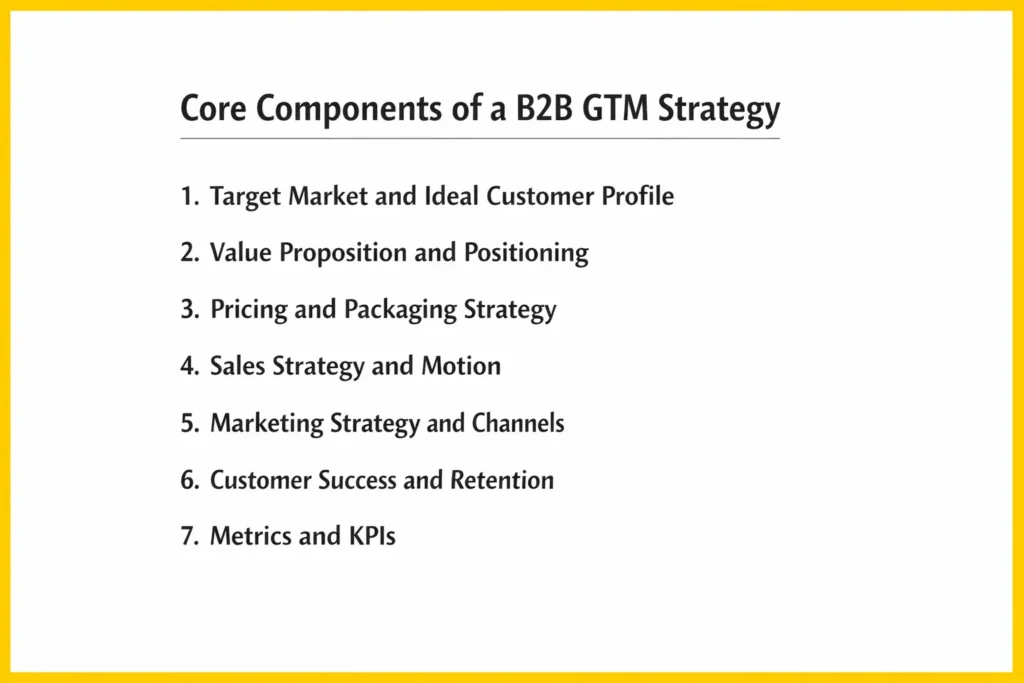
Core Components of a B2B GTM Strategy


An image of the core components of a B2B GTM strategy.

A good GTM strategy is typically reduced to some key parts. Losing one of them will slow your growth.

1. Target Market and Ideal Customer Profile


That is the wrong place to start. The closing line of the sentence that comes just before your sign-off is what actually tells the reader what happens next. Do they need to respond? Are you following up? Is the thread done? Without it, the email just ends and the reader is left guessing.

The first thing you should clearly know is who you are selling to. When you are not specific in targeting, then everything becomes more difficult. The marketing is spending money reaching the wrong individuals, and the sales are wasting time talking to the people who will not become their potential buyers.

A proper Ideal Customer Profile is a filter. It informs you which companies are worth noticing and which ones are not.

What Makes a Strong ICP


Start by answering a few basic questions.

  • First, who is the real person who experiences the problem that your product is solving?
  • Second, who has the money and the urgency to repair it?
  • Third, who has the authority to buy your solution?
For example, if you are a premium skincare brand selling acne care products, not everyone having acne will be your ICP. Your exact ICP should be men and women aged 22–35 in metro cities who can pay a premium price and are looking for an urgent solution.

A Simple Way to Define Your ICP


Instead of guessing, look at your existing customers.

Identify the companies that:

  • closed quickly
  • adopted the product without friction
  • closed quickly
  • adopted the product without friction
  • renewed subscriptions
  • expanded their spending
  • recommended you to others
Then compare them with customers who struggled. You will likely notice patterns. Certain industries convert faster. Some companies adopt products more easily. Those insights help you define a precise ICP.

Then compare them with customers who struggled.

You will likely notice patterns. Certain industries convert faster. Some companies adopt products more easily. Those insights help you define a precise ICP.

Finding Prospects That Match Your ICP


Once your ICP is clear, the next step is finding similar prospects.

Tools such as Clearout’s Sales Prospecting tool help you build an outreach-ready list, filtering contacts by role, company size, industry, and technology usage. That way, you build prospect lists that actually match the companies you want to sell to.

2. Value Proposition and Positioning


After defining your ICP, you need a clear answer to one question.

Why should someone choose you?

Many companies get this wrong because they talk about product features instead of results.

The Simple Value Proposition Formula


A strong value proposition usually includes three things.

1. The exact problem you solve Avoid vague phrases like “improve efficiency.” Instead, explain the problem clearly. Example: reduce CRM data cleaning from ten hours per week to thirty minutes.

2. A measurable outcome Numbers make the value obvious. Examples might include:
  • reducing bounce rates from eight percent to under two percent
  • increasing sales productivity by fifteen hours per week
  • improving campaign ROI by forty percent
3. Clear differentiation Prospects want to know why your product is different. Instead of saying you use “advanced AI,” explain the specific advantage. For example, validating catch-all email domains where other tools show unknown results.

Test Your Value Proposition


A simple test works well here.

If a prospect cannot answer these four questions after reading your message, you should rewrite it.

  • Is this product meant for me
  • What problem does it solve
  • What result will I get
  • Why is it different from other options
When those answers are clear, messaging becomes far more effective.

3. Pricing and Packaging Strategy


Pricing does more than determine revenue. It also shapes how your sales process works.

Common Pricing Models


Here are a few common approaches.

  • Per user pricing: Works well for collaboration tools where value increases as teams grow.
  • Usage-based pricing: Suitable for products where consumption varies, such as API tools.
  • Tiered pricing: Useful when serving multiple company sizes with different feature sets.

4. Sales Strategy and Motion


Your sales motion should match your deal size.

A product selling for a few thousand dollars per year cannot support a long enterprise sales process. On the other hand, large enterprise deals often require deeper conversations.

Sales Motion by Deal Size


Smaller contracts often rely on self-serve onboarding or product-led growth.

Mid-range deals are usually sold using inside sales personnel that take the buyers through demos and tests.

The bigger deals of enterprise will normally need account executives, sales engineers, and a lengthier assessment period.

Choosing the Right Sales Model


You will usually choose between three models.

  • Product-led growth: The customers will test the product and then make their sales calls.
  • Sales-led: Sales departments control the process of buying at the initial stage.

Your Sales Process


A typical sales process follows several stages.

  1. Prospecting
  2. Qualification
  3. Discovery
  4. Demonstration
  5. Proposal
  6. Negotiation
  7. Close

Each stage helps move prospects toward a buying decision while filtering out poor fits early.

To find qualified prospects, many teams use platforms like Clearout’s Email Finder to build pre-verified contact lists that match their ICP.

5. Marketing Strategy and Channels


You should determine how your prospects will learn about your product.

The marketing channels that you use must be the same as those used by your buyers in researching solutions.

Common B2B Channels


  • Content marketing and SEO: Effective when the time spent on online shopping solutions is high.
  • Paid search: Grabs the attention of prospects who are already looking to get solutions.
  • LinkedIn ads: Good in the case of targeting specific jobs and industries.
  • Outbound email: This is applicable when the ICP is clear, and you have confirmed contact lists.
  • Account-based marketing: This is suitable where the deal is of high value, and the target accounts are specified.
  • Events and communities: It is helpful in the industry where relationships are important.

6. Metrics and KPIs


Lastly, you require explicit measurements that can be used for improvement.

Important Pipeline Metrics


Some common metrics include:

  • pipeline coverage
  • win rates by segment
  • average deal size
  • sales cycle length

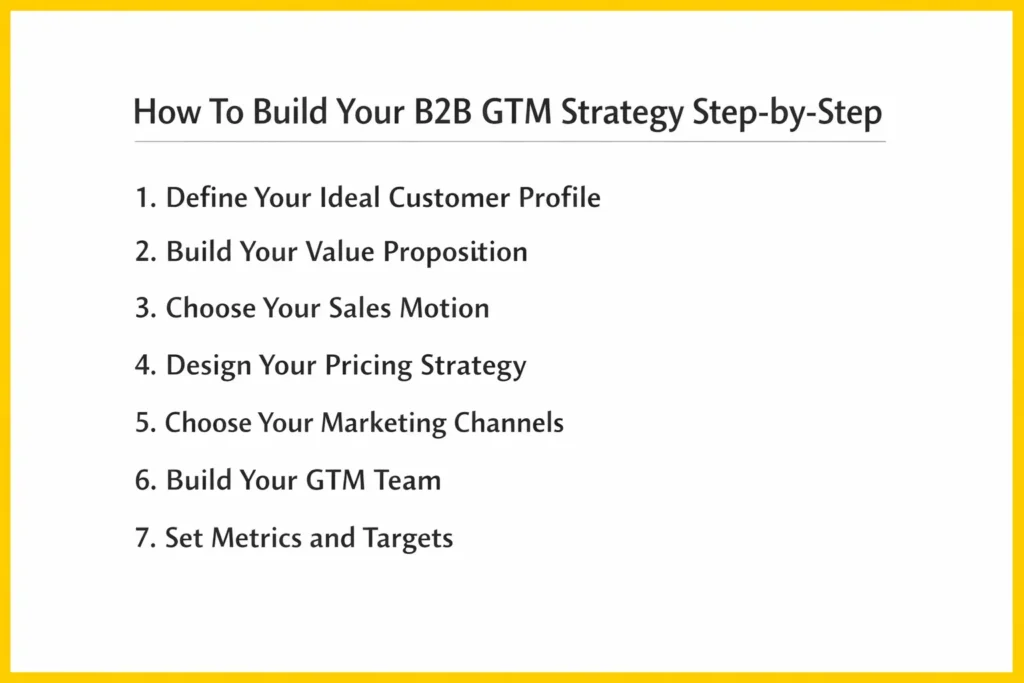
How To Build Your B2B GTM Strategy Step-by-Step


An image on steps to build a B2B GTM strategy.

Now that you understand the main GTM components, check out the steps to use them in your strategy.

Step 1: Define Your Ideal Customer Profile


Start with customer data.

Look at companies acquired in the last one or two years. Identify which customers produce the best results.

Then build a prospect list matching that profile. Tools like Clearout’s prospecting platform help you locate verified contacts of these ICP’s that fit those criteria.

Step 2: Develop Your Value Proposition


Convert the benefits of your product into quantifiable results.

Begin by defining the 3 largest issues that your ICP has. Next, determine the economic cost of such issues.

Lastly, describe the way your solution provides quantifiable benefits.

Piloting this message on actual customers aids in polishing it within a short time.


Step 3: Choose Your Sales Motion


Decide how customers will buy.

Your decision should consider:

  • target deal size
  • product complexity
  • acceptable customer acquisition cost

Step 4: Design Your Pricing Strategy


The first step is to find out your delivery expenses. Second, analyze rivalry prices and calculate the level of customer readiness to pay.

Thereafter, create price levels that are appropriate to the various customer groups.

There are 3 levels provided by many companies. Growth level, entry level, and enterprise.

Step 5: Go for Marketing Channels


Some rely heavily on search engines. Others trust peer recommendations. Some respond well to outbound outreach.

Your channel selection should match buyer behavior and available budget.

Step 6: Build Your GTM Team


Your team structure depends on your revenue targets and sales model.

Typical roles include:

What a professional signature includes:
  • marketing managers
  • SDRs
  • account executives
  • customer success managers
  • revenue operations
Clear responsibilities help teams coordinate effectively.

Step 7: Set Metrics and Targets


Monitor the production, their conversion rates, and the increase in revenues. Check these measures on a regular basis in order to detect bottlenecks.

Best GTM Strategy for B2B As Per Different Roles


The common strategy is to inform all teams whom you want to sell to, how to connect with them, and why they should matter. The plan is incorporated differently by each department. When everyone understands it, revenue grows with less confusion. When teams interpret it differently, growth slows down.

Let us break down how the GTM strategy supports each role.

1. For Founders and CEOs


For founders, the GTM strategy turns product belief into paying customers.

You may deeply understand the problem your product solves. You may feel confident that your solution is strong. But customers do not buy based on your conviction. They buy when the offer fits their situation.

A clear GTM strategy forces founders to answer direct questions:

  • Is our Ideal Customer Profile specific enough
  • Does our pricing reflect how buyers see value
  • Are we selling through channels that customers actually use
  • Can we afford our sales approach based on deal size
Without these answers, hiring a large sales team becomes risky. Testing positioning with a small group of prospects costs far less than scaling on assumptions. Strong GTM thinking protects capital. It helps founders validate before they expand.

2. For Sales Leaders


For a VP of Sales, GTM strategy acts as the operating manual for revenue.

If you target enterprise accounts, you need experienced Account Executives. If you sell to small businesses, you may need outbound reps with shorter cycles. Compensation plans must match deal size and sales length.

When sales leaders lack GTM clarity, they react quarter by quarter. They adjust hiring and targets based on short-term wins instead of long-term structure.

Clearout’s Sales Prospecting platform supports this by helping reps find and contact the right people at target accounts. Instead of dialing random contacts, teams work from verified prospect data that matches their defined ICP. This keeps outreach consistent with strategy rather than guesswork.

Sales leaders gain clearer forecasting, stronger territory planning, and more structured coaching when GTM strategy is defined.

3. For Marketing Leaders


Marketing leaders depend on GTM strategy to guide budget decisions.

Every marketing dollar must answer a simple question. Who are we targeting and how do they buy?

Without clarity, teams debate endlessly. Should we invest in paid ads or content? Events or webinars? Account-based campaigns or inbound?

GTM strategy defines:

  • Who the ICP is
  • What problems matter most
  • Which messages resonate
  • Which channels do buyers trust
When marketing and sales agree on these fundamentals, lead quality improves. Conversion rates become easier to track. Campaign spending becomes more disciplined. Marketing teams use Clearout’s Email Finder to build pre-verified prospect lists that match ICP filters. Instead of broad targeting, they reach verified contacts in the right roles at the right companies. That alignment reduces wasted spend and improves outreach precision.

4. For Revenue Operations


Revenue Operations teams build the data backbone of the company. They choose systems, design workflows, and track metrics. All of that depends on GTM clarity.

If your ICP changes, the required CRM fields change. If your sales motion shifts, pipeline stages change. If your channel mix expands, attribution tracking changes.

RevOps teams benefit from GTM strategy because it tells them what data actually matters. Instead of tracking vanity metrics, they measure signals that predict revenue.

Clearout’s Email Verification API connects to CRM and marketing systems to maintain clean data at entry points. When contacts are verified before entering the database, reporting becomes more accurate and sales teams avoid chasing invalid leads. Clean data supports disciplined GTM execution.

5. For Product Teams


Product teams use GTM strategy to guide roadmap decisions.

Every feature request competes for development time. GTM clarity helps answer:

  • Which features matter most to our ICP
  • Which improvements drive deal closure
  • Which enhancements support expansion revenue
Without GTM alignment, product teams risk building features that sound impressive but do not drive sales. When product decisions match GTM priorities, sales conversations become clearer. Messaging improves. Pricing becomes easier to justify.

The Critical Role of Data in GTM Success


An illustration of the critical role of data in GTM success

Check out more details about the data you need for GTM success.

1. Data Brings Precision to Your Ideal Customer Profile


Your Ideal Customer Profile (ICP) should come from evidence, not assumptions. The best way to define it is by studying existing customers. Look at which companies bought quickly, used the product frequently, renewed their contracts, and expanded their purchases.

This analysis requires several types of data. Customer history shows buying patterns. Firmographic information explains company size and industry. Engagement records reveal how prospects interacted with marketing and sales. Outcome data shows which accounts produced long-term revenue.

Without this evidence, teams rely on opinions. Sales may prefer one segment. Marketing may believe another segment responds better. Product teams may think a third group benefits most. When these views are not supported by data, internal debates continue without resolution.

2. Data Supports Personalization at Scale


B2B buyers should not do generic outreach anymore. Buyers expect you to understand their personality. A message that mentions a company’s recent funding, regulatory pressure, or industry trend feels more relevant than a generic email.

However, doing this manually is difficult. One salesperson can research and personalize a limited number of messages each day. Large pipelines require thousands of outreach attempts.

Data systems help by providing a structured context. They supply information about company activity, industry classification, job roles, and recent events. This information allows teams to produce targeted communication for large groups of prospects.

3. Data Reveals What Is Working


A GTM strategy never stays static. Early positioning might miss buyer expectations. Certain channels might produce weak pipelines. Messaging might fail to resonate with the intended audience.

Only data shows what is truly happening. Companies that rely on data adapt faster. Companies that rely on opinions often repeat the same mistakes because decisions follow personal preference rather than evidence.

4. Data Determines Contact Accuracy


Reaching the right people is essential for GTM execution. Incorrect contact details break the process before it begins. Emails that bounce waste marketing spend. Wrong phone numbers slow down sales teams. Outdated job titles lead outreach to people who no longer hold buying authority.

Even a strong message will fail if it never reaches the intended person. This is why contact accuracy plays such a large role in GTM execution.

5. Data Prevents List Decay


Contact data does not stay accurate for long. People change companies. Roles shift within organizations. Domains expire or move to different systems. Over time, databases fill with outdated records.

Research shows that B2B contact data can decline by nearly thirty percent each year. A list created six months ago may already contain many invalid contacts.

When companies send campaigns to outdated lists, several problems appear. Email bounce rates rise. Sales teams call disconnected numbers. Metrics become unreliable because the audience is no longer accurate.

For this reason, maintaining data quality must be continuous. Periodic cleanup is not enough. Contact records require regular validation and updates so outreach efforts remain productive.

Tools for GTM Success: Why Modern Teams Need Specialized Platforms


Without strong data tools, even a good GTM strategy struggles to produce results.

CRM systems store contacts. Marketing platforms send emails and manage campaigns. But neither of these systems fixes poor data. If email addresses are wrong or contacts have changed jobs, those platforms simply continue sending messages to bad records.

This is where specialized GTM tools become essential.

Clearout for GTM Teams


Clearout provides a data quality layer for modern GTM execution. It makes sure that you run outreach, marketing campaigns, and enrichment on high-quality and accurate data.

You don't need multiple tools for GTM anymore since Clearout can continuously validate, enrich, and maintain your contact data at scale.

What result will you get?

  • Low bounce rates and reduced outreach wastage.
  • Improved sender reputation and consistent inbox placement.
  • High-probability buyers and conversions
Clearout makes sure that your downstream tools like CRM, ESPs, and enrichment platforms show their peak performance.

Below are the core capabilities GTM teams can rely on.

1. Email Validation


Email deliverability starts with valid addresses.

Clearout Email Verifier does 20+ checks to validate an email address. It reviews address structure, domain validity, and mailbox availability. This process helps identify invalid emails before campaigns begin.

When companies clean their lists regularly, bounce rates drop, and sender reputation stays healthy. Messages are far more likely to reach inboxes.

2. Phone Number Validation


Modern prospecting rarely relies on one channel. Email, phone calls, and LinkedIn outreach often work together.

ClearoutPhone verifies phone numbers so sales teams avoid dialing disconnected lines. It also identifies line type and carrier details, which helps teams understand how to approach outreach.

When phone numbers are correct, sales reps spend more time speaking with prospects rather than dialing numbers that no longer work.

3. Data Enrichment


Basic contact lists often contain only names and email addresses. That information alone does not provide enough context for meaningful outreach.

Clearout adds company attributes such as:

  • company size
  • industry category
  • estimated revenue
  • technology stack
  • funding status
These details help teams group prospects and write outreach that speaks directly to their business situation.

4. Contact Discovery


When teams enter new markets or expand territories, they need fresh prospect lists.

Clearout Sales Prospecting tool allows users to find an Ideal Customer Profile and locate professionals working in companies. This helps teams build prospect lists faster without relying only on manual research.

5. Form Validation


Clearout Form Guard validates every email, phone, and name in real-time, instantly, or as entered. Plug it into any form to block low-quality or invalid data and keep your pipeline clean.

It can be used with 100,000+ forms with vanilla HTML and all major form builders. Its real-time logs let you see incomplete entries to analyze drop-offs, refine your forms, and retarget high-intent visitors. For GTM teams, Form Guard can be helpful in keeping your CRM clean and improving your outreach.

6. Continuous List Hygiene


Contact data changes constantly.

People change jobs. Companies restructure. Email addresses stop working. If databases are not checked regularly, outreach quality declines quickly.

Clearout connects with CRM systems and email sending platforms, so new contacts can be checked automatically. It also helps teams clean older records before running campaigns.

This ongoing process keeps databases accurate over time.

Your Go-to-Market Success Framework


A strong go-to-market strategy often decides how far a product can grow. Many companies build good products but still struggle to reach the right customers. The difference usually comes down to how clearly the company defines its market, communicates value, and organizes its teams around revenue.

GTM Strategy Is a Continuous Process


GTM planning is not something a company writes once and forgets. It is an ongoing discipline.

Teams constantly refine key elements such as:
  • defining the ideal customer profile with precision
  • explaining the product value in clear and measurable terms
  • selecting outreach channels that match how buyers actually research and purchase
  • organizing sales and marketing teams around the same message
  • reviewing results and improving what works
Every part of GTM planning relies on data. Customer behavior, outreach results, conversion rates, and revenue patterns guide better decisions over time.

What a Strong GTM Strategy Produces?


When the GTM strategy is executed properly, companies begin to see clear results.

These outcomes include:
  • predictable revenue growth instead of random sales wins
  • lower customer acquisition costs through better targeting
  • stronger positioning against competitors
  • long-term revenue expansion from satisfied customers

Execution Requires the Right Tools


Planning alone does not generate revenue. Teams must also run outreach, manage data, and monitor results across multiple channels.

That is why specialized GTM tools are essential. Sales teams need accurate contact records. Marketing teams require detailed company information for targeting campaigns. Revenue teams need reliable data to evaluate pipeline health.

Without strong data systems, even well-planned GTM strategies struggle to deliver results.

Reliable Data Is the Foundation of GTM Execution


Contact accuracy plays a central role in market success.

  • If email addresses are invalid, campaigns bounce.
  • If phone numbers are outdated, sales teams waste hours dialing incorrect contacts.
  • If company information is incomplete, segmentation becomes weak and outreach feels generic.
Data quality determines whether your strategy reaches real prospects or disappears into invalid records.

Your Next Steps for GTM Success


An illustration showing the next steps for GTM success

If you want your go-to-market strategy to deliver results, begin with these practical actions.

1. Review Your GTM Clarity


Start by examining how clearly your organization understands its target market.

Ask questions such as:

  • Can every sales and marketing team member describe your ideal customer profile precisely
  • Does your value proposition explain measurable business outcomes
  • Do sales and marketing teams agree on what qualifies as a strong lead

2. Examine Your Data Quality


Next, look at the condition of your contact database.

Important signals include:

  • email bounce rates during campaigns
  • the last time your database was validated
  • the availability of company attributes such as industry and employee size
  • the accuracy of contact information for professionals in target accounts

3. Build Strong Data Infrastructure


Once data issues are visible, the next action is improving how your organization maintains contact records.

Modern revenue teams rely on systems that verify email addresses, validate phone numbers, and enrich company information automatically. This process keeps databases accurate and prevents outreach campaigns from targeting outdated contacts.

Platforms such as Clearout support these tasks by validating contact records and helping teams maintain healthy databases over time and campaign-ready.

4. Continue Learning and Improving


GTM success develops through continuous improvement. Teams test messaging, review outreach results, and refine targeting regularly.

To support this process, explore detailed guides on specific GTM activities such as:

  • sales development outreach
  • targeted marketing campaigns
  • channel partnerships
  • product-led growth strategies
Each activity contributes to the larger GTM system that drives revenue.

Final Checklist


Before launching your GTM strategy, verify:

  • ICP is specific (not "B2B companies")
  • Value proposition is tested with prospects
  • Sales motion matches deal size economics
  • Pricing supports your CAC model
  • Channels match where ICP researches
  • Team structure supports revenue goals
  • Metrics dashboard is tracking key KPIs
Verify your data first. Then execute your GTM strategy.

Get High-Quality Data Today

FAQs


1. What is a B2B GTM strategy?
A B2B GTM strategy explains how a company reaches the right business customers and turns them into paying clients. It defines who the product is for, the problem it solves, and how sales and marketing will reach those buyers. You map the destination, choose the route, prepare the team, and carry the right equipment so the journey ends with customers choosing your product.
2. How do you prepare a GTM strategy?
Preparing a GTM strategy begins with understanding your best customers. Start by defining your ideal customer profile and identifying the companies most likely to benefit from your product. Next, explain the exact problem you solve and the outcome buyers receive. After that, choose the channels where those buyers search for solutions.
3. What are the most common GTM strategy mistakes?
Many strategies fail because companies misunderstand their target market or try to sell to everyone. Another common issue is weak communication between sales, marketing, and product teams. Also, many teams forget to track important metrics.
4. What tools help teams execute a GTM strategy successfully?
Tools like Clearout support GTM execution by validating email addresses, enriching contact records, and helping teams find verified prospects that match their ideal customer profile. When your data is accurate, outreach reaches real buyers and your GTM strategy works as intended.

Share this article

Recent Posts

31 Mar 2026
The Complete B2B Go-To-Market Strategy Guide for 2026

Explore how modern B2B teams design a strong go-to-market strategy that aligns sales and marketing, ...

23 Mar 2026
How to End an Email: 15 Sign-Off Examples by Context

Discover how to end an email professionally with 15 sign-off examples. Choose the right closing by c ...

20 Mar 2026
Why Many Email Finders Return Inaccurate Emails | How to Fix

Many email finders return inaccurate emails due to outdated data, lack of verification, and other hi ...

18 Mar 2026
How to Automate Bulk Email Verification With API (Step-by-Step)

Learn how to automate bulk email verification using an API. Explore this step-by-step guide on setup ...

17 Mar 2026
B2B Investor Outreach: A Step-by-Step Guide for Founders

Learn how to do B2B investor outreach step by step. Discover how to find the right investors, locate ...

Clearout's

Form Guard

Validate email, phone & name on any forms!

  • Real signups only
  • Verified emails
  • Valid phone numbers
  • No fake names
  • Cleaner CRM
  • No devs needed
Try for Free Now

Email Verification, Email Finding Form Guard & Prospecting Service

Expand Your Reach By Finding & Verifying Ideal Prospects.

Sign up & get 100 free credits

No Credit Card required

Create Free Account
Company

Why Clearout?

Pricing

Contact Us

Careers

Press

Enterprise

Sitemap

FAQ

Status

Products

Email Verifier

Email Finder

Form Guard

Prospect

LinkedIn Email Finder

Reverse Lookup

Google Sheets Add-on

WordPress Plugin

ClearoutPhone

What's New?

Resources

Integrations

HubSpot

Team Account

API

Compare Email Verifier

Compare Email Finder

Compare Prospecting

Use Cases

Blog

Help

Legal

Privacy Policy

Terms

DPA

Security

Trust Center

Certification

ISO 27001/2022

SOC 2 Type 2

GDPR

Partnership

HubSpot Certified

Affiliates

Partners

Clearout for browser

⚡ Supercharge Your Prospect Research with Clearout's LinkedIn Chrome Extension - Find and Verify Emails with Confidence!

Clearout Chrome extension

clearout
© 2026 Clearout Inc. All Rights Reserved. Powered by Clearout.
Auto Credit Replenishment is here! Your credits can now recharge automatically. Learn More ➞
X