- Products
- ResourcesDEVELOPER

 API
API
Clearout APIs are structured around REST and JSON Webhooks
Capture real-time events in your application workflow Form Guard
Real-time form validation to keep bad contacts out of your CRMKNOWLEDGE BASE Getting started
Sending campaigns without bounces is made simple FAQ
FAQ
Easily find answers to services, security and common questionsUSE CASES Lead Generation
Learn how professionals generate quality leadsGUIDESPricing Transparent & flexible pricing to support pay-per-use or recurringCompare Email Verification Tools AI-powered email verification with 99%+ accuracy, real-time validation, and transparent risk scoringCompare Email Finder Tools Pre-verified B2B email addresses with confidence scoring, find real person email, not role-based addressBLOGSEmail Verification ToolsFind Anyone’s Email Address
Most Accurate, Fast & Free WaysForm Validation
Importance, Ways & Best PracticesView All Blogs - Pricing
- Integrations
- Enterprise
- Login


B2B Investor Outreach: A Step-by-Step Guide for Founders
When founders rely on mass emails copied from templates, investors quickly ignore them. These messages feel impersonal and show no research. As a result, inboxes stay quiet.
A thoughtful investor outreach plan works very differently. B2B investor outreach is a process through which founders can identify an investor that is a good fit for their business, reach out to them with personal messages, and establish a professional relationship that can result in funding.
This guide tells you how to find investors that will fit your company stage and industry, locate correct contact information, and craft messages that will catch their attention.
Table of Content
What Is B2B Investor Outreach?
Your potential investors may include venture capital firms, angel investors, corporate investment groups or family offices. All these investors regularly review new companies and determine which companies should be funded.
The B2B part is important. The investors funding B2B companies pursue distinctive investment themes, company stage of preference, and industries.
Investor outreach, due to this reason, must be well prepared. Considerable mindset can assist founders to reach the correct investors and initiate significant discussions.
How to do B2B Investor Outreach (A Step-by-Step Guide)?
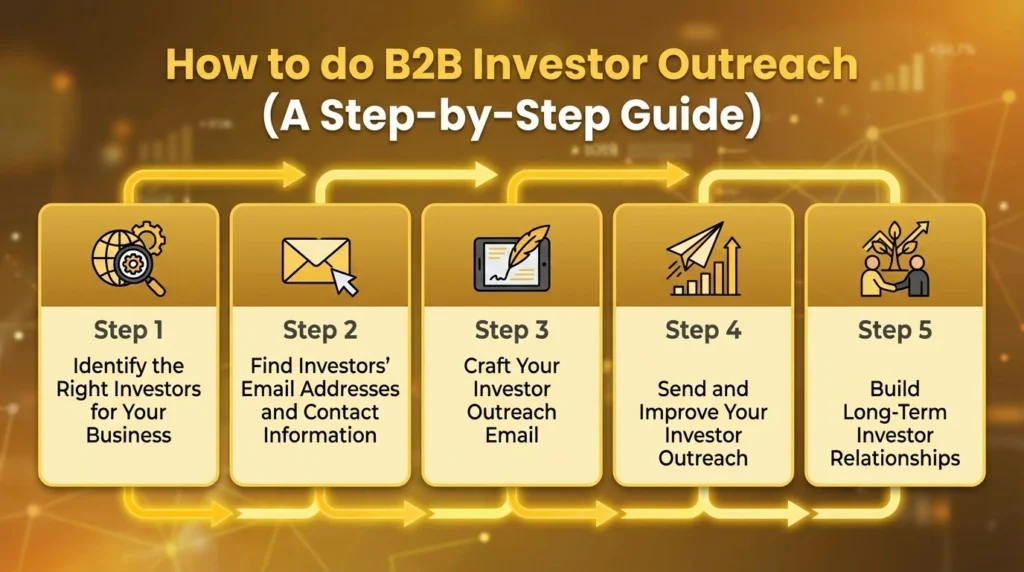
Step 1: Identify the Right Investors for Your Business
Start with investors who fund your stage
Every investor operates within a specific funding stage. Others may invest in startups at a very young age while some would not invest until a firm has a good growth in revenue. Angel investors typically take the sides of companies at pre-seed or seed level. The venture capitalists tend to invest in seed or Series A. Growth funds tend to invest in B rounds or subsequent rounds.
Look for investors who support your industry
Many investors specialize in certain industries. Some support financial technology companies. Others concentrate on healthcare, enterprise software, artificial intelligence, or climate technology. You can learn about an investor’s industry interests by reviewing their portfolio companies. Portfolio pages on venture capital websites show which companies they have funded. If a firm has invested in several companies within your industry, it shows a clear interest in that category.
Build a focused investor list
After researching potential investors on LinkedIn, create a structured list. This list becomes the foundation of your outreach process. Your list should include:
- Investor name
- Venture capital firm
- Investment stage
- Industry focus
- Portfolio companies related to your sector
- Contact information
Organize investors by priority
Not every investor will be equally valuable for your company. Some bring deep knowledge about your industry. Others offer strong networks that help with hiring or partnerships. You can group investors into 3 simple categories.
- Tier one investors
- Tier two investors
- Tier three investors
Step 2: Find Investors' Email Addresses and Contact Information
Using Clearout Email Finder to locate investor email addresses
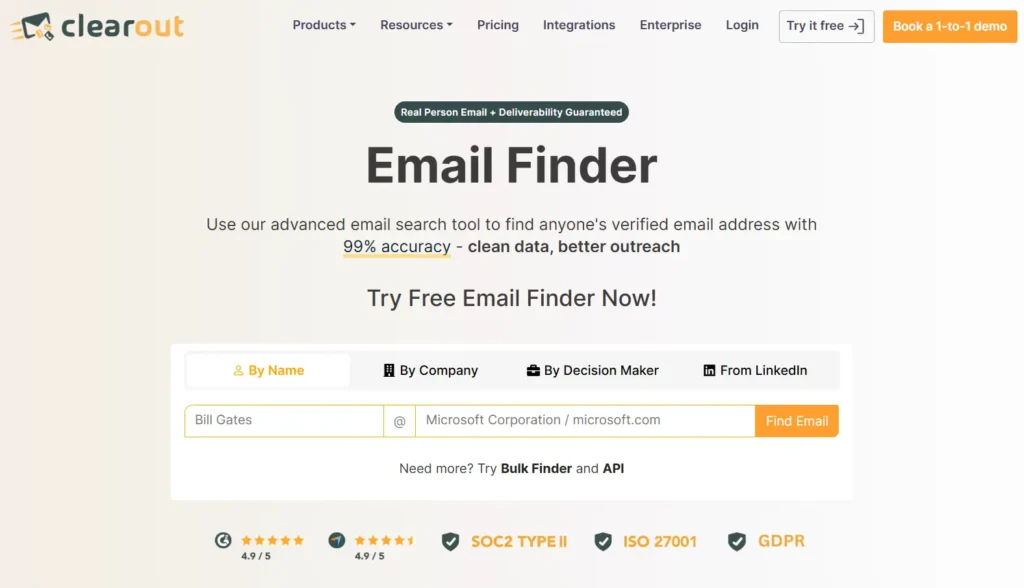
Clearout Email Finder simplifies this process by helping founders find pre-verified email addresses of investors.
Here is how founders commonly use it during investor outreach.
1. Search by investor name and company
2. Get pre-verified email addresses before sending
3. Identify the correct person at each firm
4. Keep contact information accurate
Many founders report that tools like Email Finder help them locate verified email addresses for a large portion of their investor list. This dramatically reduces research time.
Check venture capital firm websites
Many venture capital firms publish partner profiles on their websites. These pages sometimes include direct email addresses.
Look through the firm’s team page carefully. Investor bios, contact pages, and press sections occasionally contain useful contact information.
Even when an email address is not listed, these pages often include the investor’s full name and role. This information becomes helpful when searching elsewhere.
Search AngelList and Crunchbase
Startup databases such as AngelList and Crunchbase contain profiles for many investors. These profiles also contain social links or contacts.
These platforms gather details about press releases, fund announcements, and enlightenment. Going through them will assist you in finding more ways of reaching investors.
Look at conference speaker pages
Investors frequently speak at startup conferences and industry events. Event websites sometimes publish speaker bios along with contact details or personal websites.
Reviewing these event pages may provide another path to contacting investors.
Step 3: Design Your Investor Outreach Email
The inboxes of investors are overloaded. Founders send out emails to many investors more than a hundred times per week. You can only afford to make your message interesting within a few seconds.
An effective outreach email contains several important components.
Write a headline that is interesting
The opening line of the email defines the openness of the email. The subject lines should be generic like "Investment opportunity" and hardly anyone is going to be interested in it. Rather, give something particular about your company. Examples of stronger subject lines include:
- Introduction: Series A for [Company]
- Building [Category] for [Market]
- Pre-seed startup with early traction
Start with a relevant opening
The first sentence should explain why you contacted that specific investor. Talk about their past investments, a paper they have authored, or a firm in their portfolio. This indicates that you have made time to know their interests.
Share traction clearly
In the opening line of your email, make a simple comment about traction. Examples include:
- Monthly revenue growth
- Number of customers
- Key partnerships
- Product adoption metrics
End with a clear request
Finish the email with a basic request to have a talk. As an example, request whether they would consider making a quick call in a week or whether they would enjoy a review of your pitch deck. Making the next action simple increases the chances of receiving a reply.
Step 4: Send and Improve Your Investor Outreach
Sending too many emails at once or contacting invalid addresses can damage your ability to reach investor inboxes.
Check email addresses before sending
Invalid email addresses lead to bounced emails. When bounce rates become high, email providers may begin filtering your messages. Tools like Clearout Email Verification help founders confirm that email addresses are valid before sending outreach messages. Keeping bounce rates low protects your sender reputation.
Send emails gradually
Avoid sending dozens of emails at the same time. Instead, contact investors in small groups over several days. This approach allows you to manage responses and refine your message based on early feedback.
Track outreach results
Record information such as:
- Email sent date
- Response received
- Meeting scheduled
- Investor feedback
Step 5: Establish Long-term Relationships with Investors
Often responses arrive after a follow-up message.
Send a follow up after some days
In case of not having a reply within a few days, make a short follow-up message. Mention any progress or improvement, including customer acquisition or product achievements. This indicates further impetus.
More follow-up in the future
In case a response to it is still not received, it is productive to make another follow-up. You could be referring to a new article, new collaboration, or growth indicators. It is optimal to stop outreach unless the situation changes considerably after 2 follow-ups.
Reply quickly when investors respond
When an investor replies, respond promptly. If they request your pitch deck, send it quickly. If they suggest a meeting, offer available times within the next few days.
Best Tools for Investor Outreach
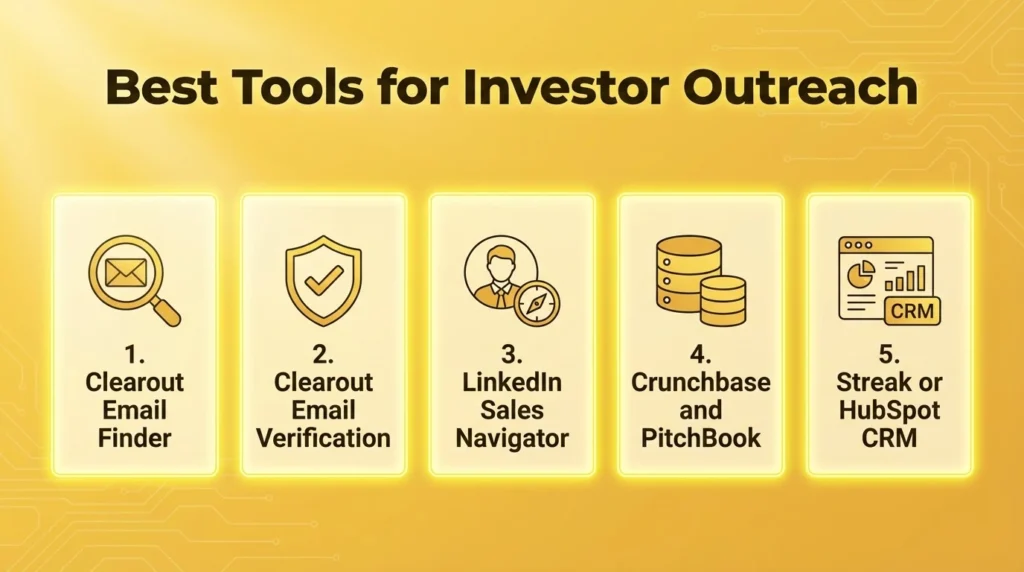
Clearout Email Finder assists founders in finding pre-verified professional email addresses that are related to particular investors and venture capital firms. Founders can use the names and companies to find the right email address ethics rather than guessing the email format.
This is also used to verify whether the email address is open to receive messages. It means that founders do not send bouncy emails. Authenticated contact information is useful to ensure founders are able to access investor inboxes on a regular basis.
Clearout Email Verification assists in verifying email addresses prior to campaigns. It identifies invalid addresses and temporary addresses which can not get your email.
Mutual connections are also displayed in the platform. Through these relationships, founders can be at times introduced to investors, a factor that assists in initiating warmer discussions.
4. Crunchbase and PitchBook
Founders are able to filter investors depending on stage, industry, location and new investments. This simplifies the creation of a list of investors who will be eager to back firms that are similar to theirs.
4. Streak and HubSpot CRM
Founder-friendly tools like Streak or HubSpot CRM allows the organizer to plan communication with the investors in a single place. Through these tools, founders have the ability to document outreach emails, reply, set reminders and monitor conversations.
Why Should You Do Investor Outreach as B2B Founders?
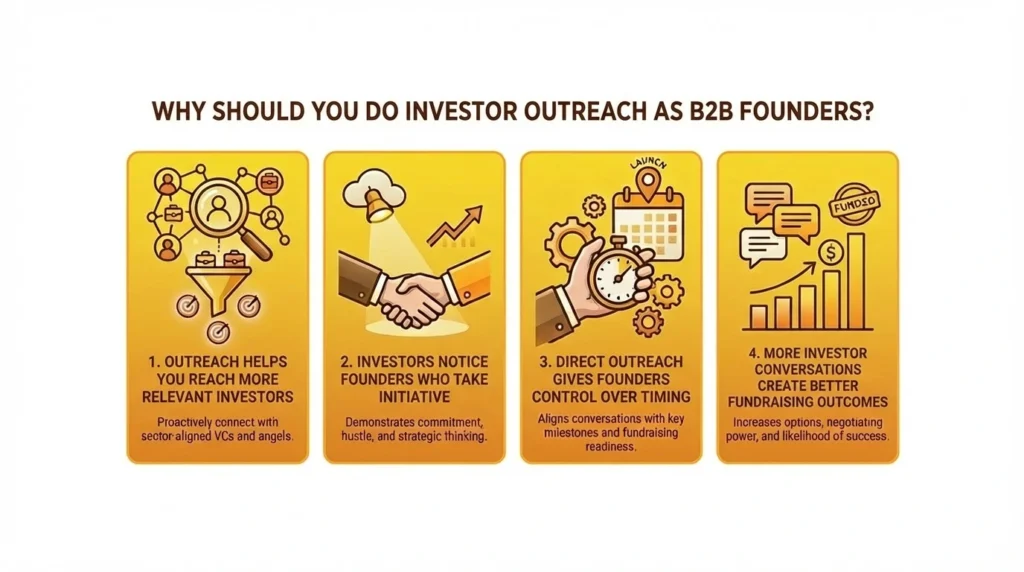
1. Outreach helps you reach more relevant investors
Talking to more investors will enable founders to observe trends in discussions. You start to realize what investors are interested in, what questions are asked most of the time, and in which aspects of your story they take interest.
Such insights would assist you to make your pitch better and present your business in subsequent discussions.
2. Investors notice founders who take initiative
When the founder speaks of the prior investments, reasons why the company would appeal to them and shows them clear traction, the message is heard.
Such an outreach demonstrates that the founder is willing to research and communicate in an understandable manner.
3. Direct outreach gives founders control over timing
This process can take weeks. Sometimes it never happens.
4. More investor conversations create better fundraising outcomes
If several investors show curiosity about the business, discussions often move faster. This creates a healthy competitive environment among investors.
For founders, this means more options. Instead of accepting the first offer available, they can choose an investor who understands their company and supports their long-term direction.
B2B Investor Outreach Best Practices
1. Do Your Homework Before Every Email
- Research the specific partner you are contacting: Do not email generic firm addresses. Find the partner who focuses on your sector and stage. Read their blog posts, listen to podcasts where they speak, and review their portfolio for companies similar to yours.
- Reference specific portfolio companies: The easiest way to show research is by mentioning relevant portfolio investments. “I am reaching out because you backed [Company], and we are building adjacent infrastructure for the same market.”
- Understand firm stage and check size: Do not ask a pre-seed firm to lead your 15 million Series B. Do not pitch a growth equity firm your 500K angel round. Stage mismatches waste everyone's time and signal that you have not done basic research.
2. Lead With Traction, Not Vision
- Quantify your traction specifically.
“2 million ARR growing 15 percent monthly” beats “strong revenue growth.”
“47 enterprise customers with 50K ACV” beats “great customer traction.” - Numbers are credible. Adjectives are marketing.
- Show growth trajectory, not just current state.
Absolute numbers matter less than growth rates for early-stage companies. 500K ARR growing 20 percent monthly is more exciting than 2 million ARR growing 3 percent monthly. - Highlight metrics investors care about for your business model.
- SaaS investors want MRR, churn, CAC, and LTV
- Marketplace investors want GMV, take rate, and cohort economics
- Consumer investors want DAU, retention, and engagement
- Speak the language relevant to your model.
3. Respect Investors’ Time Constraints
- Keep emails under 150 words.
Investors do not read long emails from unknown founders. Get to the point quickly. - Make next steps frictionless.
Do not ask when would be a good time to talk. Send a calendar link.
Do not ask if you would like to see our materials. Attach your deck or metrics. - Deliver materials immediately when requested.
If an investor asks for your deck, send it within an hour. If they request financial details, provide them the same day. Speed signals prioritization and organizational competence.
Common Investor Outreach Mistakes to Avoid