

- Products
- ResourcesDEVELOPER

 API
API
Clearout APIs are structured around REST and JSON Webhooks
Capture real-time events in your application workflow Form Guard
Real-time form validation to keep bad contacts out of your CRMKNOWLEDGE BASE Getting started
Sending campaigns without bounces is made simple FAQ
FAQ
Easily find answers to services, security and common questionsUSE CASES Lead Generation
Learn how professionals generate quality leadsGUIDESPricing Transparent & flexible pricing to support pay-per-use or recurringCompare Email Verification Tools AI-powered email verification with 99%+ accuracy, real-time validation, and transparent risk scoringCompare Email Finder Tools Pre-verified B2B email addresses with confidence scoring, find real person email, not role-based addressData Pulse & HubSpot Breeze Intelligence Pre-verified B2B email addresses with confidence scoring, find real person email, not role-based addressBLOGSEmail Verification ToolsFind Anyone’s Email Address
Most Accurate, Fast & Free WaysForm Validation
Importance, Ways & Best PracticesView All Blogs - Pricing
- Integrations
- Enterprise
- Login



The Definitive Guide to Cold Email Outreach for B2B in 2026
Want to win new clients/ customers?
Then, cold emailing is just the weapon to pick!
Cold email outreach is a relatively new type of outbound marketing that entails compiling a list of potential clients and then addressing them by email.
However, it is not easy to yield effective results with cold emailing. The two primary reasons why cold emails get less traction are–
First, you don’t have a relationship with your audience yet.
Second, you lack non-verbal feedback, so you can’t modify your approach in real-time.
In order to get more clicks and replies, your cold emails need to be personalized, powerful, intriguing, and to the point.
So, do not worry about the hardships on your way to mastering cold emails, but focus on the positive results. We are here to help you out in your cold email outreach process.
Let’s take a closer look at what cold email outreach is and why it works.
Then, cold emailing is just the weapon to pick!
Cold email outreach is a relatively new type of outbound marketing that entails compiling a list of potential clients and then addressing them by email.
However, it is not easy to yield effective results with cold emailing. The two primary reasons why cold emails get less traction are–
First, you don’t have a relationship with your audience yet.
Second, you lack non-verbal feedback, so you can’t modify your approach in real-time.
In order to get more clicks and replies, your cold emails need to be personalized, powerful, intriguing, and to the point.
So, do not worry about the hardships on your way to mastering cold emails, but focus on the positive results. We are here to help you out in your cold email outreach process.
Let’s take a closer look at what cold email outreach is and why it works.
Table of Content
What is "Cold Email Outreach"?
Cold email outreach is when you send an email to a potential client/customer that doesn’t know you or your business. They don't know you yet and will hear from you for the first time. Thus, they are also called "cold" leads.
The goal of a cold email is not to make a direct sale but to build a relationship with strangers into business partners or clients. In other words, to warm those cold leads up, little by little.
The goal of a cold email is not to make a direct sale but to build a relationship with strangers into business partners or clients. In other words, to warm those cold leads up, little by little.

Why Do Cold Emails Work?
Cold emails still work because they fit how B2B buyers actually think today.
When someone hears about a new product, their first reaction usually isn’t to book a sales call. They take a step back, do a bit of research, understand the problem better, and see if the solution is even relevant to them.
Studies show this clearly. Around 61% of B2B buyers prefer not to talk to a sales rep early on, and 73% ignore outreach that feels random or irrelevant.
Hence, buyers aren’t tired of being contacted.
When someone hears about a new product, their first reaction usually isn’t to book a sales call. They take a step back, do a bit of research, understand the problem better, and see if the solution is even relevant to them.
Studies show this clearly. Around 61% of B2B buyers prefer not to talk to a sales rep early on, and 73% ignore outreach that feels random or irrelevant.
Hence, buyers aren’t tired of being contacted.

That shift in mindset is a big reason cold email continues to outperform more interruptive channels. Cold calls ask for attention immediately. Email doesn’t. It gives prospects control over when they engage. And that’s what makes cold email feel different and more effective.
With cold email, the prospect stays in control from the very beginning The subject line and opening sentence quickly set expectations. If the message hits, they’ll keep reading. If it misses the mark, they’ll ignore it and get on with their day. Simple as that.
That’s what makes cold email a calmer, more scalable way to start a conversation. You’re not forcing engagement. You’re opening the door and letting the prospect decide whether to step through it.
And in B2B, that’s perfectly fine. Not every company needs what you’re selling. The goal was never to reach everyone. It’s to reach the right people at the right time. When cold emails are clear, relevant, and well targeted, they help prospects self-select early and lead to conversations that are far more productive for both sides.
With cold email, the prospect stays in control from the very beginning The subject line and opening sentence quickly set expectations. If the message hits, they’ll keep reading. If it misses the mark, they’ll ignore it and get on with their day. Simple as that.
That’s what makes cold email a calmer, more scalable way to start a conversation. You’re not forcing engagement. You’re opening the door and letting the prospect decide whether to step through it.
And in B2B, that’s perfectly fine. Not every company needs what you’re selling. The goal was never to reach everyone. It’s to reach the right people at the right time. When cold emails are clear, relevant, and well targeted, they help prospects self-select early and lead to conversations that are far more productive for both sides.
What are the Various Use Cases of Cold Email?
Cold emails aren’t just about pitching your product or service; they're a versatile tool that can support different aspects of your business growth. Companies use cold email for a few main reasons:
1. Lead Generation
Cold email isn’t about selling. It’s about reaching out to your customers to interact with them. When cold emails have emotions and feel connected, people reply.
Example:
Example:
Subject: Reaching out about {{specific detail}}
Hey {{First Name}},
I came across {{Company Name}} and saw what you’re doing in {{industry}}, especially {{specific detail}}. We help teams connect with the right prospects.
Want to chat? I can share a couple of ideas.
Best,
{{Your Name}}
2. Sales Outreach
A cold email is usually just the first message. You send it to see if a conversation makes sense. If it does, you continue.
Example:
Example:
Subject: Simplifying {{specific pain point}}
Hey {{First Name}},
Reaching out because teams like {{similar company}} were facing {{specific pain point}}, and we helped them simplify the process.
Not sure if this matters. Maybe worth a quick chat. I can send details.
Thanks,
{{Your Name}}
3. Partnership & Collaboration
Sometimes you’re not trying to sell anything. You might be looking for partners. Cold email is often how those conversations start.
Example:
Example:
Subject: Collaboration idea
Hi {{First Name}},
Been following {{Company Name}} for a bit really like how you do {{specific area}}. We work with a similar audience, though there could be a way to collaborate. Content, referrals, whatever makes sense.
If you’re interested, happy to chat. No pressure.
Best,
{{Your Name}}
4. Event & Webinars
Getting the right people matters more than getting everyone. Cold email helps you reach the ones who actually care. That’s how attendance grows.
Example:
Example:
Subject: Short session on {{specific challenge}}
Hey {{First Name}},
We’re doing a short {{webinar/event}} on {{topic}} for {{role/industry}}. It’s about tackling {{specific challenge}}. Thought it might be useful for you at {{Company Name}}. Sharing this in case it matters.
Can send details if you want.
Cheers,
{{Your Name}}
5. Recruitment & Talent Outreach
Good candidates don’t always apply. Cold emails help you reach them anyway. A thoughtful message can open the door.
Example:
Example:
Subject: Exploring potential roles
Hi {{First Name}},
Came across your profile. I really liked your experience in {{skill/area}}. Some people
we talk to aren’t actively looking but might be interested.
Short chat does that make sense?
Best,
{{Your Name}}
6. Customer Feedback & Market Research
A cold email is a way to ask. For feedback. For opinions. For early input. And sometimes, that’s where relationships begin.
Example:
Example:
Subject: Your thoughts on {{specific topic}}
Hey {{First Name}},
I’m reaching out because we’re gathering insights from people in {{industry}} about {{specific topic}}. Your perspective would be really valuable. No pitch, just a few questions.
Mind sharing your thoughts?
Thanks,
{{Your Name}}
The 3 Tenets of Cold Email Outreach
Cold emails aren’t just about pitching your product or service; they're a versatile tool that can support different aspects of your business growth. Companies use cold email for a few main reasons:
A company that develops a valuable product or service but does not have enough B2B clients will need to get its name in front of them by promoting its brand. And cold outreach is the best way to do this. Yet, the last thing you want is for your email to be labeled as spam.
1. Building a high-quality email list: The most important aspect of an email marketing campaign is to have a high-quality email list of prospects. The better the quality, the higher the conversion rate.
The idea is to understand your target audience's "type."
What is the ideal business for your product or service?
What problems will your service solve for these businesses?
How your reader engages with your emails will aid in further narrowing down the characteristics of potential clients.
Once you have spotted your target audience, start compiling their email addresses into a list.
Make sure the emails you are sending reach a valid email address and do not simply bounce back to you.
The idea is to understand your target audience's "type."
What is the ideal business for your product or service?
What problems will your service solve for these businesses?
How your reader engages with your emails will aid in further narrowing down the characteristics of potential clients.
Once you have spotted your target audience, start compiling their email addresses into a list.
Make sure the emails you are sending reach a valid email address and do not simply bounce back to you.

It’s best to use an email verifier like Clearout to confirm the validity of your email lists.
Or if you are building an email list from scratch, the Clearout email finder can also be a great way to ensure you get only valid and high-quality leads in your email list.
Or if you are building an email list from scratch, the Clearout email finder can also be a great way to ensure you get only valid and high-quality leads in your email list.

Just enter your prospect’s name and company, and within seconds you will get their valid email address. It can help you find email addresses in bulk, saving you a lot of time and resources.
2. Creating an email template: The heart of any successful cold email outreach campaign. A template is a generic representation of how you would approach others about your business.
Mind it, it is just an email structure that you would be following for a particular group of people and not a customized email that you would actually be sending out to them.
Mind it, it is just an email structure that you would be following for a particular group of people and not a customized email that you would actually be sending out to them.

Your target audience's template should be brief, informative, and to the point. Then it's time to spruce things up and touch them up with personalization. The more personalized your emails are, the better results you will get.
For some great examples and inspiration, check out Cold Email Templates
For some great examples and inspiration, check out Cold Email Templates
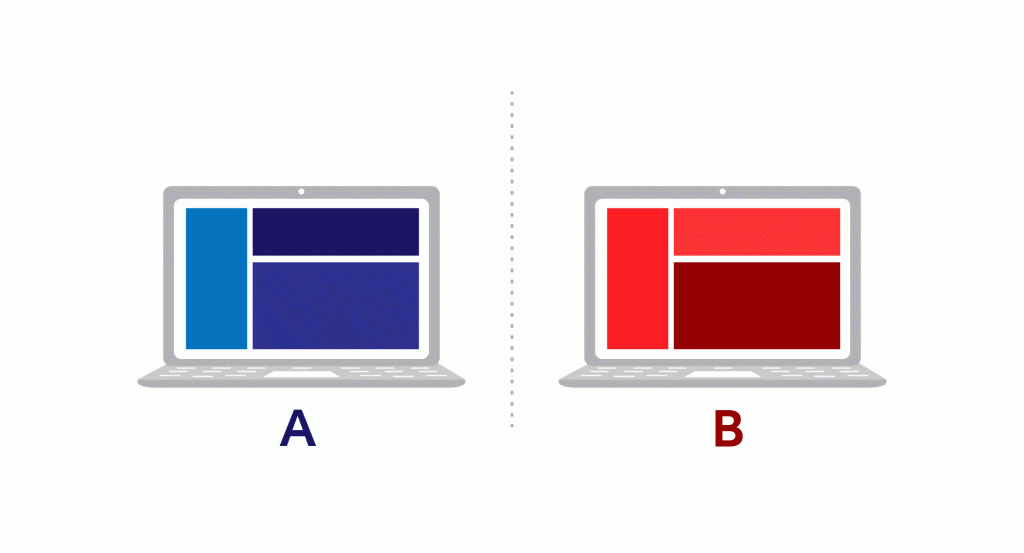
3. A/B Testing: When it comes to cold email outreach, the importance of A/B testing cannot be overstated. It tells you which email and which elements would bring in a better response.
A response rate of 5% may be considered low. Well, one percent is less. A minor change to your template can mean the difference between the two.
To properly conduct A/B tests, all variables must remain the same except for one. Once the perfect combination of As and Bs is found, the perfect template can be created.
A response rate of 5% may be considered low. Well, one percent is less. A minor change to your template can mean the difference between the two.
To properly conduct A/B tests, all variables must remain the same except for one. Once the perfect combination of As and Bs is found, the perfect template can be created.
Now that we understand the essentials of cold email outreach, let's proceed to how you can strengthen the core of it, i.e, writing the perfect cold email.
How to Write an Effective Cold Email (With Examples)?
Shane Snow conducted an interesting experiment for his book Smartcuts, where he sent 1,000 cold emails to executives and received virtually no response.
So he tried again with a smaller portion of the same group and had better results by applying a few principles and great advice from people like Adam Grant, Tim Ferriss, and Heather Morgan.
Learning from the experiments and experts, it has been concluded that an effective email cold email should ought these five things:
1. Personalize the message for the recipient - It calls for a lot of research to learn about your target audience. Personalization isn’t just about a generic mention or just adding your recipient’s name to the email.
Personalization is thinking about who the recipient is, how they perceive the world, what interests them, what their pain points are, and what they desire. This shows that you have worked hard to understand them.
So he tried again with a smaller portion of the same group and had better results by applying a few principles and great advice from people like Adam Grant, Tim Ferriss, and Heather Morgan.
Learning from the experiments and experts, it has been concluded that an effective email cold email should ought these five things:
1. Personalize the message for the recipient - It calls for a lot of research to learn about your target audience. Personalization isn’t just about a generic mention or just adding your recipient’s name to the email.
Personalization is thinking about who the recipient is, how they perceive the world, what interests them, what their pain points are, and what they desire. This shows that you have worked hard to understand them.
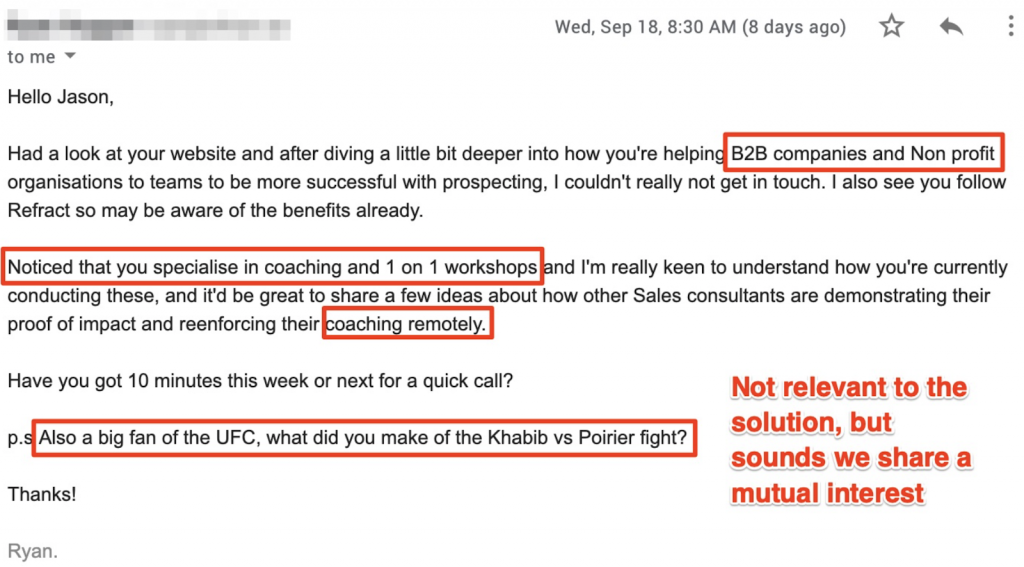
Also, adding why you are emailing them rather than anyone else makes them listen to you more.
This is because people are far more motivated to help you when they believe they are uniquely qualified to do so. You can tell a story that makes sense to them if you outline exactly where they fit in.
This is because people are far more motivated to help you when they believe they are uniquely qualified to do so. You can tell a story that makes sense to them if you outline exactly where they fit in.
2. Establish your credibility – When we meet a stranger or receive an email from one, we want to know who they are and why they are important to us.
Even though you have done a lot of background research on the people you're emailing, they know nothing about you. You must demonstrate your credibility and trustworthiness.
Knowing someone in common is the most powerful type of social proof you can provide. Mention any direct connections you have. You are no longer a stranger if you have a mutual friend. If there are no mutuals, try mentioning how you learned about them via LinkedIn, a social meet, etc.
Depending on the individual or the pitch you make, your authority, credibility, or social standing play a role. Mention such details quickly a line or two should do it. You are more likely to get a response if you are more "important."
Even though you have done a lot of background research on the people you're emailing, they know nothing about you. You must demonstrate your credibility and trustworthiness.
Knowing someone in common is the most powerful type of social proof you can provide. Mention any direct connections you have. You are no longer a stranger if you have a mutual friend. If there are no mutuals, try mentioning how you learned about them via LinkedIn, a social meet, etc.
Depending on the individual or the pitch you make, your authority, credibility, or social standing play a role. Mention such details quickly a line or two should do it. You are more likely to get a response if you are more "important."
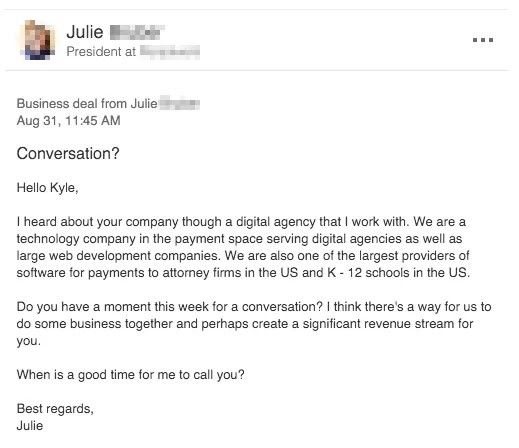
If you don't have such credibility or social proof, try emphasizing the similarities or their interests. Look for exceptional connections, such as hometowns and unusual hobbies. "Similarities matter most when they're rare," says Adam Grant.
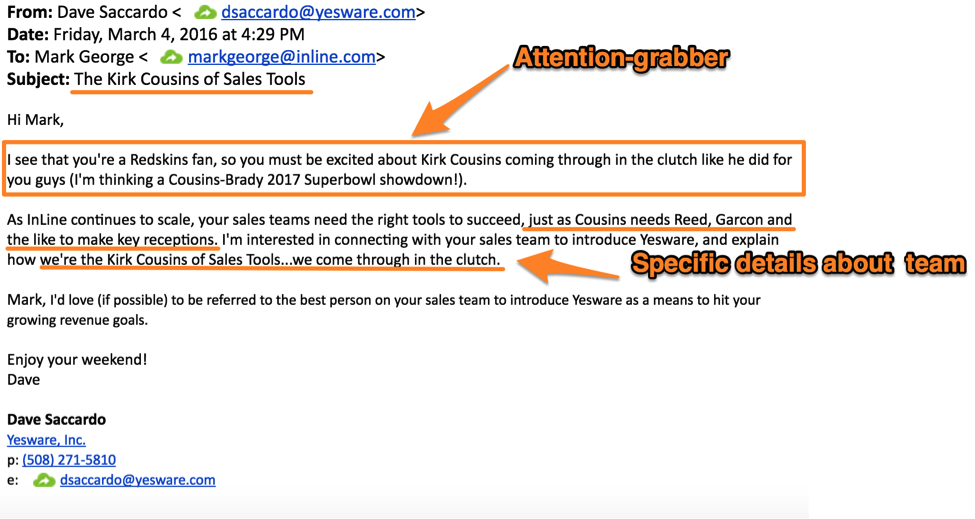
The point is that you want to find a way to transition from "stranger" to "member of the recipient's group."
3. Focus on pain points and provide value – Why would your prospects care about reading your email? The majority of them won't even bother opening your emails if they do not seem to be of any use to them at all.
To make an impact on your prospects, you need to provide something of interest and value in the emails. Your best bet can be to highlight their pain points and then slowly move towards how your product/service can help them improve their situation.
So, do your research, segment your list into groups that might have similar pain points, and provide a solution for them. Make sure to mention the pain point in the subject line so that they are intrigued enough to open the email.
To make an impact on your prospects, you need to provide something of interest and value in the emails. Your best bet can be to highlight their pain points and then slowly move towards how your product/service can help them improve their situation.
So, do your research, segment your list into groups that might have similar pain points, and provide a solution for them. Make sure to mention the pain point in the subject line so that they are intrigued enough to open the email.
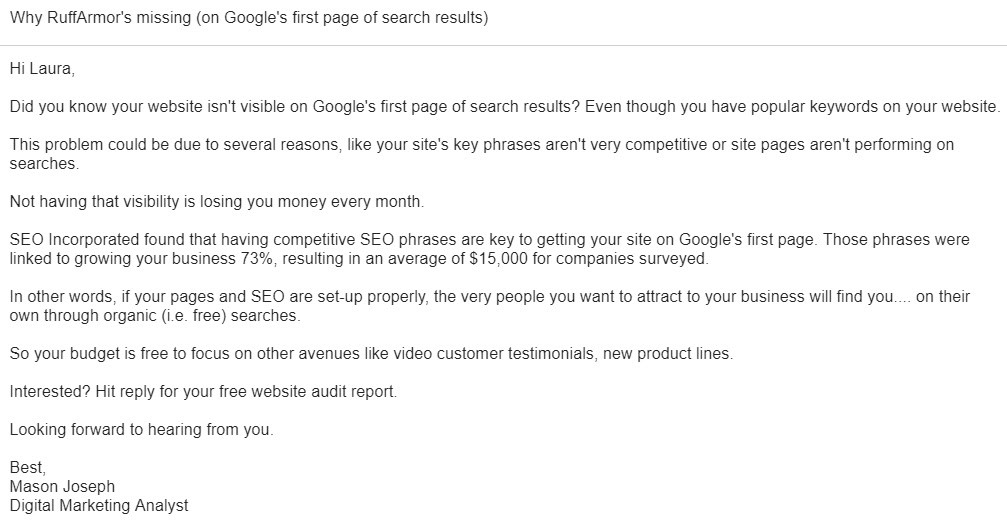
Even if you don't provide a direct solution to the problem, it can still be a good opportunity to build relationships. Try introducing them to the people (in case you are targeting someone specific (decision-makers- CEO, VC, etc). This will bring you to their If you notice, they will be grateful for your help. They might end up showing interest in your offerings or even introduce you to others who might be interested.
If you are targeting a group of people, you can offer them a guide or tips to solve their problem at the end of the email. You can also mention what you offer and how it might help them as well. You will build your credibility this way, and they might become interested in your services after hearing from you.
If you are targeting a group of people, you can offer them a guide or tips to solve their problem at the end of the email. You can also mention what you offer and how it might help them as well. You will build your credibility this way, and they might become interested in your services after hearing from you.
4. Keep your message short and crisp – Honestly, nobody has time to read a 500-word email from a stranger. The emails that are shorter, and to the point get much better responses.
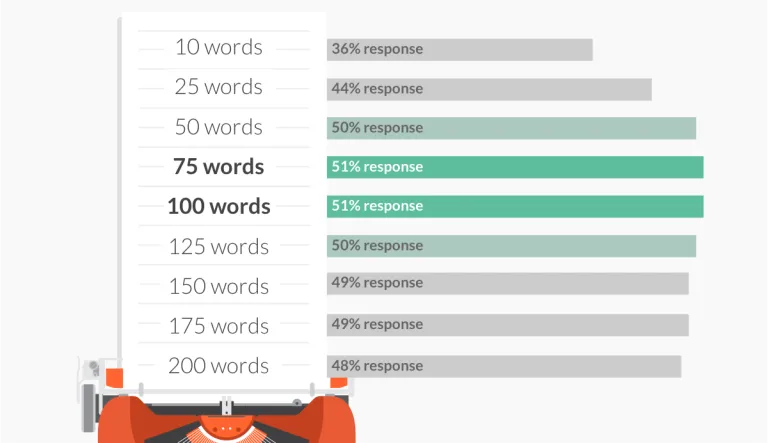
Because you have limited words, you need to be smart and convey just the right message that is intriguing as well.
The best way to keep things short and direct is to write as you would speak.
If you meet someone in person, you wouldn’t just walk up and start pitching them. You’d introduce yourself, say something nice, try to make a connection, and then make a request that makes sense. In short, your emails should sound natural and not like robots.
Think about what would make you different from 10 other people pitching them something similar, and you can entice your reader to respond to you and not the others.
Also, make sure that you make it very clear what “action” you want them to take. How you talk matters. Oh, and never forget to add a CTA that guides them to what you are asking them to do.
The best way to keep things short and direct is to write as you would speak.
If you meet someone in person, you wouldn’t just walk up and start pitching them. You’d introduce yourself, say something nice, try to make a connection, and then make a request that makes sense. In short, your emails should sound natural and not like robots.
Think about what would make you different from 10 other people pitching them something similar, and you can entice your reader to respond to you and not the others.
Also, make sure that you make it very clear what “action” you want them to take. How you talk matters. Oh, and never forget to add a CTA that guides them to what you are asking them to do.
5. Be appreciative and give your prospects a superior position – People like to be appreciated, and this can work in your favor. Even a simple "Thank you so much, I'm grateful" can double response rates.

Also, tell people that it's okay if they are too busy. Giving them an out makes them more likely to help you. This also makes them feel in power and not like they are being forced to do something.
6. Don’t look for templates– If you think copy - pasting a template you found on Google can bring in great results, then you are absolutely WRONG!
No matter how well crafted a template might look for mass outreach, it won’t work.
Why?
Because it is not personalized. (Remember, the more specific and personalized an email is, the better the outcome.)
So, rather than sticking to mass templates, look for examples. Learn from them, then come up with your own email skeleton and personalize it further based on your group of recipients.
No matter how well crafted a template might look for mass outreach, it won’t work.
Why?
Because it is not personalized. (Remember, the more specific and personalized an email is, the better the outcome.)
So, rather than sticking to mass templates, look for examples. Learn from them, then come up with your own email skeleton and personalize it further based on your group of recipients.

Conclusion
Cold emails don't have to make you feel like a fish out of water. Cold outreach can yield lucrative opportunities, provided you reach your prospects and capture their attention.
So, do your research, build your cold outreach strategy, and utilize the power of words. Good Luck!
So, do your research, build your cold outreach strategy, and utilize the power of words. Good Luck!
Verify Your Email Lists Instantly
FAQs
1. Do cold emails still work?
Yes. People open emails when they feel relevant. Not messages that feel like they went to a list.
2. Is cold email a better option than cold calling for B2B?
Yes. Email gives people space. Email gives people space to respond when it works for them. Cold calls can just barge in and throw off their whole day.
3. What makes a cold email effective?
Relevance and clarity. When it’s obvious why you’re reaching out and why it matters, responses follow.
4. How long should a cold email be?
Short and easy to scan. If it takes longer than a minute, people won’t read it. Keep it short.
5. How do I avoid sending spam?
Keep your list clean and verified. Write like a real person. Skip generic or pushy messages, and your emails will actually get read.