

- Products
- ResourcesDEVELOPER

 API
API
Clearout APIs are structured around REST and JSON Webhooks
Capture real-time events in your application workflow Form Guard
Real-time form validation to keep bad contacts out of your CRMKNOWLEDGE BASE Getting started
Sending campaigns without bounces is made simple FAQ
FAQ
Easily find answers to services, security and common questionsUSE CASES Lead Generation
Learn how professionals generate quality leadsGUIDESPricing Transparent & flexible pricing to support pay-per-use or recurringCompare Email Verification Tools AI-powered email verification with 99%+ accuracy, real-time validation, and transparent risk scoringCompare Email Finder Tools Pre-verified B2B email addresses with confidence scoring, find real person email, not role-based addressBLOGSEmail Verification ToolsFind Anyone’s Email Address
Most Accurate, Fast & Free WaysForm Validation
Importance, Ways & Best PracticesView All Blogs - Pricing
- Integrations
- Enterprise
- Login


Email Frequency by Industry: What Works in 2026
Figuring out how often to send emails isn’t easy. Send too many, and people just mark you as spam or unsubscribe. With 88% of people checking their email every day and 39% looking at their inbox three to five times daily, it becomes necessary that your email frequency should be correct.
The tricky part? There’s no universal email sending frequency. Every industry’s got its own standard to follow. People buy differently by interacting with your emails. E-commerce customers want rapid updates. B2B buyers prefer slower and value-packed touches. And newsletters also win with consistency.
In this guide, we’ll walk you through how email frequency changes as per your industry. We will also share some tried-and-tested email marketing tips, and how to land on the perfect schedule so that you keep your audience interested (without tanking your open rates or getting sent to spam).
The tricky part? There’s no universal email sending frequency. Every industry’s got its own standard to follow. People buy differently by interacting with your emails. E-commerce customers want rapid updates. B2B buyers prefer slower and value-packed touches. And newsletters also win with consistency.
In this guide, we’ll walk you through how email frequency changes as per your industry. We will also share some tried-and-tested email marketing tips, and how to land on the perfect schedule so that you keep your audience interested (without tanking your open rates or getting sent to spam).
Table Of Content
What Is Email Frequency?
Email frequency is how often you send marketing emails to your subscribers, weekly or monthly. It includes automated emails (like welcome, cart recovery, nurture flows) and manual campaigns.
It directly impacts:
It directly impacts:
- Engagement
- Unsubscribe rate
- Spam complaints
- Sender reputation
- Inbox placement
Sending emails too often
This is a guaranteed way to make your subscribers feel completely overwhelmed and burnt out. If your frequency is too high, subscribers feel overwhelmed.
27% of people unsubscribe because brands send too many emails.
Omnisend also found that email fatigue increases sharply when businesses send repetitive or irrelevant content.
Over-sending leads to:
27% of people unsubscribe because brands send too many emails.
Omnisend also found that email fatigue increases sharply when businesses send repetitive or irrelevant content.
Over-sending leads to:
- Higher spam complaints
- Lower trust
- Declining open rates
- Poor inbox placement
This gets even trickier with B2B email marketing. Decision-makers want messages that matter to them, not just a bunch of random emails.
Email Frequency Gaps: Not Sending Emails Often Enough
Under-sending creates the opposite problem.
When you rarely show up:
When you rarely show up:
- Subscribers forget your brand
- Engagement drops
- Filters see you as inconsistent
- Inbox placement suffers
Omnisend makes it pretty clear: when businesses send emails on a regular schedule, they get better results than those who just wing it. People start to remember you. That recognition leads to real engagement.
So, why do some industries send more emails? Honestly, it’s all about their customers. Every group has its own pace in how they shop, how they read things, how quickly they decide. It’s just different from one audience to the next.
So just copying another brand’s email schedule rarely works. You’ve got to match your email frequency to your customers.
So, why do some industries send more emails? Honestly, it’s all about their customers. Every group has its own pace in how they shop, how they read things, how quickly they decide. It’s just different from one audience to the next.
So just copying another brand’s email schedule rarely works. You’ve got to match your email frequency to your customers.
Why Email Frequency Differs by Industry?
Every industry moves at its own speed because customers are all different. Basically, your email schedule has to match how your audience actually shops, learns, and decides on things. Here’s what shapes email frequency:
1. User intent and expectations
Some audiences actively look for deals, offers, and new arrivals, so higher frequency feels natural. Others subscribe to knowledge, insights, or guidance. They expect value, not constant promotions, so a slower and content-first cadence works better.
2. Email purpose
Promotional emails naturally require higher frequency, especially when you have sales, launches, or seasonal events. Educational or nurture emails, however, need much space. Sending them too often lowers interest instead of trust.
3. Automations change the total frequency
Brands with strong automation welcome flows, cart recovery, and re-engagement can communicate more without overwhelming subscribers. These automated touchpoints handle most engagement.
For example, ecommerce brands with heavy automation might reach inboxes daily, even if they only send a few campaigns per week.
For example, ecommerce brands with heavy automation might reach inboxes daily, even if they only send a few campaigns per week.
How To Find Your Email Frequency?
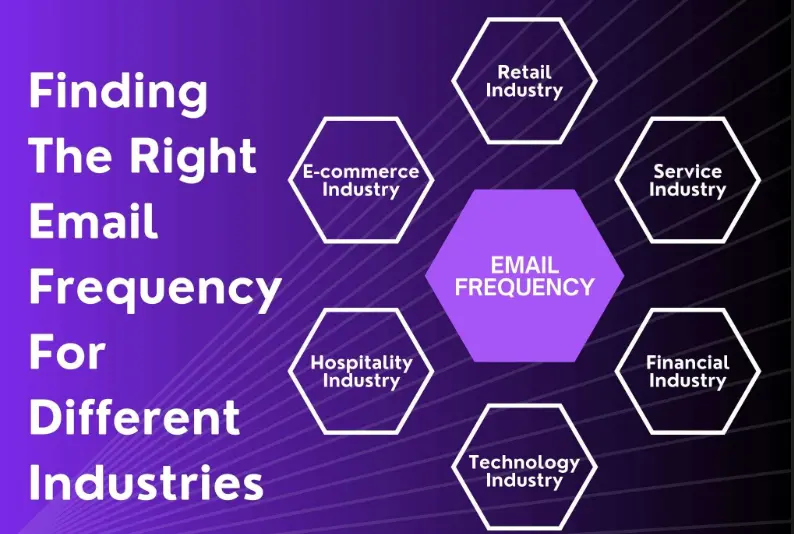
Remember that every industry has a different pace? We're going to break down how often you should email as per your industry and what the common US benchmarks are.
1. The E-comm Life: Quick Sales and Fast Emails
E-commerce thrives on urgency, new arrivals, and seasonal promotions, which makes higher email frequency effective. In fact, 22% of marketers send marketing emails 2-3 times per day and 21% send them daily.
Email Frequency Best Practices:
Email Frequency Best Practices:
- Use segmentation to avoid sending every email to everyone
- Balance offers with educational or UGC emails
- Prioritize automated flows (cart, browse, winback)
2. B2C Services & Lifestyle Brands
If you run a service-based B2C business like a salon, gym, life coaching practice, or home service, sending emails every day isn’t necessary. A moderate sending schedule usually works better. Focus on sharing emails that feel relevant and helpful, and match how your customers normally engage with you.
Best Practices:
Best Practices:
- Seasonal reminders work well
- Educational content increases trust
- Offer-based cadences should be limited to avoid fatigue
3. B2B (Long Sales Cycles)
B2B buyers need time, information, and value, not constant promotion. The best B2B email marketing frequency focuses on insights, credibility, and longer nurturing.
Best Practices for B2B Email Frequency:
Best Practices for B2B Email Frequency:
- Combine newsletters and nurture sequences
- Avoid sending too many sales emails
- Maintain tight segmentation for role relevance
4. SaaS (Trials, Demos, Product Education)
SaaS email frequency changes as per the user's stage (trial, onboarding, etc.). Hence, hit them with quick and short sequences.
Best Practices:
Best Practices:
- A strong onboarding sequence is essential
- Behavior-based automation improves engagement
- Keep product updates crisp and relevant
5. Newsletters & Publishers
Newsletters are based on consistency. You will get reliable delivery either on a daily, weekly or bi-weekly basis.
Best Practices:
Best Practices:
- Select a schedule and follow it.
- Prioritize content over sales
- Monitor scroll depth & reply engagement
6. Agencies, Consultants, Coaches
Trust-heavy industries benefit from less and educational frequencies. People want guidance and not spammy emails.
Best Practices:
Best Practices:
- Insights-heavy newsletters perform well
- Case studies are strong engagement drivers
- Maintain a 70/30 value-to-promotion ratio
7. Real Estate
Real estate email frequency should follow the customer lifecycle from discovery and viewing to closing.
Best Practices:
Best Practices:
- Include learning materials such as purchase/selling manuals.
- Make personalized property notifications and market updates.
8. Local Businesses (Salons, Gyms, Clinics)
Your local businesses will perform well only if you give reminders, deals, and updates. Maximum email frequency may cause fatigue but modest frequency of weekly e-mails works well.
Best Practices:
Best Practices:
- Send frequent promotions, updates, or reminders of appointments.
- Add seasonal or regional event-based promotions.
- Keep it in balance with knowledgeable and news content.
Email Frequency Benchmarks
You know that email frequency changes everywhere. However, it all depends on how fast people buy and what they expect. These benchmarks are basically your starting guide. They quickly show you where you stand so that you can fix any gaps in your emailing and feel totally confident in your plan.
| Industry | Recommended Frequency | Email Frequency Notes |
|---|---|---|
| Ecommerce | 3-7 emails/week | High frequency works due to short buying cycles |
| B2C Services | 2-4 emails/week | Mid-level pace; personalization boosts engagement |
| B2B | 1-2 emails/week | Value-driven, avoid over-sending. |
| SaaS | 2-5 emails/week | Higher during trials; automation essential |
| Newsletters | 1-7 emails/week | Consistency is key |
| Agencies/Consultants | 1-3 emails/week | Balanced educational cadence |
| Nonprofits | 2-4 emails/week | Storytelling-centered frequency |
| Real Estate | 4-8 emails/week | Lifecycle-driven |
| Local Businesses | 1-3 emails/week | Offers + reminders perform best |
What are the Best Practices for Automated Email Frequency
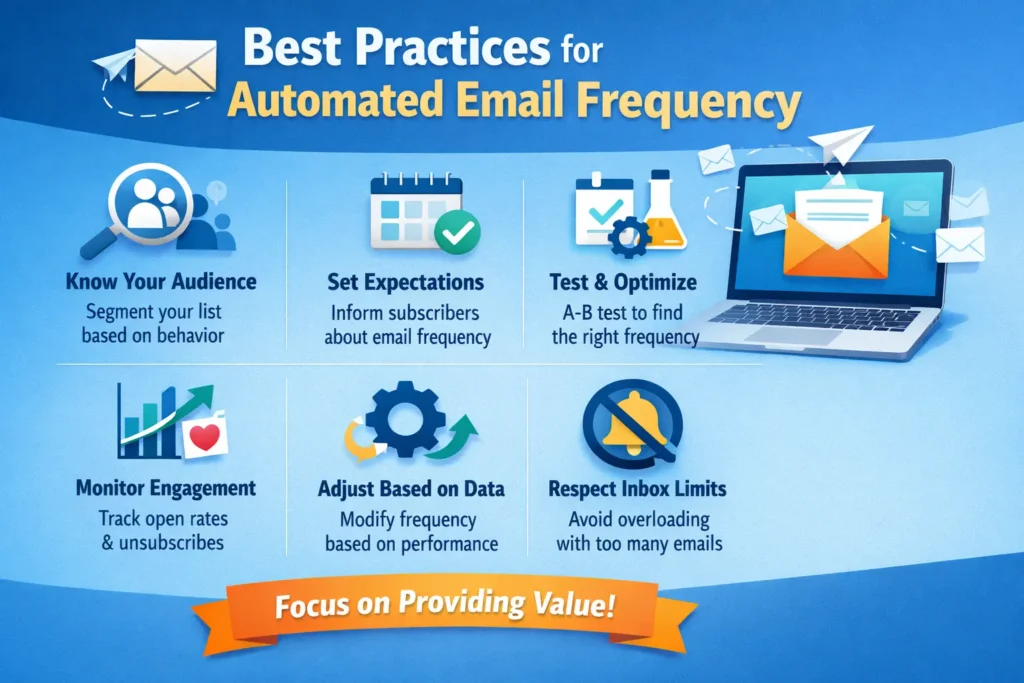
Automation is great. It really is. But if you overdo it, people notice. So, what should be the practices you need to follow for a better email frequency?
1. Count Every Email
Don’t forget your automated emails. Welcome emails, order confirmations, cart reminders, they all count. Sometimes people only think about the campaigns they send manually. That’s a mistake. Your subscribers see all of it.
2. Make It Relevant
Only send emails that matter. Did the customer buy something? Say thanks. Looking at a product? Give a tip or quick advice. However, random messages are skipped by people most often. Or worse, they mark them as spam. Keep it tied to what they did.
3. Keep Things Fresh
Automated emails aren’t “write once and forget.” That welcome email from last year? Might be off now. Check your flow every few months. Update content, links, and offers. Even small changes make emails feel alive.
4. Don’t Send Duplicates
Two emails at the same time? Don't do it. Space them out. Every email must have an objective. Otherwise, individuals become frustrated and move away.
Do it right, and automation actually works. People stay interested. Your emails reach the right inboxes. And your campaigns do what they’re supposed to do.
Do it right, and automation actually works. People stay interested. Your emails reach the right inboxes. And your campaigns do what they’re supposed to do.
How Clearout Helps You Get Email Frequency Right
Email frequency works only when you’re sending to real, reachable people. Clearout helps you do that at the source.
It validates email addresses in real time on signup forms, via API, or in bulk so fake, disposable, role‑based, and risky emails never enter your list. With Form Guard, Clearout filters junk data before it hits your CRM, stopping low‑quality signups from inflating your audience.
By keeping your list clean and accurate, Clearout helps you:
It validates email addresses in real time on signup forms, via API, or in bulk so fake, disposable, role‑based, and risky emails never enter your list. With Form Guard, Clearout filters junk data before it hits your CRM, stopping low‑quality signups from inflating your audience.
By keeping your list clean and accurate, Clearout helps you:
- Send campaigns only to valid, active inboxes
- Reduce bounces and protect your sender reputation
- Base your email frequency decisions on genuine user behavior, not noise
The result is simple: fewer wasted sends, more reliable engagement signals, and email frequency that actually matches how real users interact with your brand.
Use Clearout to clean and protect your email data so every email you send is intentional and effective.
Use Clearout to clean and protect your email data so every email you send is intentional and effective.
FAQs
1. How often should most businesses send emails?
There’s no fixed rule here. Most businesses end up sending a handful of emails each week, but it really comes down to how people respond. If emails are being opened and read, you’re probably sending the right amount. If not, it’s worth pulling back.
2. Will sending more emails increase spam complaints?
Yes. If emails show up too often and don’t feel useful, people get annoyed. That’s when spam complaints happen. On the other hand, if subscribers know what they signed up for and your emails actually help them, sending more often usually isn’t a problem.
3. How do I test the right email frequency?
Yes. Subscribers experience all emails in the same way, regardless of whether they are sent through automation.
4. Should automated emails count toward frequency?
Yes, subscribers feel the same way. Always consider both automations and campaigns when calculating total email touchpoints.
5. What’s the safest email frequency if I’m unsure?
The safest email frequency starting point is just to commit to one email per week. Stick with that, watch your engagement numbers, and only send more when you feel ready. It keeps things steady and simple.