

- Products
- ResourcesDEVELOPER

 API
API
Clearout APIs are structured around REST and JSON Webhooks
Capture real-time events in your application workflow Form Guard
Real-time form validation to keep bad contacts out of your CRMKNOWLEDGE BASE Getting started
Sending campaigns without bounces is made simple FAQ
FAQ
Easily find answers to services, security and common questionsUSE CASES Lead Generation
Learn how professionals generate quality leadsGUIDESPricing Transparent & flexible pricing to support pay-per-use or recurringCompare Email Verification Tools AI-powered email verification with 99%+ accuracy, real-time validation, and transparent risk scoringCompare Email Finder Tools Pre-verified B2B email addresses with confidence scoring, find real person email, not role-based addressBLOGSEmail Verification ToolsFind Anyone’s Email Address
Most Accurate, Fast & Free WaysForm Validation
Importance, Ways & Best PracticesView All Blogs - Pricing
- Integrations
- Enterprise
- Login


How Long Should a Cold Email Be? (2026 Guide)
According to Hunter's 2025 research, 71% of people ignore cold emails due to their irrelevance. This shows that a cold email without any context that matters to people will not be a success.
Inbox attention spans are reduced to seconds in 2026. Email sorting systems that use AI become less responsive to long and unfamiliar emails. Message length is a trust signal that is analyzed by the spam filters. And your prospects? They read on their phones for 30 seconds between meetings. Hence, you should understand the exact length your cold email should be.
This guide is the answer to what the length of your cold emails should be and inbox behaviors. You will get to know the exact word counts, what to trim, what to retain and how word length impacts on the open rates and spam placement.
Inbox attention spans are reduced to seconds in 2026. Email sorting systems that use AI become less responsive to long and unfamiliar emails. Message length is a trust signal that is analyzed by the spam filters. And your prospects? They read on their phones for 30 seconds between meetings. Hence, you should understand the exact length your cold email should be.
This guide is the answer to what the length of your cold emails should be and inbox behaviors. You will get to know the exact word counts, what to trim, what to retain and how word length impacts on the open rates and spam placement.
Table of Content
How Long Should a Cold Email Be?
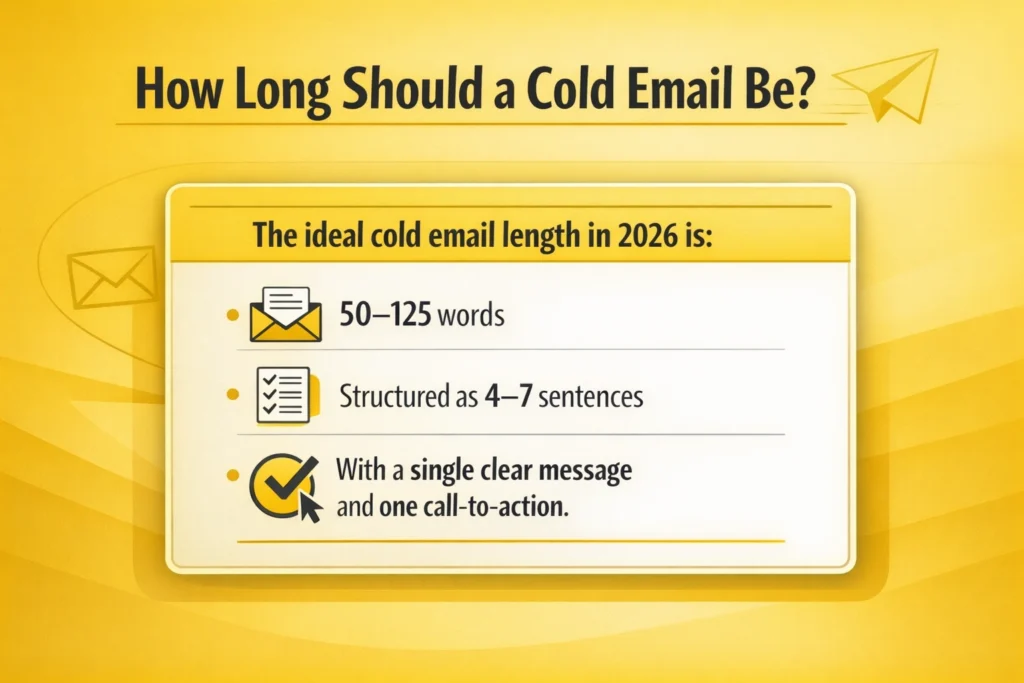
A cold email length should be approximately 50-125 words with 4-7 sentences and a call-to-action.
1. Fits modern attention spans
Emails with 50-125 words take 15-30 seconds to read on a mobile device. That is the mean window that a prospect uses to make a choice of whether to engage or to disregard. Brief emails save readers time and reduce mental burden.
2. Better visual structure
4-7 sentences create a better visual structure. The email does not have a wall of text, and the sentences can be scanned separately. This helps readers naturally move from problem to solution.
3. Optimized for mobile-first behavior
A 200-word email takes up scrolling in a smartphone, whereas a 75-word email can be displayed in the view. This in itself explains why brevity of the email is always better than its lengthiness, regardless of industry.
4. Signals intent
Email length signals value to recipients. A short email is an indication that you know what is significant to the receiver. A lengthy email signals a generic mass message. This difference is intuitively identified by the prospects.
5. Supported by performance data
Emails shorter than 50-125 words give rise to 30-50% more reply rates as compared to emails longer than 200 words. They are less likely to be labeled spam by 60% and they have better sender reputation since the level of engagement is higher.
Why Is Cold Email Length Important?
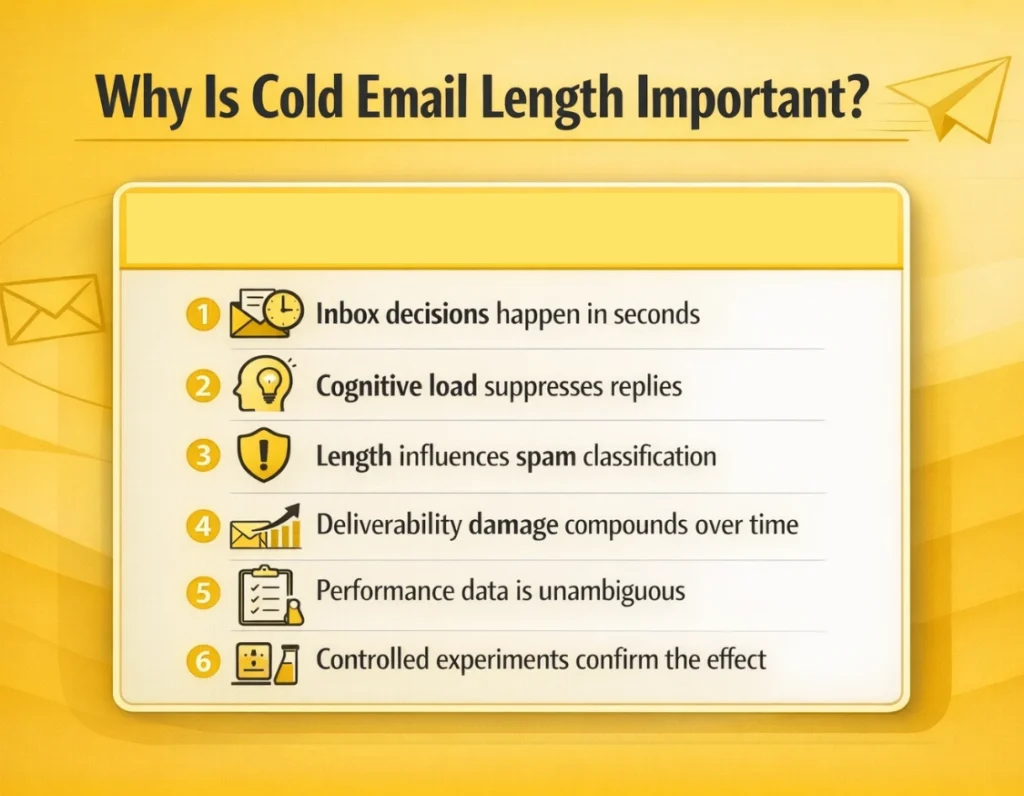
The length of cold emails is not a style option. It is a strategic variable that directly affects performance in each of the outreach funnel stages.
1. Inbox decisions happen in seconds
The behavior of the inbox has radically changed. Users make a decision in 3-5 seconds after opening an email on whether to delete it or not.
In that window, they scan the name of the sender, the subject line as well as the first or second lines. In case it is not clear that they are relevant, then the email is deleted. Email length determines whether your message registers in that critical decision window.
In that window, they scan the name of the sender, the subject line as well as the first or second lines. In case it is not clear that they are relevant, then the email is deleted. Email length determines whether your message registers in that critical decision window.
2. Cognitive load suppresses replies
Prospects are multitasking. Their intellectual level is not curious, but defensive. A 200-word email with multiple ideas requires much more mental processing than a focused 60-word email.
Behavioral psychology always demonstrates that people do not want to perform high-effort jobs when there is a low-effort option. In cold outreach, the other option is deletion.
Behavioral psychology always demonstrates that people do not want to perform high-effort jobs when there is a low-effort option. In cold outreach, the other option is deletion.
3. Length influences spam classification
Modern spam filters evaluate behavioral patterns, not just keywords. Legitimate one-to-one professional emails are typically 50–100 words. Promotional and spam emails are longer, contain multiple ideas, links, and calls-to-action.
When a cold email exceeds 200 words, it aligns statistically with spam patterns, not peer communication patterns. This weakens sender trust signals incrementally with every send.
When a cold email exceeds 200 words, it aligns statistically with spam patterns, not peer communication patterns. This weakens sender trust signals incrementally with every send.
4. Deliverability damage compounds over time
One long email will not destroy deliverability. Repeated low-engagement emails will. When hundreds of long emails receive quick deletes, minimal replies, and weak engagement, inbox providers learn that recipients do not want your messages.
Future campaigns suffer reduced inbox placement, even if you later shorten your emails. Length affects immediate response rates and long-term sender reputation simultaneously.
Future campaigns suffer reduced inbox placement, even if you later shorten your emails. Length affects immediate response rates and long-term sender reputation simultaneously.
5. Performance data is unambiguous
Industry benchmarks show a clear inverse relationship between length and replies:
- Under 100 words: 8–12% reply rate
- 100–200 words: 4–7% reply rate
- Over 200 words: 2–4% reply rate
That is a 4× performance gap driven primarily by conciseness.
6. Controlled experiments confirm the effect
One sales director tested this with identical prospects, offers, and personalization.
- 75-word emails: 11.3% reply rate
- 180-word emails: 4.8% reply rate
When respondents were asked why they replied, the most common reason was: “It was short and to the point.”
Prospects consistently signal what works. High-performing teams listen.
Prospects consistently signal what works. High-performing teams listen.
What Should be the Ideal Cold Email Length?
Not every cold email is meant to accomplish the same goal and the length requirement depends on the situation and the level of relationship. Check the table below to understand how your cold email should look.
| Cold Email Type | Ideal Word Count | Sentence Count | Why It Works |
|---|---|---|---|
| First touch | 50–75 words | 4–5 sentences | There’s no extra information. So the reader focuses on one strong reason to reply. |
| Follow-up | 30–60 words | 3–4 sentences | Context already established. Reminder + gentle nudge. Any longer feels pushy and damages rapport. |
| Value-based | 80–120 words | 5–7 sentences | Explaining insight or value requires slightly more space, but still must remain focused on one idea. |
| Referral-based | 40–70 words | 3–5 sentences | Trust shortcut via mutual connection means less convincing is needed. Get to the point immediately. |
| Partnership pitch | 90–140 words | 6–7 sentences | Requires context on mutual benefit, but still must respect attention constraints. |
1. First-touch emails require maximum discipline.
You’re an unknown sender with zero context. After they open your email, you have about 5 seconds to justify their attention. Anything over 75 words triggers skimming, which means your core message and CTA get missed.
Effective first emails follow a strict structure:
Effective first emails follow a strict structure:
- Who you are (1 sentence)
- Why you’re reaching out (1 sentence)
- Specific relevance to them (1 to 2 sentences)
- Clear next step (1 sentence)
2. Follow-ups should be the shortest emails in your sequence.
Context already exists. The goal is not to re-explain. It is to resurface. Redoing the initial pitch is a burden and annoyance.
High performing follow-ups should be approximately 40 words and stimulate a reply. Example pattern: reference, nudge, time-bound CTA.
High performing follow-ups should be approximately 40 words and stimulate a reply. Example pattern: reference, nudge, time-bound CTA.
3. Value-based emails can be slightly longer but capped.
When you introduce data, insight, or a non-obvious observation, you earn more length, but 80 to 120 words is the ceiling. The mistake is explaining the insight inside the email. Don’t. Tease the insight and make the CTA about discussing it.
Pattern that works:
Pattern that works:
- Specific observation
- Brief proof (similar company plus result)
- CTA to explore relevance
4. Subject line and preview text count toward length psychology.
Even a short body feels long if the subject line and preview are verbose.
- Subject line: 3 to 7 words
- Preview text: complementary, not pitch-heavy
If the combined impression feels dense, open rates and engagement drop.
5. Mobile visibility is the final filter.
If your CTA is not visible without scrolling on mobile, the email is too long.
- iPhone: approximately 60 to 80 words per screen
- Preview text: complementary, not pitch-heavy
If the combined impression feels dense, open rates and engagement drop.
What a Good Cold Email Should Have (Beyond Length)
Length discipline is foundational, but conciseness alone won't generate replies. Your short email still needs these essential elements to convert.
1. Clarity from the first sentence.
Your opening line must answer the question every prospect asks: Why should I care? Openings such as “I wanted to reach out, I hope this email finds you well,” are generic and are just a wasted word.
2. Clean, validated email list.
Here's what most people overlook: everything you write in the 60 words is good, but you do not get a notice after sending the email, as you are sending it to spam mail. There is nothing like high bounce rates that kill sender reputation quicker than any other aspect.
Validate your list before optimization of email length. The best email validation systems such as Clearout, detects invalid emails, typos, mailbox presence, domain verification, risky email contacts, etc.
Validate your list before optimization of email length. The best email validation systems such as Clearout, detects invalid emails, typos, mailbox presence, domain verification, risky email contacts, etc.
3. Minimal but meaningful.
You do not have to have 3 sentences that testify that you stalked their LinkedIn profile. You require 1 certain reference which could only be applicable to them.
The recent company announcement of theirs, a podcast they were on, and a challenge that was particular to their industry this quarter. One sentence maximum. Then move to value.
The recent company announcement of theirs, a podcast they were on, and a challenge that was particular to their industry this quarter. One sentence maximum. Then move to value.
4. One idea per email.
You want to mention your product, share a case study, invite them to a webinar, and ask if they're the right person to talk to. Stop. That's too much. Ask whether they are the right individual to speak to. One email, one idea, one ask.
In case you are unable to summarize the purpose of your email using fewer than 6 words, then you are attempting to do too much. Have a discussion on solving [specific problem] or Share relevant case study or an intro call about [specific topic]. Pick one.
In case you are unable to summarize the purpose of your email using fewer than 6 words, then you are attempting to do too much. Have a discussion on solving [specific problem] or Share relevant case study or an intro call about [specific topic]. Pick one.
5. Right timing and sending behavior.
Even a perfect 75-word email sent at 2 AM on Sunday hurts deliverability—it signals automation or spam.
- Email during working hours.
- Send on Tuesday and Thursday, 8 AM-4 PM
- Mondays (inbox flooded) and Fridays (people check out early).
What to Remove to Keep Cold Emails Short?
It is more difficult to cut the words than to write them. This is what you must be able to remove in your cold emails to reach the best length without losing their effectiveness.
1. Company history and background.
It does not matter to anyone that you were established in 2018 with 47 employees and recently took Series B funding. They are concerned with whether you are capable of solving their problem.
Eliminate all company background as long as it is irrelevant to this particular prospect. Even at that, make it no more than five words: "We are the team that created [famous product].”
Eliminate all company background as long as it is irrelevant to this particular prospect. Even at that, make it no more than five words: "We are the team that created [famous product].”
2. Long introductions about yourself.
“My name is Alex, and I am the VP of Business Development at Company X, where I have been employed for six years assisting companies such as yours to overcome [problem]....”
Cut everything that's not essential. This is enough: "I can assist [type of company] in solving [specific problem]
Cut everything that's not essential. This is enough: "I can assist [type of company] in solving [specific problem]
3. Unnecessary credibility signals.
You do not have to include all the logo clients that you work with, all the awards you have won, or all the certifications that you have received. This is a sense of insecurity camouflaged as a sense of credibility.
If you need three sentences of social proof to convince them to take a call, your value proposition is weak.
If you need three sentences of social proof to convince them to take a call, your value proposition is weak.
4. Over-explaining the product or service.
Your cold email is not a product demo. You do not have to elaborate on what you are doing, what your platform is, what your methodology is. You must show sufficient interest in the next conversation. Nobody reads past word three.
Example: "Our customer behavior is analyzed to determine churn three months ahead of time it occurs. Simple. Clear. Save the details for the call.
Example: "Our customer behavior is analyzed to determine churn three months ahead of time it occurs. Simple. Clear. Save the details for the call.
5. Apologies and permission-seeking language.
Saying sorry to bother you, I hope it is okay to call and all the apologies go against your message before you even make it. They won't mind your outreach if you're adding real value. Erase all apologetic phrases.
Cold Email Length by Different Roles
Here's a comparison table for quick reference:
| Your Role | Prospect Role | Word Count | Tone | Key Focus |
|---|---|---|---|---|
| Founder | Founder/Exec | 40–80 | Peer-to-peer | Mutual interest, specific insight |
| Sales | Decision-maker | 60–120 | Professional | Clear pain point + result |
| Sales | Decision-maker | 60–120 | Professional | Clear pain point + result |
| Marketing | Marketing leader | 80–150 | Strategic | Insight or trend + value |
| Recruiter | Potential candidate | 90–130 | Respectful, opportunity-focused | Role clarity + why them |
| Partner dev | Potential partner | 90–140 | Collaborative | Mutual benefit + specific opportunity |
Your role and your prospect's role both influence ideal email length. Here's how to adapt based on who's sending and who's receiving.
1. Founders reaching out to other founders
You're expected to write short emails: no more than 40 to 80 words. Founder-to-founder communication has a peer dynamic. Prolonged emails by founders are sales pitches. Keep it tight and personal.
Hey [Name], you just raised your Series A, congrats. I created [your company] to solve [related problems] and learned something about [certain relevant insight] that could be of use for you as you scale. Let me know the best time we can have a call at.
2. Sales reps reaching decision-makers.
- Business (15 words)
- How you've helped similar companies (25 words)
- Clear outcome/result (15 words)
- CTA (20 words).
3. Marketing professionals reaching marketing leaders
When opening with insights or value, you can use 80 to 150 words. Marketing individuals value strategic thinking and information, thus you can add one powerful statistic or observed trend. The email should remain result-oriented.
Quick Checklist: Is Your Cold Email the Right Length?
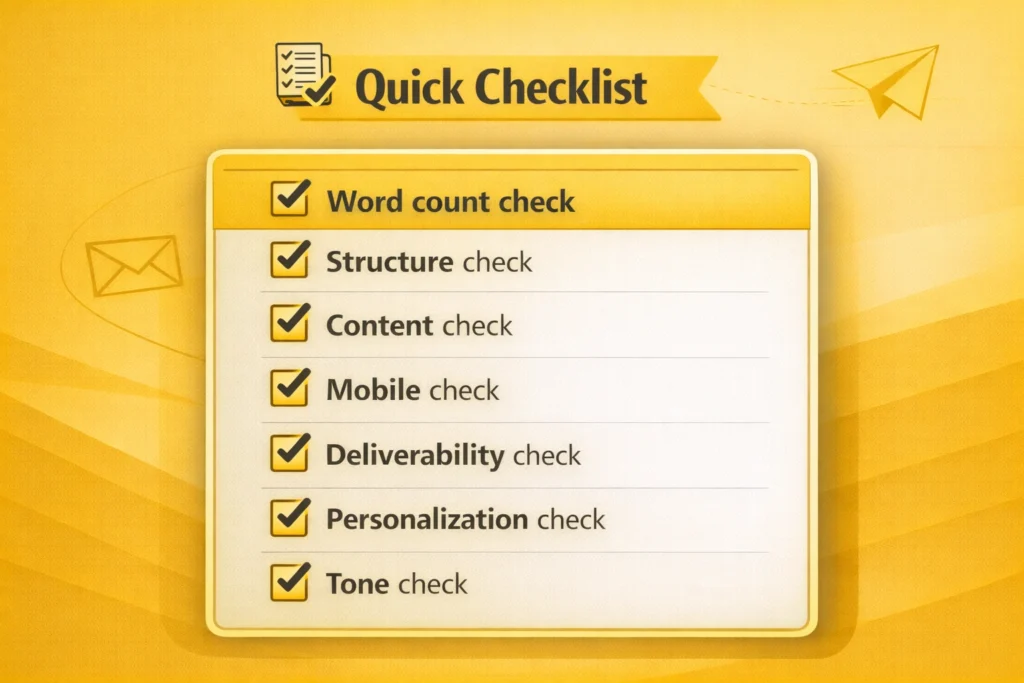
Check this list before you send your next cold email campaign. Everything has a direct influence on reply rate and deliverability.
Word count check:
- Under 125 words total
- Under 100 words if first touch
- Under 75 words if founder-to-founder
- Under 60 words if follow-up
Structure check:
- 4–7 sentences maximum
- One paragraph or two short paragraphs
- No sentence longer than 20 words
- White space between sentences (not wall of text)
Content check:
- One clear idea (not three ideas crammed together)
- One call-to-action (not multiple options)
- Relevant within the first sentence
- No company history or background
- No buzzwords or jargon
- Zero to one link maximum
Mobile check:
- Entire email visible without scrolling
- CTA visible in first screen
- Readable on small screen
- Plain text or minimal formatting
Deliverability check:
- Email list validated (no invalid addresses)
- Sending from warmed domain
- Sent during business hours in recipient's timezone
- No spam trigger words
- Clean HTML-to-text ratio
Personalization check:
- One specific reference to the recipient
- Not creepy or over-researched
- Actually relevant to your ask
Tone check:
- Sounds like human, not marketing copy
- No apologies or permission-seeking
- Confident but not pushy
- Natural language (contractions okay)
If your email fails more than two items on this checklist, edit before sending. If it fails five or more, start over. This checklist represents the difference between 3% reply rates and 10%+ reply rates across thousands of campaigns.
Your Next Steps
First, audit your current cold email templates. Run them through the checklist above. Cut everything that doesn't directly serve relevance, value, or your CTA.
Second, validate your email list with an email validation tool like Clearout before your next campaign. High bounce rates from invalid addresses destroy sender reputation faster than any other factor. Even perfect 60-word emails can't generate replies if they never reach the inbox. Clean your list first.
Third, test length systematically. Send the same offer to similar prospects: half get your current email length, half get a version cut to 75 words. Measure reply rates.
Second, validate your email list with an email validation tool like Clearout before your next campaign. High bounce rates from invalid addresses destroy sender reputation faster than any other factor. Even perfect 60-word emails can't generate replies if they never reach the inbox. Clean your list first.
Third, test length systematically. Send the same offer to similar prospects: half get your current email length, half get a version cut to 75 words. Measure reply rates.
Improve Your Reply Rates
FAQs
1. Is 200 words too long for a cold email?
Yes. Two hundred words is too long for an effective cold email in 2026. Emails this length see 50–70% lower reply rates than emails under 100 words. They require scrolling on mobile, create cognitive load, match spam patterns, and signal that you don't respect the recipient's time. Keep cold emails between 50 and 125 words for optimal performance.
2. Do shorter cold emails really get more replies?
Absolutely. Data from millions of cold emails shows that messages between 50–125 words generate reply rates 30–50% higher than emails over 200 words. Shorter emails are easier to read on mobile, create less cognitive load, demonstrate respect for time, and force you to focus on what matters.
3. What's the ideal length for a first cold email?
50 to 75 words is ideal for a first touch cold email. You're an unknown sender with zero context. Brevity creates intrigue without overwhelming. This length forces you to focus on one compelling reason to respond while demonstrating you respect their attention.
4. Does cold email length affect spam filtering?
Yes, significantly. Spam filters analyze message length because legitimate person-to-person emails average 50–100 words, while spam averages 200–500+ words. Long emails with multiple links and heavy formatting trigger spam algorithms. Shorter, plain-text emails deliver better and build a stronger sender reputation over time.
5. How long should a follow-up email be?
30 to 60 words maximum. Context already exists from your first email. Your follow-up should be a brief, gentle reminder with a clear CTA. Anything longer feels pushy and redundant. Example: "Hi [Name], following up on my Tuesday email about [topic]. Does a brief call make sense? I'm flexible on timing."
6. Should cold emails to executives be shorter?
Yes. C-level executives receive hundreds of emails daily and delete ruthlessly. For senior executives, 40–75 words is optimal. They need to grasp your relevance and value in 10 seconds, or they're moving on. Respect their time constraints with maximum conciseness.
7. Can cold emails ever be longer than 125 words?
Rarely. The only scenarios where 125+ words might work: highly technical B2B sales where complexity requires explanation, industries with more formal communication norms, or when you're responding to an inbound inquiry (not true cold outreach). Even then, 150 words should be your absolute ceiling.