clearout
  • Products
    • Email Verifier Verify emails addresses individually, in bulk or through API, with 99% accuracy
    • Email Finder Find individual or bulk emails by entering the person & company name or domain
    • Form Guard IconForm Guard Protect your forms from spam, bots, and invalid submissions with real-time email, phone, and name verification.
    • Prospect SQL/MQL list building with high levels of personalization, real-time data enrichment and prospect search
    • Clearout For SheetsVerify email addresses directly on Google Sheets with Clearout for sheets add-on
    • Prospect – LinkedIn Chrome ExtensionBuild verified, targeted prospect lists directly from LinkedIn profiles
    • ClearoutPhoneValidate phone numbers across 240+ countries in bulk, quick or real time validation
    • Free Tools
    • Disposable Email Checker
    • Reverse LinkedIn Profile Lookup Tool
    • Reverse Email Lookup Tool
    • Email List Cleaner
    • Company Domain Finder API
  • Resources
      DEVELOPERAPI iconAPI
      Clearout APIs are structured around REST and JSON
      Webhooks iconWebhooks
      Capture real-time events in your application workflow
      Form Guard iconForm Guard
      Real-time form validation to keep bad contacts out of your CRM
      KNOWLEDGE BASEGetting started iconGetting started
      Sending campaigns without bounces is made simple
      FAQ iconFAQ
      Easily find answers to services, security and common questions
      USE CASESLead Generation iconLead Generation
      Learn how professionals generate quality leads
      GUIDESPricing arrow iconTransparent & flexible pricing to support pay-per-use or recurringCompare Email Verification Tools arrow iconAI-powered email verification with 99%+ accuracy, real-time validation, and transparent risk scoringCompare Email Finder Tools arrow iconPre-verified B2B email addresses with confidence scoring, find real person email, not role-based addressBLOGSEmail Verification ToolsFind Anyone’s Email Address
      Most Accurate, Fast & Free Ways
      Form Validation
      Importance, Ways & Best Practices
      View All Blogs
  • Pricing
  • Integrations
  • Enterprise
  • Login
Try it free Book a 1-to-1 demo
Akanksha Mishra / April 21, 2026 April 21, 2026

Sales Prospecting vs Lead Generation: What’s the Difference?


Sales Prospecting vs Lead Generation: What’s the Difference?

Sales prospecting and lead generation are often confused with each other. They actually play different roles in the sales process.

Lead generation fills your pipeline with potential buyers while sales prospecting finds people who are actually likely to buy and starts a direct conversation with them.

The issue is that there are teams that are not aware of the difference between these, and it is costing them a lot of money. According to HubSpot, 79% of leads get converted to customers, usually because of poor follow-up or nurturing. This is because the leads are not taken care of properly.

In this guide, you will learn sales prospecting vs lead generation. Moreover, you'll get to know the best lead generation and prospecting tools.

Table of Content


‣ Sales Prospecting vs Lead Generation
‣ What is Lead Generation?
‣ What is Sales Prospecting?
‣ When to Use Lead Generation vs. Sales Prospecting (And When to Run Both)?
‣ How To Use Clearout For Sales Prospecting?
‣ 6 Real-world examples
‣ Lead Generation and Sales Prospecting: Better Together
‣ FAQs
Sales Prospecting vs Lead Generation


The easiest way to describe the difference between sales prospecting and lead generation is as follows: Lead generation is a pull movement, and prospecting is a push movement. Lead generation provides circumstances in which prospects will approach you. Sales prospecting makes your team go to find them.

Check out the table below to understand the difference between sales prospecting vs lead generation.

FactorLead GenerationSales Prospecting
Who initiates contactThe prospect - they come to youThe rep - you go to them
Primary ownerMarketing teamSales team/SDR
Funnel StageTop of funnel - awareness & interestMid-funnel evaluation & direct outreach
Volume vs precisionHigh volume, broader audienceTargeted, ICP - specific contacts only
Typical ChannelsContent, paid ads, SEO, webinars, emailsCold email, calls, LinkedIn, referrals
Personalization levelSegmented, not truly one-to-oneHighly personalised, often one-to-one
Speed to pipelineSlowerFaster
ScalabilityScales well with automationLimited by rep capacity without tooling
Data requirementAudience personas, intent signalsVerified contact data, ICP firmographics
Primary success metricMQLs, cost/lead, conversion rateSQLs, meetings booked, pipeline created
Works Best ForBrand building, long-term pipelineTarget accounts, fast pipeline creation

Lead generation is a marketing motion at its core. You create content, an ad, an event, or a free resource that draws people toward your brand. The prospect does the initial work of finding you. Your job is to make that first encounter valuable enough so that they share your contact information and stay engaged. The output is a lead who has shown some level of interest in your brand.

In sales prospecting, a rep identifies individuals that match a customer profile, researches their situation, and reaches out with a mode of marketing to make a lead.

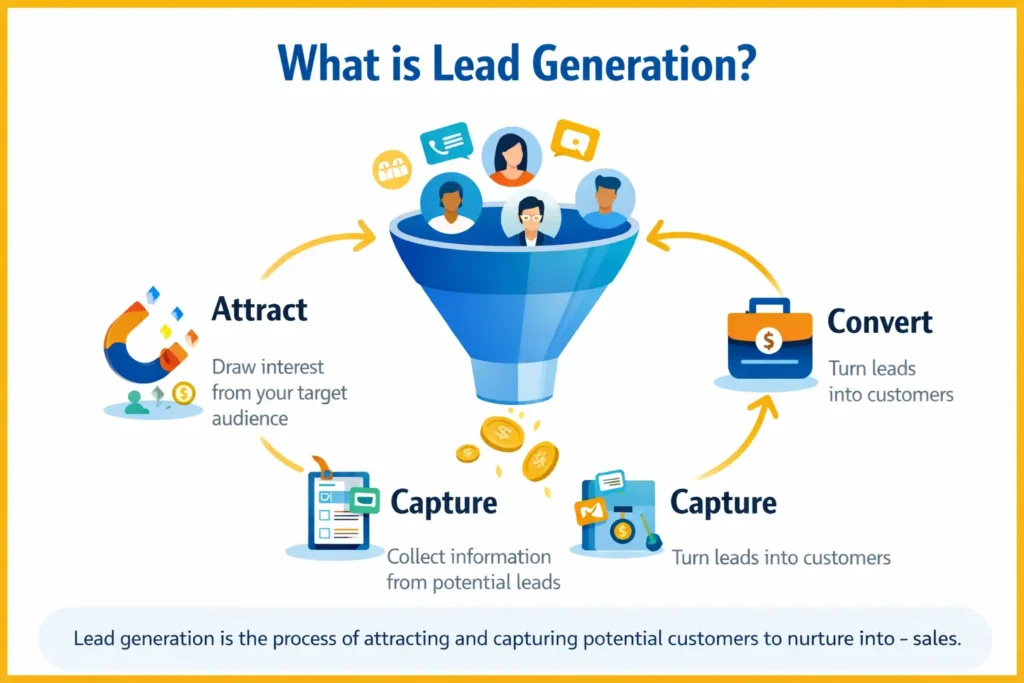
What is Lead Generation?


Lead generation marketing funnel infographic.

Lead generation is concerned with getting the right people in your business at the right time. You make content, advertise and develop systems that get interested people to you rather than going after them.

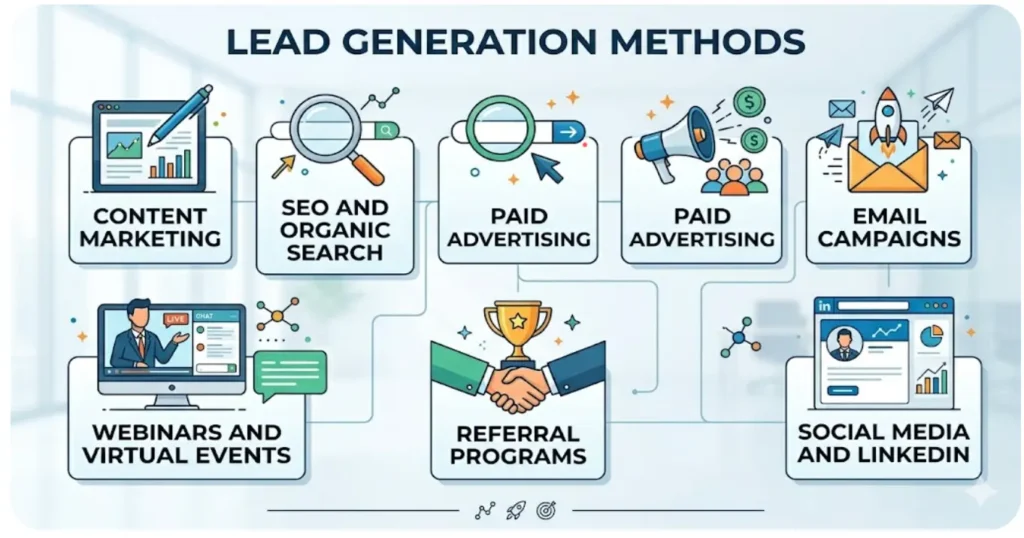
7 Best Lead Generation Methods


A detailed infographic visualising 7 key business lead generation methods.

Now let’s take a more detailed look at lead generation and go beyond traffic.

1. Content Marketing


You can use blogs, comparison guides, case studies, templates and thought leadership pieces that rank in search or get shared on LinkedIn. It's a well-optimised piece of content that can generate leads for years without spending more money. The how-to guide ranks on Google, gets shared on LinkedIn, and pulls in leads for months. The long-term ROI of content is significantly higher.

2. SEO and Organic Search


SEO has shifted from a traffic acquisition channel to a demand capture and qualification engine. The structure of organic search has changed. Search results are no longer blue links that are competing to get clicks. Higher-quality SERP contents, intent signals, and AI-provided summaries usually make users have partial answers even before visiting a site. This narrows down the click window and blocks out low-intent traffic sooner.

This alteration of the optimal execution of SEO is required in the case of lead generation. Broad, upper-of-funnel content is the same, yet it is converted using mid- and bottom-funnel pages. Comparison pages, use-case content, and solution-driven landing pages now carry more weight.

3. Paid Advertising


Google Search campaigns and LinkedIn Lead Gen Forms can help you get leads fast. Display ads also work well. These methods can bring in qualified leads. The downside is that you have to pay for each lead. Precise targeting is what separates efficient paid campaigns from expensive ones.

4. Email Campaigns


Go for email campaigns to warm up a new opt-in list, and to cultivate inbound leads who are not yet buyers. A smart email to someone who visited your pricing page 3 weeks ago can move a deal forward without anyone picking up the phone. Timing and relevance are everything here.

5. Webinars and Virtual Events


Registration is a natural lead capture moment, and the format lets you demonstrate genuine expertise in real time. People who sign up for a webinar about a specific problem are effectively telling you where they are in the buying process. That's an incredibly useful signal.

6. Referral Programs


Referred leads convert faster and can be closed at higher rates than almost any other source. That’s because the trust is partially established before the first conversation. Most companies dramatically underinvest in referral systems relative to what they return.

7. Social Media and LinkedIn


Organic content, targeted paid campaigns, and LinkedIn's Lead Gen Forms all have a legitimate role depending on who you're trying to reach. For B2B specifically, LinkedIn has no real competition when it comes to decision-maker access. If your buyers are there, you should start your content marketing.

Benefits Of Lead Generation


When you have a functioning lead generation engine, the biggest win is that the pipeline doesn't depend entirely on your sales team's daily effort.

Lead generation works through:

  • A blog post, paid campaign, or SEO page doesn't clock out at 6 pm
  • Best-performing content is pulling in leads at 2 a.m., no rep needed
Warmer leads, shorter conversations

  • Someone who Googled their problem and found you is already halfway sold
  • They arrive with context, they know what they need, they just need to trust you
  • That's a very different conversation from a cold call out of nowhere
You can actually see the metrics like

  • Cost per lead
  • Form conversion rates
  • Traffic-to-lead ratios
Stays in the room during long sales cycles

  • B2B deals that run 45 to 90+ days need more than just a rep checking in
  • A good nurture sequence keeps your brand present without being pushy
  • The content builds the relationship between touch points

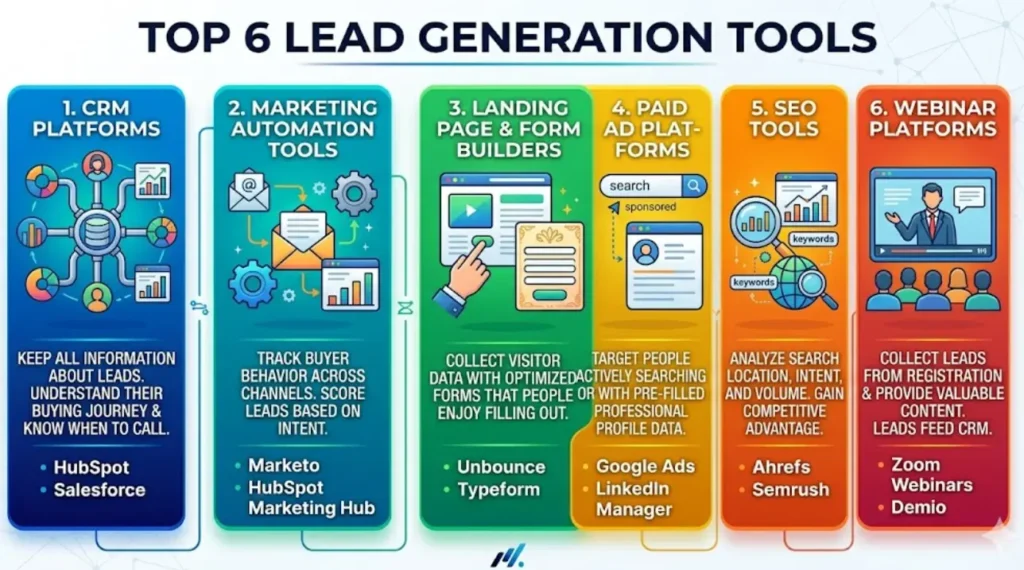
TOP 6 Lead Generation Tools


Infographic of Top 6 Lead Generation Tools across 6 categories.

When selecting the lead generation tools, you need to check initially how you wish to contact people. A combination of the following tools is used in the majority of businesses:

1. HubSpot and Salesforce CRM Systems


HubSpot and Salesforce are CRM systems where you store all the data about the individuals interested in your services or products. Without a CRM, you will lose follow-up on your leads to competitors. The fact is that most people are not aware that a good CRM does not merely store contacts, it informs you where every lead is in their purchasing process, so your sales team will always know who to call, when to call and what to say.

2. Automated Marketing Software, such as Marketo and HubSpot Marketing Hub


B2B marketing has become a lifecycle engine as opposed to a campaign engine. Systems such as Adobe Marketo Engage are designed to coordinate personalised customer experiences at scale, and not merely to do outreach. It is about directing the prospects to the first touch to revenue. Structurally, Marketo unites lead management, email execution and content personalisation into one system. Its connection with CRM systems, such as Salesforce and Microsoft Dynamics 365, ensures that marketing and sales work off the same data.

3. Unbounce and Typeform (landing page and form builder).


Unbounce Smart Traffic automatically directs visitors to the best-fit landing page variation, and requires no coding. Typeform helps businesses collect data through forms and surveys that people actually enjoy filling out. Most forms get ignored, and these two make sure yours don't.

4. Paid ad platforms like Google Ads and LinkedIn Campaign Manager


Google Ads catches people right when they're searching for what you sell; that's about as high-intent as it gets. LinkedIn's Lead Gen Forms do something different; the form fills itself with the person's profile data, so sharing their details takes seconds. Two very different platforms, and both built to bring the right people.

5. SEO tools like Ahrefs and Semrush


Ahrefs and Semrush help you figure out from which locations, their intent, volume, etc., people are searching for. They help you see how your content is doing. They also help you find ways to get ahead of your competitors.

6. Webinar platforms like Zoom Webinars and Demio


When people sign up for a webinar, their information goes into your CRM, and you can get more leads from the webinar even after it is over. This is one of the ways to get leads and also have something valuable to offer people.

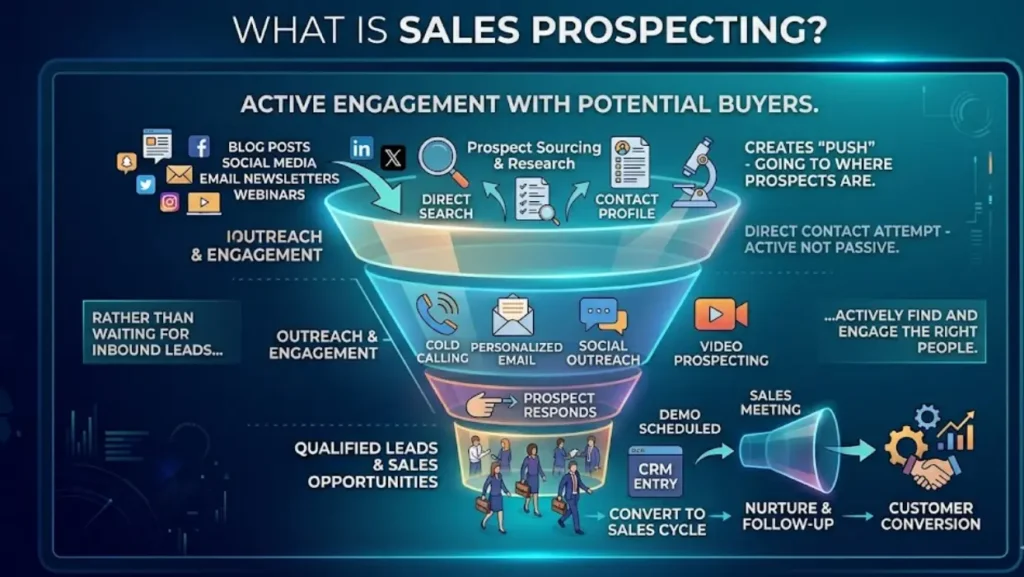
What is Sales Prospecting?


Sales prospecting process and outreach funnel infographic.

Sales prospecting is a sales-driven activity. You identify specific people, research their situation, and reach out with something tailored to their actual context. The goal is to open a qualified conversation with someone who might not even know you exist yet.

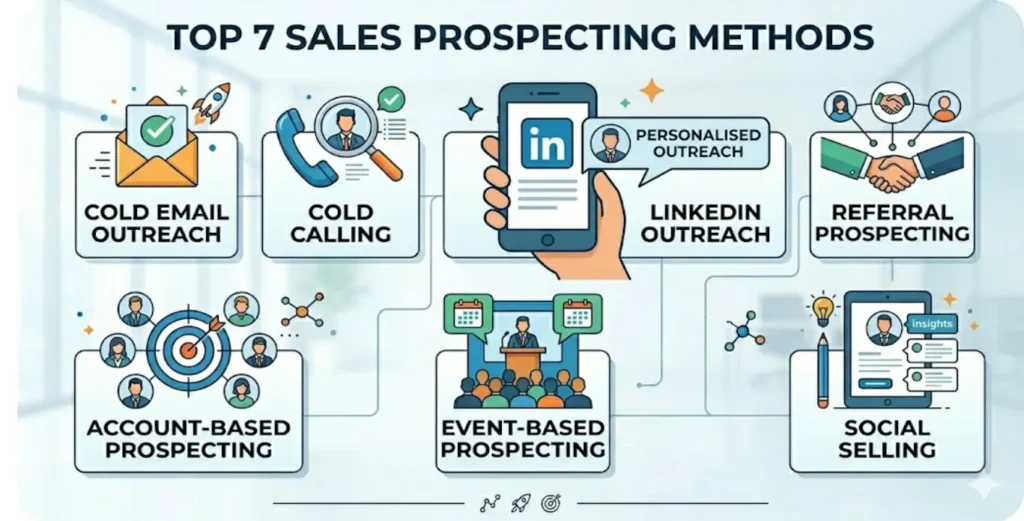
Top 7 Sales Prospecting Methods


 Infographic shows Top 7 Sales Prospecting Methods

Effective sales prospecting methods are about finding the approach. They combine research, timing, and the way to contact someone. You need to reach the person with a message that really fits their situation.

1. Cold Email Outreach


The best way to find customers is through sales prospecting. It gives you the return on investment. If you send emails to fake or wrong addresses your results suffer. The email channel gets blamed for the problem. It's actually the data that's faulty. This is where Clearout comes in. It verifies all email addresses to ensure that it is valid before sending you a message.

In this manner, you just waste your time and money on real people. Clearout assists you in acquiring the highest data quality for your outreach email. It will ensure you are communicating with individuals who have valid email addresses. This enables you to achieve the output of your email campaigns.

2. Cold Calling


Takes more time than an email, but is incredibly effective, particularly in industries where inboxes are already overcrowded. The reps that do it right actually take the time to do pre-call research.

They search for something particular, a new employee, a new product introduction, a problem that is typical at that level of the company, before making a dialled call. Putting that in the first ten seconds of a call informs the prospect this is no random dial, and makes all the difference.

3. LinkedIn Outreach


It is simple to reach decision-makers on LinkedIn. You can send a personal note or InMail. You will be able to interact with their posts prior to sending a message.

LinkedIn allows you to investigate the activity of a person, work history, people with whom you have common contacts, and news in a company. The majority of reps do not conduct this research and instead go directly into the pitching process. This is why their response rates remain low.

4. Referral Prospecting


You can request customers, partners or close acquaintances to refer you to someone who requires your services. Referred prospects go through the sales pipeline more quickly. This is because they arrive with a level of pre-existing trust. This removes a significant barrier from the very first conversation.

5. Account-Based Prospecting


You make a list of high-value companies. Then you contact people at each company at the same time. This approach works well for deals. Many people need to agree on a purchase. One person can't make the decision alone.

6. Event-Based Prospecting


The decision-makers are united in conferences and trade shows of the industry. The best sales teams will contact them before the event, make phone contact during the event and follow up within 48 hours. Just collecting business cards doesn't work. You require a good strategy such as this.

7. Social Selling


It is possible to establish a reputation on LinkedIn. Post and comment on the posts of people you would like to meet. This takes time. When a prospect already knows you, your first email gets a better response. They don't think you are a stranger.

Benefits of Sales Prospecting


  • You control who you talk to. You're not waiting for the right buyer to find you; you go find them. That matters when the pipeline is thin or inbound just hasn't picked up yet.
  • You learn things dashboards can't tell you. Every call and email, even the dead ends, will provide you with a better idea of what buyers really want and what arguments continue to appear.
  • The pipeline builds faster. Prospecting can get qualified conversations going within days. For teams that need results this quarter, that speed is hard to replace.

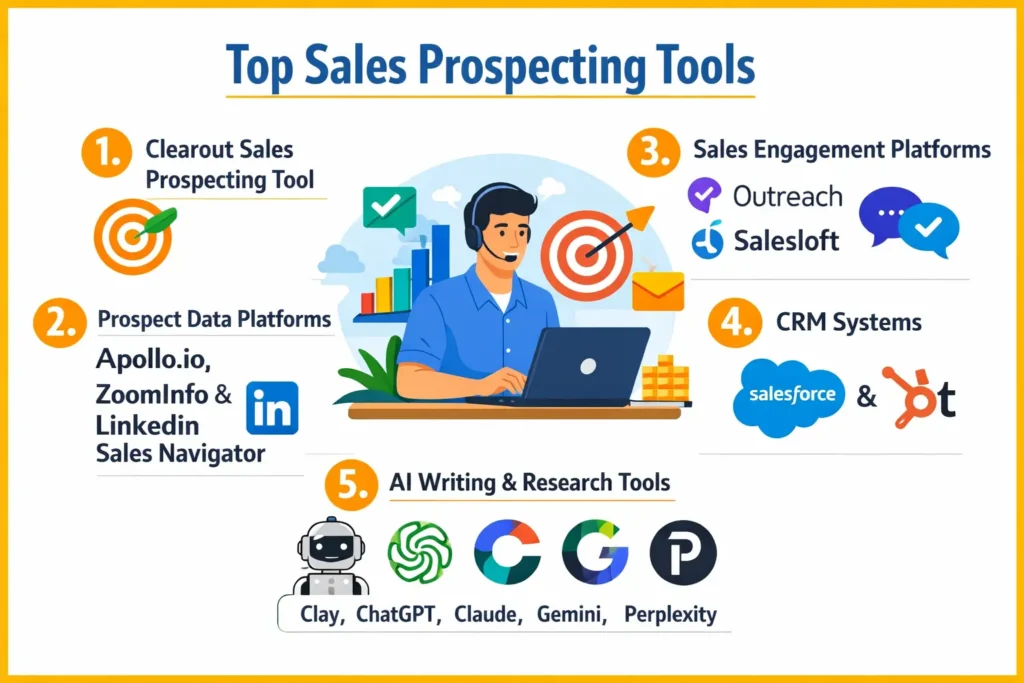
Top Sales Prospecting Tools


 Infographic of Top Sales Prospecting Tools across five categories

The tools for sales prospecting help reps find the right contacts, ensure the data is clean before outreach begins, and make the actual reaching-out process organised. Data quality is the variable that kills prospecting campaigns more than any other factor.

1. Clearout Sales Prospecting Tool


Sales prospecting requires the right people, the right data and the right time. Software such as Clearout Sales Prospecting is designed based on this concept. What’s changed underneath is how data is handled.

Rather than collecting contacts and cleaning them later, teams can now build lists that are already verified or continuously re-check existing data inside the CRM.

Sourcing has also become more direct. With access to platforms like LinkedIn and Wellfound, teams can pull prospects straight from where professionals and companies are active. This cuts down research time and makes prospecting faster and more consistent.

2. Prospect Data Platforms like Apollo.io, ZoomInfo and LinkedIn Sales Navigator


These platforms let you build targeted lists. These lists are divided in terms of the type of industry they are in, the size of their company, their job position, the kind of technology they are using and what they are interested in.

3. Sales engagement platforms like Outreach and Salesloft


These tools help you build and manage step sequences that combine email calls and LinkedIn touches. You track who's opening, clicking and replying at the contact level.

4. CRM Systems like Salesforce and HubSpot CRM


Every prospect interaction gets logged here. When a rep moves on, the context doesn't disappear with them. You always know where each deal stands, and nothing falls through the cracks.

5. AI Writing and Research Tools Like Clay, ChatGPT, Claude, Gemini and Perplexity


These tools help you draft personalised lines quickly, research prospect backgrounds, and generate copy variations to test. Used thoughtfully, they speed up prospecting without turning every email into a template.

When to Use Lead Generation vs. Sales Prospecting (And When to Run Both)?


Most teams need both methods running simultaneously, but the balance should shift depending on where you are as a business, what your pipeline looks like today, and what your team is actually equipped to execute well. Here's a practical framework.

Use lead generation strategies if:


  • You're entering a market where your brand is essentially unknown
  • Your sales cycle is long and needs buyer education along the way
  • Your ICP is broad or difficult to identify by name upfront
  • You want a pipeline that compounds over time without growing headcount
  • Organic search demand already exists for the problem you solve
  • You have a large database that isn't ready to buy yet and needs warming up

Use sales prospecting strategies if:


  • You need qualified conversations happening within the next 30–90 days
  • You're going after a specific set of named target accounts
  • Your ICP is very specific and easy to identify by title and firmographics
  • Inbound volume is too low or unpredictable to build a plan around
  • You're entering a new vertical, geography, or market segment
  • Enterprise deals require multi-threaded outreach across several contacts at once

The clearest signal you should be running both: your inbound leads are consistently lower quality than the accounts you'd actually want to work with, or your pipeline dries up every time the marketing team shifts focus to a new campaign. Neither situation is sustainable on its own.

How To Use Clearout For Sales Prospecting?


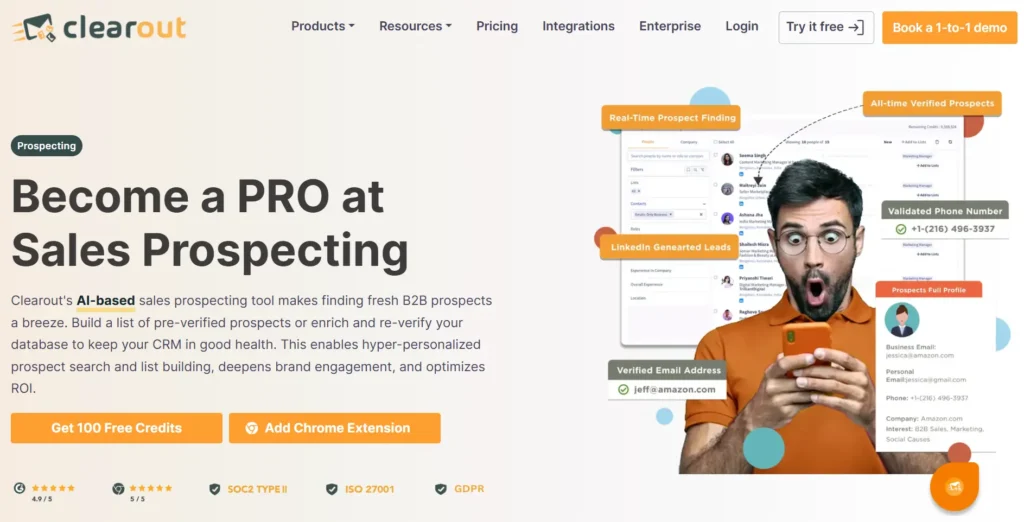
Screenshot of Clearout’s Sales Prospecting Page.

Most prospecting campaigns don't fail because of bad messaging; they fail because of bad data. A rep builds a solid list, writes genuinely thoughtful emails, sets up a well-structured sequence, and then a significant percentage of those emails bounce. Open rates collapse. Sender reputation takes a hit. The campaign becomes a failure since the actual problem was unverified contact data in your CRM.

This is exactly where Clearout fits into a prospecting workflow. Clearout is an AI-powered platform built specifically for sales and marketing teams that need their contact data to be reliable before they invest any outreach effort in it.

6 Real-world examples


Sales prospecting examples


1. Cold email to a targeted, verified list


An SDR at a SaaS company needs to reach operations managers at mid-size e-commerce businesses, but their CRM has nothing useful. They use Clearout's Prospect IQ to build the list directly, filtering by job title, company size, industry, and revenue. They pull 380 contacts, all with verified emails attached, no separate cleaning step needed. The first email speaks to a challenge that comes up constantly at that company size. Bounce rates stay low, deliverability holds, and the campaign books 22 meetings.

2. LinkedIn outreach triggered by a job change


A rep selling recruiting software monitors job change alerts for VP of Talent contacts at mid-size tech companies. A new VP in that role usually checks the tools they have during their 90 days. This is something they do every time. The sales representative contacts them a week after the change with a brief message that makes sense in that situation.

3. Following up on conferences


A sales engineer goes to an industry event, talks to people, and sends a follow-up message within two days. They mention the thing they talked about. These messages seem personal. Not like something copied and pasted. They turn into meetings at a higher rate compared to just sending a list of random people to contact.

Lead generation examples


1. Gated research report


A cybersecurity company publishes a detailed "State of SMB Security" report and places it behind a simple form name, email, and company size. Over 90 days, more than 1,200 people downloaded it. Marketing scores those leads based on firmographic fit and engagement with the follow-up email sequence. The ones that cross a scoring threshold get routed to sales as SQLs. The ones that don't enter a nurture track and get reviewed again in 30 days.

2. LinkedIn Lead Gen Form ads


A B2B HR software company runs LinkedIn Lead Gen Form ads targeting HR directors at companies with 100-500 employees. The offer is a free payroll audit template. Prospects click, fill in their information without leaving the feed, and the lead syncs directly into HubSpot. Zero separate landing page, minimal friction, and the platform's targeting does most of the qualification work before anyone from sales ever sees the name.

3. SEO-driven blog funnel


A financial planning tool publishes a well-optimised guide on cash flow forecasting for service businesses. It ranks for several high-intent queries and draws in readers actively researching that exact problem. A CTA at the bottom of the article offers a free spreadsheet template. They opt in. Some convert to trials weeks or even months after the original visit, long after any paid campaign would have stopped running.

Lead Generation and Sales Prospecting: Better Together


Sales prospecting vs lead generation aren't competing approaches. They're two interconnected parts of the same pipeline system, and the best revenue teams treat them that way. Lead generation fills the top of your funnel with interested contacts. Sales prospecting converts the most qualified of those opportunities and the ones that never came to you through inbound into real conversations that can actually close.

Getting the data quality right underneath all of it isn't the exciting part of pipeline strategy. But it's where a surprising amount of outbound success or failure actually gets decided. Don't skip it.

Try Clearout Free

FAQs


What is the difference between sales prospecting and lead generation?
Sales prospecting is the process of identifying and reaching out to potential customers directly, while lead generation focuses on attracting potential customers to your business through marketing efforts.
Is sales prospecting better than generation?
Neither is better; they just do different things. Prospecting gets you into conversations faster, which matters when you need a pipeline this quarter. Lead generation takes longer to pick up, but brings people to you consistently once it does. Most B2B teams end up using both, leaning on whichever one makes more sense for where they are right now.
What are the effective lead generation methods?
The best lead generation methods include creating content that people want to read, using search engine optimisation to get found, running paid ads, hosting webinars, creating gated assets, and sending email nurture campaigns. The top method for your business depends on where your potential customers spend their time and how long it takes them to decide to buy from you.
What tools are used for sales prospecting?
Most sales teams use a tool like Clearout to make sure the contact information they have is correct. They use tools like Apollo.io, ZoomInfo and LinkedIn Sales Navigator to find the right people to contact. They also use tools like Outreach and Salesloft to send messages to these people and a customer relationship management system or CRM, to keep track of everything.
Why does email verification matter much in sales prospecting?
Email verification protects more than just your bounce rate. Sending to unverified contacts does three things: bounces pile up, your domain gets flagged, and your emails stop reaching inboxes. Do this long enough, and you end up blocklisted. Clearout catches the bad addresses before they cause any of that.

Share this article

Recent Posts

21 Apr 2026
Sales Prospecting vs Lead Generation: What’s the Difference?

Understand the difference between sales prospecting and lead generation, how each works, and when to ...

17 Apr 2026
Email Verification Use Cases by Role and Industry

Explore real-world email verification use cases across marketing, sales, CRM, security, product, and ...

16 Apr 2026
GTM Execution: How B2B Teams Turn GTM Strategy Into Revenue

Discover how B2B teams execute GTM strategies to drive real revenue. Explore frameworks, common pitf ...

15 Apr 2026
Top 15 Anti-Spam Tools For Web Forms In 2026 (By Use Case)

Compare the 15 best anti-spam tools for web forms by use case, including contact forms, signup forms ...

06 Apr 2026
Honeypots vs Modern Bots: Why Spam Still Gets Through

Learn why honeypots alone fail to stop bots and how combining them with real-time form validator lik ...

Clearout's

Form Guard

Validate email, phone & name on any forms!

  • Real signups only
  • Verified emails
  • Valid phone numbers
  • No fake names
  • Cleaner CRM
  • No devs needed
Try for Free Now

Email Verification, Email Finding Form Guard & Prospecting Service

Expand Your Reach By Finding & Verifying Ideal Prospects.

Sign up & get 100 free credits

No Credit Card required

Create Free Account
Company

Why Clearout?

Pricing

Contact Us

Careers

Press

Enterprise

Sitemap

FAQ

Status

Products

Email Verifier

Email Finder

Form Guard

Prospect

LinkedIn Email Finder

Reverse Lookup

Google Sheets Add-on

WordPress Plugin

ClearoutPhone

What's New?

Resources

Integrations

HubSpot

Team Account

API

Compare Email Verifier

Compare Email Finder

Compare Prospecting

Use Cases

Blog

Help

Legal

Privacy Policy

Terms

DPA

Security

Trust Center

Certification

ISO 27001/2022

SOC 2 Type 2

GDPR

Partnership

HubSpot Certified

Affiliates

Partners

Clearout for browser

⚡ Supercharge Your Prospect Research with Clearout's LinkedIn Chrome Extension - Find and Verify Emails with Confidence!

Clearout Chrome extension

clearout
© 2026 Clearout Inc. All Rights Reserved. Powered by Clearout.
Auto Credit Replenishment is here! Your credits can now recharge automatically. Learn More ➞
X