

- Products
- ResourcesDEVELOPER

 API
API
Clearout APIs are structured around REST and JSON Webhooks
Capture real-time events in your application workflow Form Guard
Real-time form validation to keep bad contacts out of your CRMKNOWLEDGE BASE Getting started
Sending campaigns without bounces is made simple FAQ
FAQ
Easily find answers to services, security and common questionsUSE CASES Lead Generation
Learn how professionals generate quality leadsGUIDESPricing Transparent & flexible pricing to support pay-per-use or recurringCompare Email Verification Tools AI-powered email verification with 99%+ accuracy, real-time validation, and transparent risk scoringCompare Email Finder Tools Pre-verified B2B email addresses with confidence scoring, find real person email, not role-based addressData Pulse & HubSpot Breeze Intelligence Pre-verified B2B email addresses with confidence scoring, find real person email, not role-based addressBLOGSEmail Verification ToolsFind Anyone’s Email Address
Most Accurate, Fast & Free WaysForm Validation
Importance, Ways & Best PracticesView All Blogs - Pricing
- Integrations
- Enterprise
- Login



Targeted vs Bulk Email Marketing: Which Wins for B2B SaaS?
B2B SaaS teams often choose between two email strategies. One sends fewer emails to a precise and well-matched audience. The other sends many emails to reach more people faster.
HubSpot's own research shows segmented email campaigns get 30% more opens and 50% more click-throughs than unsegmented campaigns. There's an exceptional difference in metrics that you get from targeted and bulk email marketing.
This article compares targeted email marketing vs. bulk email marketing using real benchmarks. We will look at deliverability, bounce rate, opens, clicks and replies. Each metric sheds light on a different aspect of the precision vs volume argument. The verdict below shows which among targeted vs. bulk email marketing wins out.
HubSpot's own research shows segmented email campaigns get 30% more opens and 50% more click-throughs than unsegmented campaigns. There's an exceptional difference in metrics that you get from targeted and bulk email marketing.
This article compares targeted email marketing vs. bulk email marketing using real benchmarks. We will look at deliverability, bounce rate, opens, clicks and replies. Each metric sheds light on a different aspect of the precision vs volume argument. The verdict below shows which among targeted vs. bulk email marketing wins out.
Table Of Content
What is targeted email marketing?
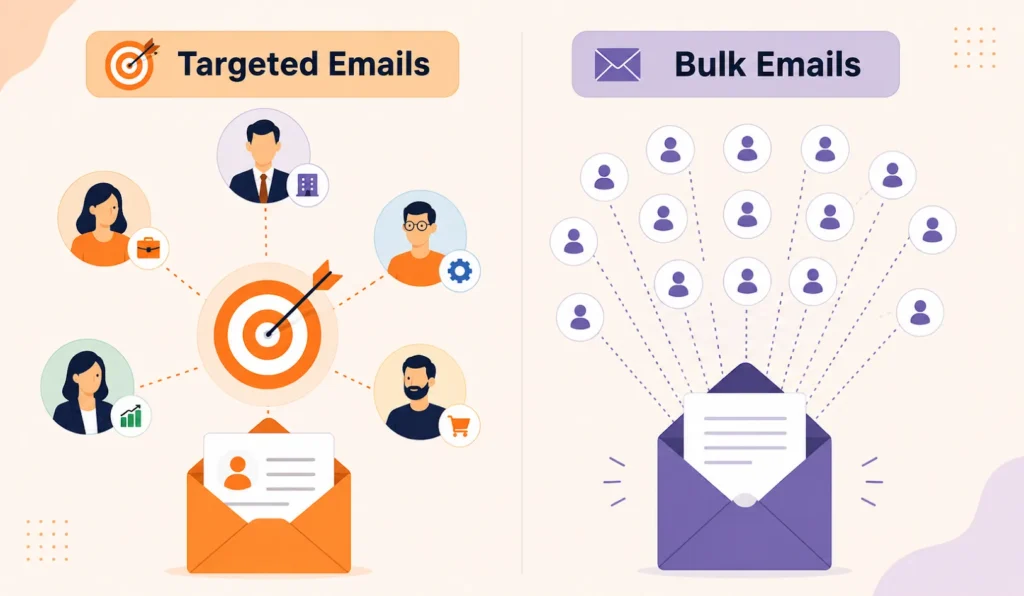
Targeted email marketing is about sending messages to a small, well-defined audience segment. Each message is tailored to the recipient’s role, industry, or buying cycle stage. This approach depends on accurate firmographic and behavioral data.
Personalized email marketing and targeted email marketing overlap heavily in practice. Both start from the same premise: fewer, better-matched recipients outperform a large, undifferentiated list. This is the foundation of any serious B2B email outreach strategy.
Personalized email marketing and targeted email marketing overlap heavily in practice. Both start from the same premise: fewer, better-matched recipients outperform a large, undifferentiated list. This is the foundation of any serious B2B email outreach strategy.
What is email marketing in bulk?
Bulk email marketing sends one message to a large and mostly unsegmented list. The goal is exposure. Mass emailing works on the assumption that volume alone will produce enough replies.
However, it pushes identical content to every contact without adjusting for context or intent. The personalized email vs bulk email divide starts right here, at the decision to segment.
However, it pushes identical content to every contact without adjusting for context or intent. The personalized email vs bulk email divide starts right here, at the decision to segment.
Examples of targeted email marketing campaigns
There are many different aspects to targeted email marketing, depending on what you're looking to achieve. Maybe you can email a limited number of high-value accounts, prospects when they've just announced funding, or email users when they interact with your product. What they have in common is that all campaigns are targeting with correct contact information.
Targeted email outreach vs bulk email outreach: Which strategy delivers more revenue?
Let's say two sales teams want to increase their revenue.
The first team emails a carefully targeted group of decision-makers 1,000 highly personalized emails.
The second team sends 25,000 cold emails with a little personalization to a much larger audience.
On the surface, the second seems to be the better option as it reaches a larger audience. However, when considering the numbers, the picture changes. Check here!
The first team emails a carefully targeted group of decision-makers 1,000 highly personalized emails.
The second team sends 25,000 cold emails with a little personalization to a much larger audience.
On the surface, the second seems to be the better option as it reaches a larger audience. However, when considering the numbers, the picture changes. Check here!
| Metric | ABM (1000 contacts) | High-Volume (25,000 contacts) |
|---|---|---|
| Open Rate | 65% (650 opens) | 40% (10,000 opens) |
| Reply Rate | 20% (200 replies) | 3% (750 replies) |
| Positive Reply Rate | 8% (80 positive replies) | 1% (250 positive replies) |
| Meetings Booke | 5% (50 meetings) | 0.5% (125 meetings) |
| Average Contract Value | $50,000 | $10,000 |
| Pipeline Generated | $2.5M | $1.25M |
| Close Rate | 25% | 5% |
| Deals Closed | 13 | 6 |
| Revenue Booked | $650K | $60K |
But if you are offering an expensive item or targeting a niche audience, then it is far better to send a few hundred targeted emails, rather than thousands of emails to a general audience.
Open Rate: 65% targeted vs 40% bulk
When email messages are sent at the right time, they're more likely to be opened. A message that is linked to a funding round or a change of leadership at the right time is the right message for the person. Bulk email has a generic subject and is therefore only relevant in an opportunistic way.
Reply Rate: 20% targeted vs 3% bulk
Opens show curiosity. Replies show fit. Targeted emails are built on a real signal, like a new hire in the exact role your product serves, so the offer already matches a need. Bulk email guesses at need instead of confirming it first.
Positive Reply Rate: 8% targeted vs 1% bulk
This is the widest gap in the data because a positive response needs timing as well as attention. Targeted lists screen out accounts not in-market before the first email goes out. Bulk lists bypass that filter and so a large percentage of replies are rejections or unsubscribes.
Meetings Booked: 5% targeted vs 0.5% bulk
Meetings follow directly from positive replies. Bulk still books more meetings in raw count, 125 versus 50, simply by emailing 25x more people. But targeted outreach books meetings at a 10x rate per contact reached.
Average Contract Size: Targeted $50,000 or Bulk $10,000
If your contacts are more likely to fit your ideal customer profile, larger deals become more prevalent. However, if you have lists targeting every business regardless of their size, you'll waste more time on prospects who were never going to contribute large amounts of revenue.
Close Rate: 25% targeted vs 5% bulk
Close rate reflects how much qualifying happened before the deal reached sales. Targeted accounts already match a confirmed signal, so the sales conversation starts from fit, not discovery. Bulk-sourced deals need more qualifying mid-cycle, and some fall out once the prospect turns out to be a bad fit.
Deals Closed: 13 targeted vs 6 bulk
Targeted closes more total deals from a list 25 times smaller. Roughly one deal per 77 emails sent, versus one per 4,167 for bulk. Every stage of the bulk funnel loses more contacts than the equivalent targeted stage, so bulk's early volume edge disappears by the time deals close.
Revenue Booked: $650K targeted vs $60K bulk
This is where every gap above compounds. Higher opens feed higher replies. Higher replies feed more meetings. More meetings lead to more revenue, with bigger deals and better close rates. Each of these gaps isn’t huge on its own, but when added up across nine funnel stages, targeted outreach generates almost 11x more revenue from a fraction of the contacts.
Deliverability rates compared
Deliverability infrastructure sets the ceiling for both strategies, but targeted and bulk sending hit that ceiling very differently. Bulk campaigns operate right at this ceiling since high-volume sending trips are the same signals mailbox providers use to flag spam, and inbox placement across marketing email sits around 83-85%.
Targeted sends stay well clear of it, since a shorter, verified list keeps complaint rates near 0.03-0.07%, well under Gmail and Yahoo's 0.3% blocklist threshold.
Targeted sends stay well clear of it, since a shorter, verified list keeps complaint rates near 0.03-0.07%, well under Gmail and Yahoo's 0.3% blocklist threshold.
Domain authentication: Targeted vs bulk
Both targeted and bulk strategies need SPF, DKIM, and DMARC configured properly before any sending starts.
A small and verified list stays fairly safe since fewer bounces then avoid domain-wide sender penalties entirely. Unverified bulk lists push spam-folder rates from 5-10% up to 34% percent per 2026 data.
A small and verified list stays fairly safe since fewer bounces then avoid domain-wide sender penalties entirely. Unverified bulk lists push spam-folder rates from 5-10% up to 34% percent per 2026 data.
Bounce rate: Under 2% targeted vs above it for bulk
Bounce rate is really a data quality metric. Targeted lists built from verified, firmographic-matched contacts bounce less because the underlying data is cleaner.
Bulk lists pulled from unverified or aging sources can be above the 2% threshold.
Bulk lists pulled from unverified or aging sources can be above the 2% threshold.
How to conduct targeted email marketing?
When I analyzed successful targeted email campaigns, I noticed one pattern almost every high-performing team shared. Their advantage was a better prospect database. Here are the exact strategies used to make these campaigns successful.
Build micro lists
Don't create one list called "Manufacturing CEOs" and send the same email to everyone.
Experienced teams don't.
They split that audience into much smaller groups.
Experienced teams don't.
They split that audience into much smaller groups.
- Companies that recently raised funding.
- Companies hiring SDRs.
- Companies expanding into new markets.
- Companies using a competitor.
One trend became obvious as I studied targeted email campaigns. Teams rarely struggled to find prospects. They struggled to keep those prospects reachable.
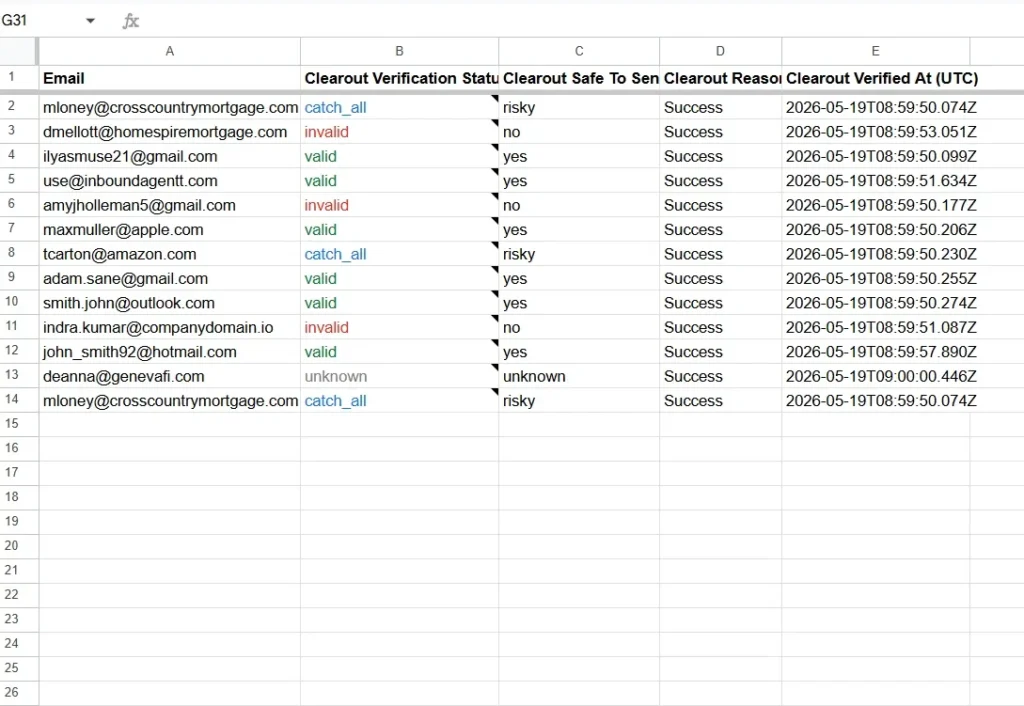
Contact data changes, but the impact shows up later through lower deliverability and fewer conversations. That's why experienced teams verify every list with Clearout Email Verifier before launching a campaign.
Never build a prospect list from a single source
A lot of people export contacts from LinkedIn or buy a database and call it a day.
Experienced teams cross-check every prospect before outreach. They compare LinkedIn, the company website, recent news, hiring activity, and verified contact details. If the information doesn't line up, that contact doesn't make the list.
The list becomes smaller, but the quality goes up dramatically.
Experienced teams cross-check every prospect before outreach. They compare LinkedIn, the company website, recent news, hiring activity, and verified contact details. If the information doesn't line up, that contact doesn't make the list.
The list becomes smaller, but the quality goes up dramatically.
Don't collect emails. Build a contact database
This is one habit that separates experienced outbound teams.
Before they get into your outreach sequence, you need to know their role, company, reporting level, LinkedIn profile information, phone number, and a verified work email.
Before they get into your outreach sequence, you need to know their role, company, reporting level, LinkedIn profile information, phone number, and a verified work email.
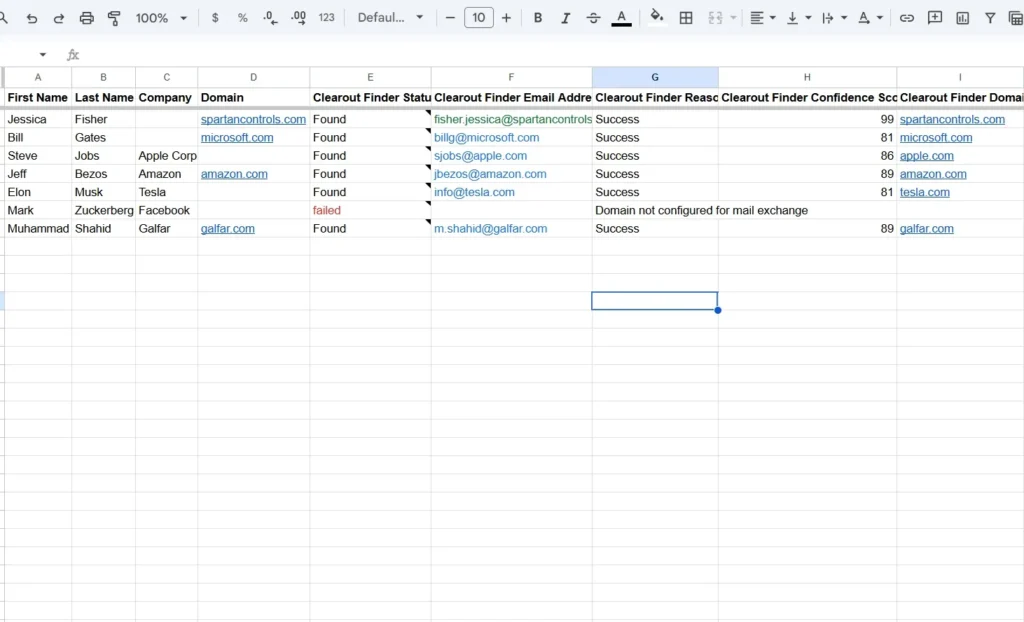
This is where tools such as Clearout Prospect and Email Finder come into play. Don't rely on data from multiple tools; create a verified contact database from the best ones. That's because they give you the information to segment, personalize, and reach every contact.
Remove people faster than you add them
Most people obsess over growing their database. Experienced teams obsess over shrinking it.
Every campaign tells you who no longer belongs on the list. People who changed jobs. Companies that don't fit anymore. Contacts that never engage.
Every campaign tells you who no longer belongs on the list. People who changed jobs. Companies that don't fit anymore. Contacts that never engage.
Protect your list after you've built it
Every new form submission, manual entry, or CRM import slowly introduces bad emails, invalid phone numbers, and incomplete records. Within a few months, your carefully segmented list starts losing accuracy.
That's why many RevOps teams now treat list maintenance as an ongoing process. Clearout Data Pulse automatically re-verifies email addresses, phone numbers, and names as contacts are created or updated in your CRM.
So, it keeps the CRM clean, and you can rely on the contact database completely since it is of high-quality.
That's why many RevOps teams now treat list maintenance as an ongoing process. Clearout Data Pulse automatically re-verifies email addresses, phone numbers, and names as contacts are created or updated in your CRM.
So, it keeps the CRM clean, and you can rely on the contact database completely since it is of high-quality.
When to use each strategy?
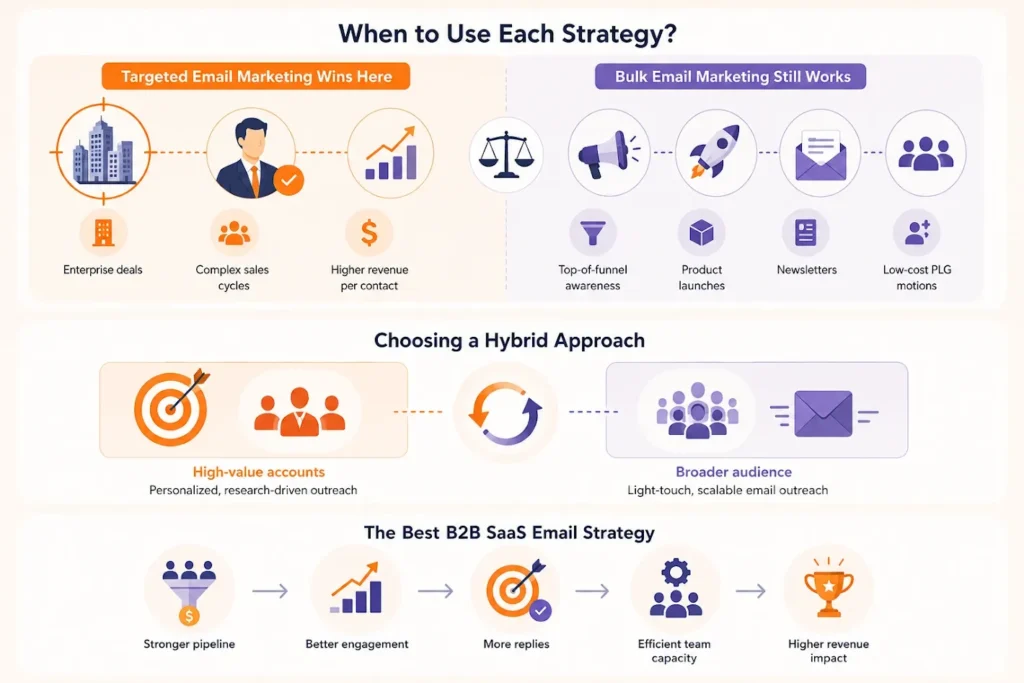
Choosing between targeted and bulk email is a strategy call. The right fit depends on your deal size, sales cycle, and funnel stage. Here's how to know which one to use and when.
1. Targeted email marketing wins here
- Enterprise deals: High contract value justifies the extra research and personalization per contact.
- Complex sales cycles: Multiple stakeholders need relevant, context-aware messaging to earn a reply.
- Named account outreach: ABM campaigns to specific target accounts perform best with a targeted approach.
2. Bulk email marketing still works
Top-of-funnel awareness campaigns can still use bulk email marketing effectively. Product launches aimed at an entire existing customer base fit this model. Newsletters and low-cost PLG motions rely on mass email marketing for reach.
3. Choosing a hybrid approach
Most mature B2B SaaS teams run both strategies at once. High-value accounts get personalized email campaigns with deep research behind each send. The broader list receives lighter-touch and scalable email outreach for awareness.
This mix is the strongest B2B SaaS email strategy available. It's also the best email outreach strategy for B2B SaaS companies balancing pipeline goals with team capacity.
This mix is the strongest B2B SaaS email strategy available. It's also the best email outreach strategy for B2B SaaS companies balancing pipeline goals with team capacity.
The verdict
Targeted email marketing always wins in terms of deliverability, opens, clicks and replies. Bulk email marketing still has a role for early awareness or top of funnel reach. But precision only works if your contact data is accurate since bad data breaks personalized email campaigns just as fast as bulk ones.
Hence, if you want to have an effective email marketing campaign, start with verified data. And you can do this with Clearout.
Hence, if you want to have an effective email marketing campaign, start with verified data. And you can do this with Clearout.
Ready to build a targeted lead list?
FAQs
1. How effective is B2B email marketing in 2026?
Yes, when the targeting is strong. Median B2B open rates are between 36.7% and 42.35%, median click-through rates are between 2% and 4%. The volume of sending is much less important for the performance of email campaigns than the quality of the lists and segmentation.
2. How can email marketing improve conversion rate?
To improve your email conversion rates, segment contacts by role, industry, and buying stage before sending. Personalize each message around a specific, relevant detail. Moreover, verify every email address before it enters a sequence, since bad data suppresses replies. Clearout's Email Verifier runs that check automatically, before each email goes out.
3. What is the difference between a batch and a segmented email campaign?
Batch sends, also called mass email campaigns, push one message to an entire list without differentiation. However, a segmented campaign splits contacts by firmographic, behavioral, or lifecycle signals first. Each segment then receives messaging matched to its specific context.