
clearout
  • Products
    • Email Verifier Verify emails addresses individually, in bulk or through API, with 99% accuracy
    • Email Finder Find individual or bulk emails by entering the person & company name or domain
    • Form Guard IconForm Guard Protect your forms from spam, bots, and invalid submissions with real-time email, phone, and name verification.
    • Form Guard IconData Pulse Verify, enrich, and monitor your CRM contacts in real time - heartbeat monitor for your data.
    • Prospect SQL/MQL list building with high levels of personalization, real-time data enrichment and prospect search
    • Clearout For SheetsVerify email addresses directly on Google Sheets with Clearout for sheets add-on
    • Prospect – LinkedIn Chrome ExtensionBuild verified, targeted prospect lists directly from LinkedIn profiles
    • ClearoutPhoneValidate phone numbers across 240+ countries in bulk, quick or real time validation
    • Free Tools
    • Disposable Email Checker
    • Reverse LinkedIn Profile Lookup Tool
    • Reverse Email Lookup Tool
    • Email List Cleaner
    • Company Domain Finder API
  • Resources
      DEVELOPERAPI iconAPI
      Clearout APIs are structured around REST and JSON
      Webhooks iconWebhooks
      Capture real-time events in your application workflow
      Form Guard iconForm Guard
      Real-time form validation to keep bad contacts out of your CRM
      KNOWLEDGE BASEGetting started iconGetting started
      Sending campaigns without bounces is made simple
      FAQ iconFAQ
      Easily find answers to services, security and common questions
      USE CASESLead Generation iconLead Generation
      Learn how professionals generate quality leads
      GUIDESPricing arrow iconTransparent & flexible pricing to support pay-per-use or recurringCompare Email Verification Tools arrow iconAI-powered email verification with 99%+ accuracy, real-time validation, and transparent risk scoringCompare Email Finder Tools arrow iconPre-verified B2B email addresses with confidence scoring, find real person email, not role-based addressBLOGSEmail Verification ToolsFind Anyone’s Email Address
      Most Accurate, Fast & Free Ways
      Form Validation
      Importance, Ways & Best Practices
      View All Blogs
  • Pricing
  • Integrations
  • Enterprise
  • Login
Try it free Book a 1-to-1 demo
Priyanshi Sharma / July 1, 2026 July 1, 2026

GTM Trends 2026: 7 Shifts Shaping B2B Go-to-Market


GTM Trends 2026: 7 Shifts Shaping B2B Go-to-Market

Sales teams have more AI tools than ever, yet the results haven't changed as much as many expected. Around 84% of sales reps missed quota last year, and reps still spend only 30% of their time actually selling. That number has barely improved over the last few years.

The problem is how revenue teams use it. In 2026, winning teams aren't chasing every new AI tool. They're building smarter GTM processes that help sales, marketing, and RevOps work better together.

In this guide, we'll look at the GTM trends shaping 2026 and the practical changes leading teams are making, starting with one shift in prospecting that many businesses still overlook.

Table of Content


‣ Trend 1: Micro-campaigns replace list building as the primary outbound motion
‣ Trend 2: Content-led prospecting replaces cold outreach as the first touch
‣ Trend 3: Vertical AI wins where horizontal AI failed
‣ Trend 4: GTM knowledge graphs become the operating layer for AI
‣ Trend 5: RevOps shifts from tool adoption to workflow redesign
‣ Trend 6: AI is evaluated on revenue
‣ Trend 7: Connection depth replaces attention volume as the GTM goal
‣ The data quality thread running through every 2026 GTM trend
‣ FAQs
Trend 1: Micro-campaigns replace list building as the primary outbound motion


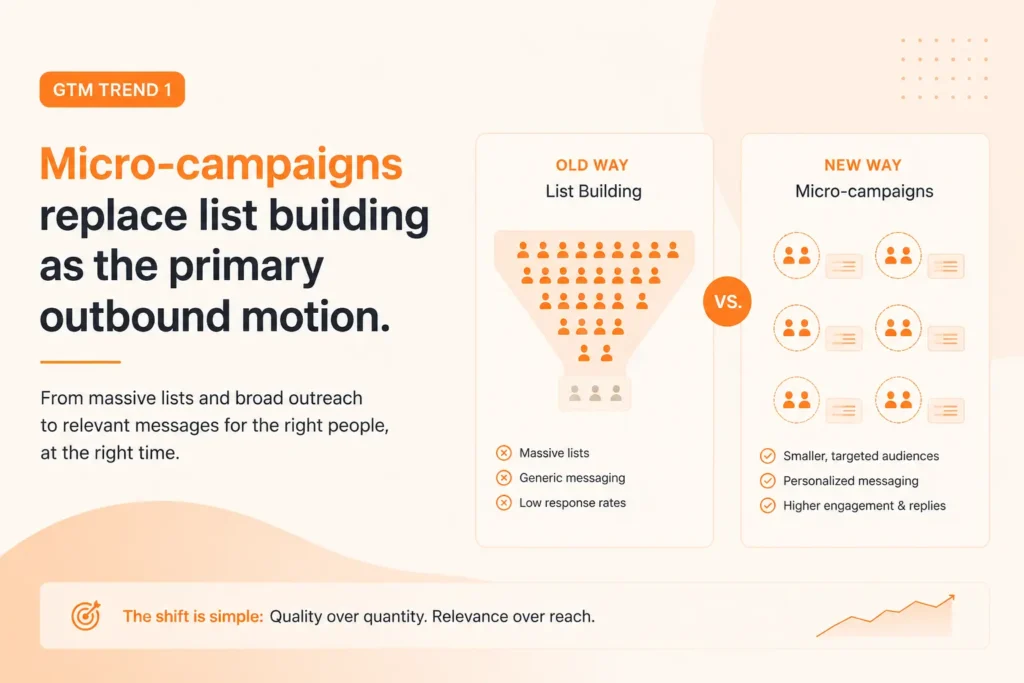
A GTM trend showing micro-campaigns replaces a volume list building.

This is the most significant shift in B2B GTM trends of 2026, and most teams are still running the old playbook.

The old way of list building is evolving fast. You would build a large static list of several thousand contacts, segment it broadly by industry or company size, and run the same sequence to everyone on it. That approach is producing diminishing returns across every metric that matters.

The new motion is micro-campaigns. Small, highly targeted lists of 50 to 250 contacts built using very specific filtering and AI-generated signals. Each list is relevant this week. It will not be relevant next month. The moment the signal that triggered the list changes, the list is replaced.

What makes a micro-campaign different from a regular campaign?


Old list buildingMicro-campaigns
2,000 to 10,000 contacts per campaign50 to 250 contacts per campaign
Built on static firmographic filtersBuilt on live signals: hiring patterns, funding rounds, job changes, tech stack shifts
Relevant for 3 to 6 monthsRelevant for days to weeks
Same sequence for every contactHighly specific messaging tied to the triggering signal
Verified once before importVerified before every send

The signals that power micro-campaigns in 2026:

  • A company just posted 5 SDR roles.
  • A decision-maker changed job last week.
  • A competitor just shut down a product line.
  • A target account just raised a Series B.
  • An executive just published a post about a specific pain point.

One thing we've noticed is that the best outbound teams don't rush to contact someone the minute a buying signal appears. If a company announces funding on Monday morning, hundreds of sales emails hit their inbox by lunch. Instead, they wait for 24-48 hours, then reach out with a message that connects the news to the prospect's business.

Why do micro-campaigns break without clean data?


A micro-campaign with 80 contacts can't stand any bad data. A bounce rate of 15% over 5,000 contacts is definitely painful but not too bad to endure. With 80 contacts on a list, 12 of them will bounce before the first contact reads an email.

Therefore, every contact on a micro-campaign list needs to be verified before the sequence fires. Not after the first send. Before.

This means email verification is no longer a pre-campaign hygiene step run quarterly. It is a per-list requirement run every time a new micro-campaign list is generated.

The CRM hygiene problem micro-campaigns expose:

Micro-campaigns also expose a CRM problem most teams have been ignoring. When you pull 80 contacts from your CRM for a specific signal-based campaign, you discover immediately how many of those contacts have decayed email addresses, missing phone numbers, and outdated job titles.

A CRM that is cleaned quarterly cannot support a motion that generates new targeted lists weekly. CRM hygiene has to become continuous.

How to make micro-campaigns work?


Run every micro-campaign list through email verification before any sequence is enrolled. Remove invalid, disposable, and catch-all addresses before the first email fires. Verify that contacts pulled from your CRM are still at the company and still reachable. Flag catch-all addresses separately and treat them with lower send volume until deliverability is confirmed.

The three-step process that protects micro-campaign deliverability:

  1. Generate the list using your signal of choice
  2. Run every contact through email verification before sequence enrollment
  3. Remove invalid and risky addresses and start the campaign only on verified contacts

Clearout's Email Verifier runs 20 or more checks per address including MX record lookup, SMTP mailbox ping, syntax validation, disposable address detection, and catch-all scoring. Results come back in minutes. A verified list of 80 contacts takes under 2 minutes to process.

For CRM hygiene, running a verification pass on your full contact database every 90 days prevents micro-campaign lists from pulling stale contacts. B2B email addresses decay at 22.5% per year. A CRM that has not been verified in 6 months has a meaningful percentage of contacts that will bounce the moment they enter a sequence.

Verify your email list before the next micro-campaign


Try Clearout Free
No card required

Trend 2: Content-led prospecting replaces cold outreach as the first touch


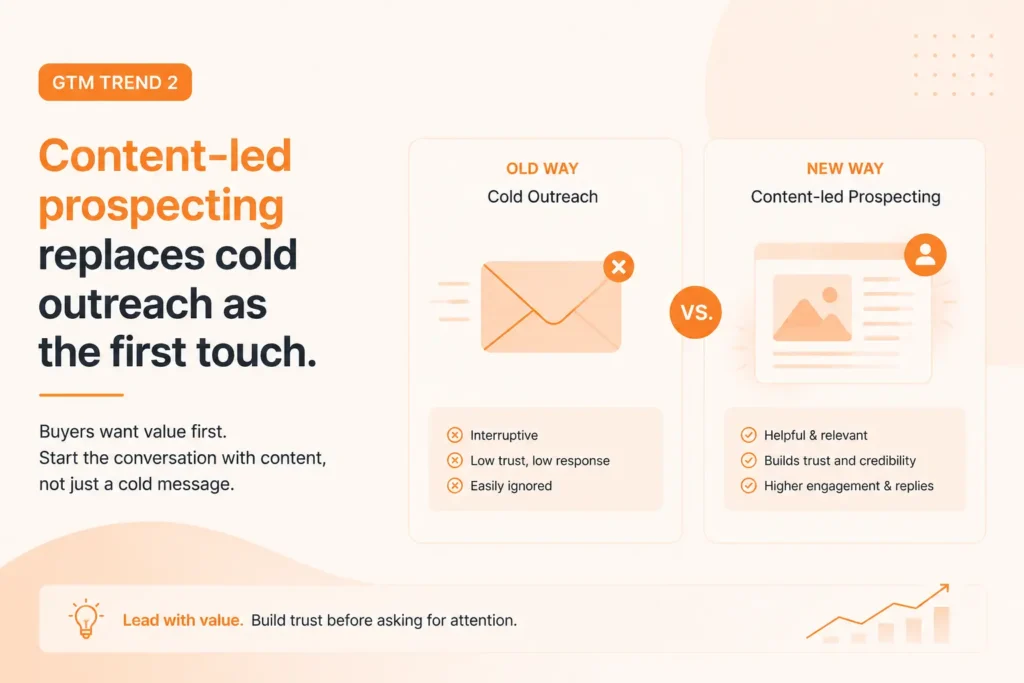
 A GTM trend showing content-led prospecting replacing cold outreach.

One go-to-market strategy that's becoming the new normal is content-led prospecting.

Content-led prospecting focuses on content that your prospects interact with as the trigger and context for your outreach, instead of content and prospecting being two distinct tasks.

What does content-led prospecting look like?


A prospect engages with your LinkedIn post about a specific problem. That engagement triggers an outreach sequence referencing the post. A prospect downloads a guide from your website. The follow-up sequence addresses the specific problem the guide covered rather than sending a generic demo request.

Content becomes the intelligence layer. Engagement becomes the signal. Outreach becomes a relevant response to demonstrated interest rather than an interruption.

Why is this shift happening now?


Buyers have changed how they research. In 2026, a large part of the B2B pipeline is affected prior to a buyer's visit to any channel a vendor owns. They're reading newsletters, joining communities, watching YouTube, getting recommendations from AI systems, and reading Reddit threads.

Opinions have already been formed by the time a buyer requests a demo or a contact form is completed. Shortlists have already taken shape. The teams that are present earlier in that research process, through content that gets consumed in third-party environments, are being considered before the teams that wait for inbound signals.

The three layers of content-led prospecting:


Contacts with prior engagement, at least one open or click in the last 6-12 months.

Layer 1: Content as entry point


Producing content for the formats and platforms where your buyers research. All of those LinkedIn long-form posts, technical guides, or community engagement on Reddit, posts that appear for problem-aware searches on YouTube, work as entry point content.

Layer 2: Engagement as signal


Knowing your audience and acting on the signal of engagement as a buyer signal. A person who has read your 3-part series on a problem is more qualified than a person who has had a single visit to your homepage.

Layer 3: Outreach as context-aware response


Using content engagement as the opening context for outreach. The sequence references what the prospect engaged with and positions your product as the next logical step.

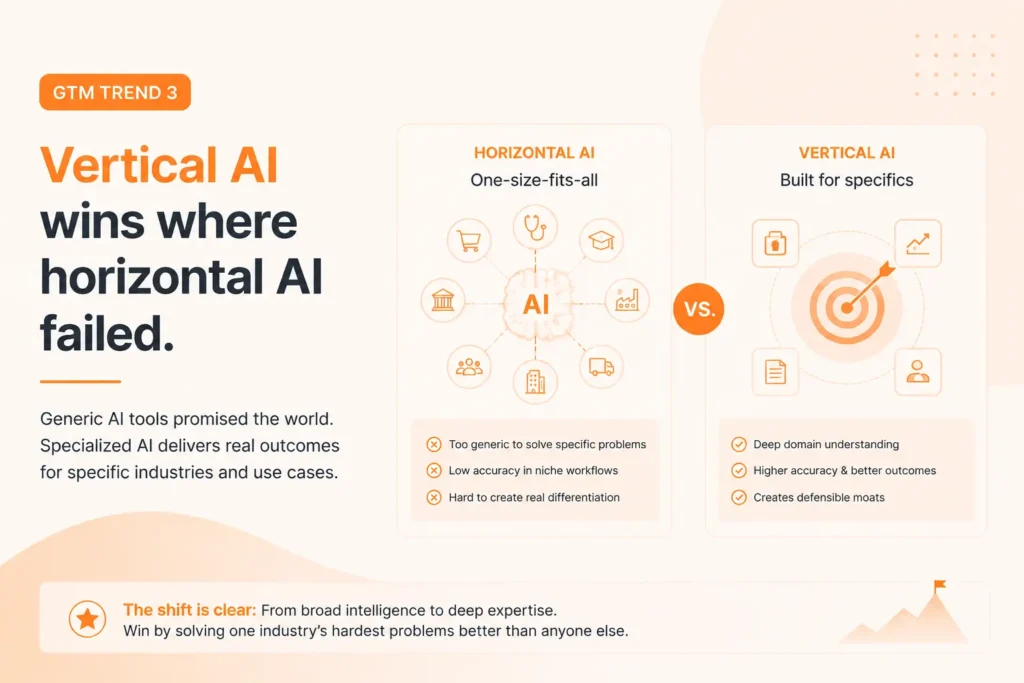
Trend 3: Vertical AI wins where horizontal AI failed


A GTM trend showing vertical AI wins.

For years, companies adopted general-purpose AI copilots, believing a single broad AI layer could handle every GTM function. Teams ended up maintaining context manually, writing and rewriting prompts, and hard-coding workflows.

The GTM automation trends pointing toward 2026 show a clear correction. Teams are shifting from horizontal build-it-yourself AI toward vertical purpose-built AI solutions. This helps to encode domain-specific context by default and ships with pre-built GTM workflows.

Why did horizontal AI produce limited GTM results?


Every time a strategy changed, messaging was updated, or a new competitor emerged, teams had to manually update context across every tool. Mistakes were made in front of buyers through outdated content in deal rooms, incorrect answers on calls, and poor messaging in follow-up emails.

The shift in practice:

Horizontal AI approachVertical AI approach
You maintain all context manuallyDomain context encoded by default
Prompts require constant maintenancePre-built opinionated workflows ship ready
Mistakes surface in front of buyersGuardrails built for the function
No measurement of knowledge impactUsage tied directly to outcomes

By the end of 2026, the question will no longer be "can we build this ourselves on top of a general-purpose model?" It will become "why are we rebuilding something that already exists when our time would be better spent strengthening our GTM motions?"

Trend 4: GTM knowledge graphs become the operating layer for AI


A GTM trend showing GTM knowledge graphs as an operating layer.

This is the go-to-market innovation conversation that is dominating serious GTM discussions in 2026.

Every AI agent deployed across a GTM stack needs to understand how the company actually sells. What you sell and why you win. Who you sell to. What matters in a deal. How success is measured. Right now, that knowledge is fragmented across decks, playbooks, slide files, and people's heads.

The structural problem:

Each AI tool builds its own partial understanding of your GTM reality from whatever context you manually upload. Those inputs become outdated quickly. The result is GTM context scattered across manually maintained clusters that no single system can query reliably. When teams use AI to assist reps or power agentic workflows, the AI defaults to what everyone else does because it lacks your specific company context.

Why is the CRM data model the right starting point?


A company's CRM data model is the closest documented version of how it actually sells. Fields, objects, and relationships encode products, stages, competitors, metrics, and sales motions.

Changes in the business, new competitors, new processes, etc., almost reflect changes in the CRM first.

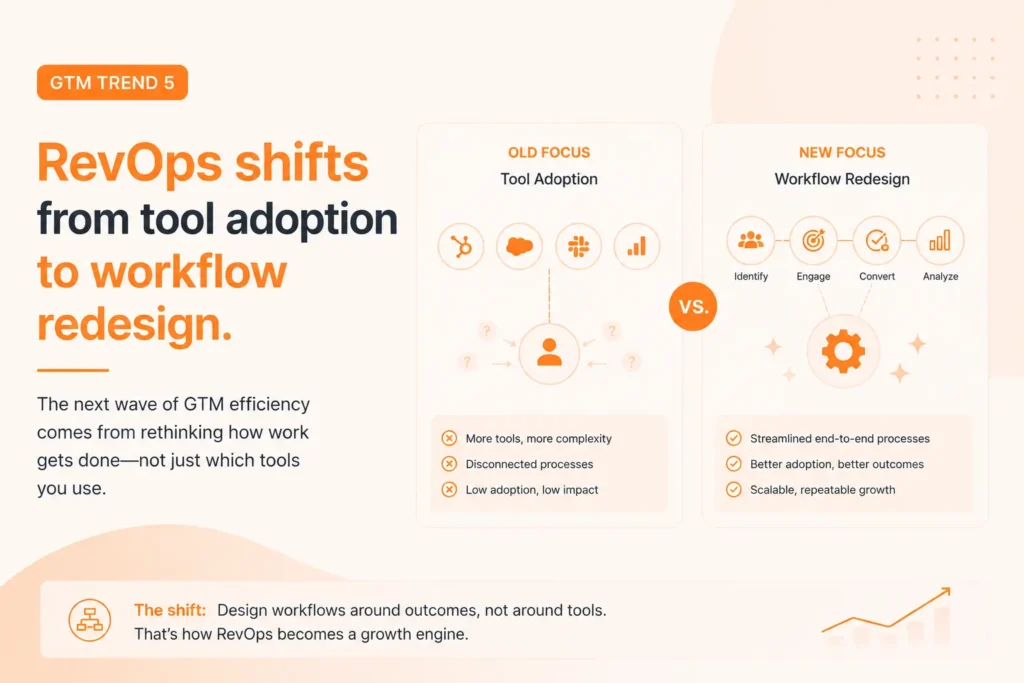
Trend 5: RevOps shifts from tool adoption to workflow redesign


 A GTM trend showing RevOps shifts to workflow redesign.

The most important RevOps shift in 2026 go-to-market trends is about whether the processes underneath tools are worth automating at all.

Today, many are moving orchestration outside the CRM using platforms like n8n, Temporal, or custom event pipelines. That makes it much easier to plug in AI models, swap vendors, and change workflows without rebuilding the entire revenue stack every time a tool changes.

Where does this show up?


Teams have found that the tech stack they have built up over the years using point solutions isn't flexible enough for the processes they require for the AI-enabled future. Rather it creates a new generation of custom solutions and integrated platforms instead of tool-based solutions.

The most successful teams took time to redesign processes from scratch with AI capabilities in mind before deploying AI on top of them.

They are now building around business events instead. A funding round, a pricing page visit, a support ticket, or a product usage spike can trigger enrichment, lead scoring, routing, and outreach instantly. The CRM becomes the system of record.

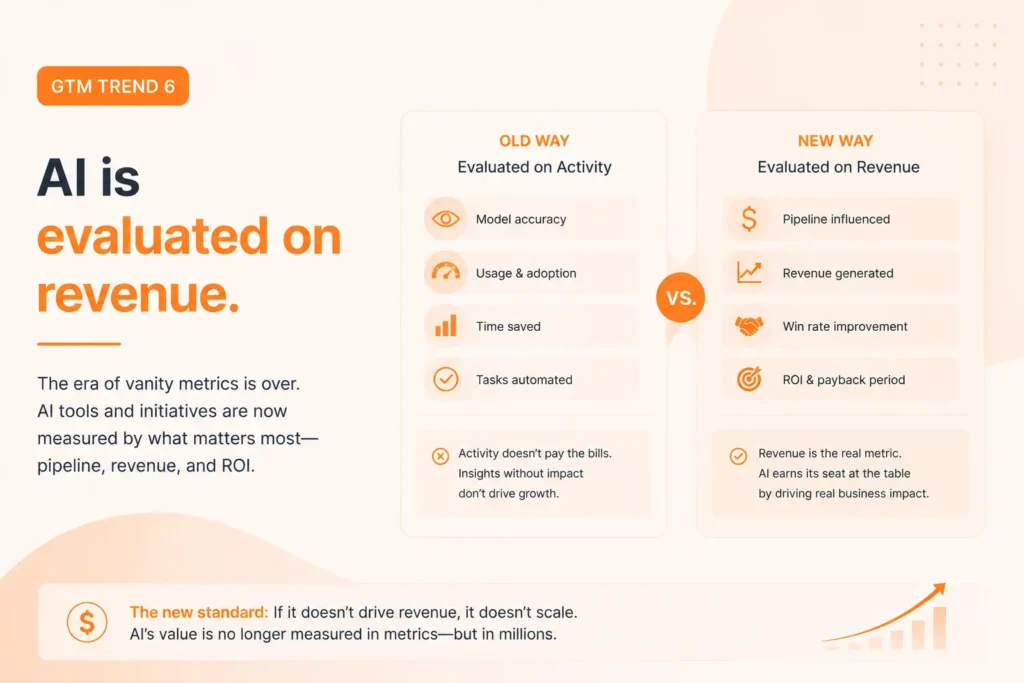
Trend 6: AI is evaluated on revenue


 A GTM trend showing that AI is evaluated on revenue.

This is one of the most consequential B2B GTM trends of 2026. Boards and CFOs are asking a single question: where is the revenue that AI was supposed to generate?

After years of pilot programmes and capability demonstrations, GTM AI initiatives are now evaluated on measurable pipeline impact. Companies that cannot demonstrate return on investment are losing budget regardless of how sophisticated their AI stack looks.

Why AI underdelivers?


AI fails because of inputs. The most sophisticated algorithm cannot produce reliable GTM outputs when fed invalid contacts, stale firmographic data, and unresolved account hierarchies. For GTM teams, the quality of the underlying data infrastructure directly determines whether AI produces a competitive advantage or an expensive distraction.

What does AI require to produce measurable GTM results?


Accurate and current contact data to prioritise accounts reliably. Resolved contacts, roles, and hierarchies to route leads correctly. Trusted intent signals attached to verified identities. Organisational context that reflects how the company actually sells rather than generic industry patterns.

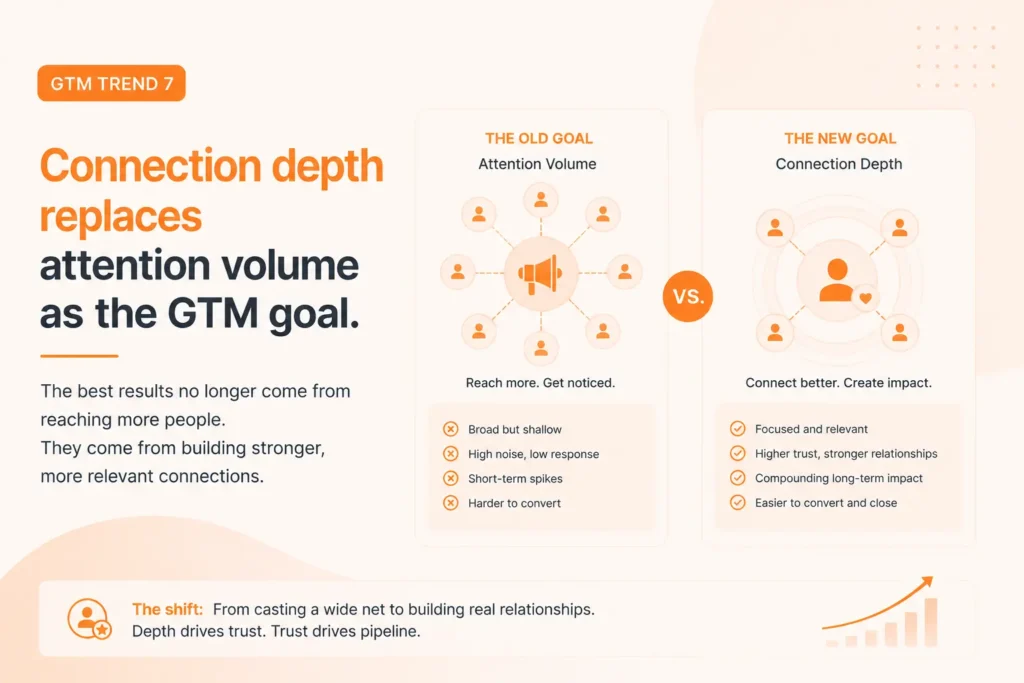
Trend 7: Connection depth replaces attention volume as the GTM goal


A GTM trend showing connection depth replaces attention volume.

Attention alone is no longer a growth strategy. AI content creation and outreach flood buyers with content on all channels at once.

The value of GTM does not exist anymore when someone shows up at some event or completes a form. It is made when groups have an understanding of why they did it, what it means about their intention, and what they will do about it, which will make the buyer feel that their time was well spent.

The change from volume metrics to intent signals:

Volume metricIntent signal replacing it
Event attendanceDepth of engagement during the event
Form fillsReturn visits and related content exploration
MQL countPeer involvement and high-intent follow-on actions
Email opensReplies and specific link interactions

The data quality thread running through every 2026 GTM trend


Every trend on this list shares one structural dependency. Each one requires verified and accurate contact data to function at the level it promises.

The entry points where bad data corrupts GTM motions:

  • Free trial and freemium signups bring in disposable emails and fake phone numbers.
  • Paid acquisition landing pages receive mistyped addresses and bot form submissions.
  • Third-party list imports contain contacts that have decayed since the data was sourced.
  • Webinar registrations attract throwaway emails used to access gated content without committing to follow-up.

Clearout across the full GTM data layer:

Clearout Email Verifier removes invalid, disposable, catch-all, and risky addresses before they enter any outreach sequence or micro-campaign list. Bounce rates drop and every campaign fires on contacts that actually exist.

Clearout Email Finder returns verified business emails from names and domains with a confidence score per result. Prospecting lists for micro-campaigns start clean. So, SDR spends less time on manually hunting email formats.

Form Guard validates email, phone, and name at the point of form submission before a contact is ever created. Bot submissions, disposable addresses, fake phone numbers, and gibberish names are blocked at entry. The CRM only receives contacts that passed validation from the moment they arrived.

The go-to-market teams that get exceptional results are the ones whose AI workflows, outreach sequences, and attribution models are all built on verified data. High quality lead inputs produce reliable outputs.

Try Clearout Free
No card required

FAQs


1. What are the GTM trends in 2026?
Go-to-market is changing faster than ever. Instead of chasing huge lead lists, companies are spending more time finding the right prospects and reaching out when they're actually ready to buy. AI is helping teams work faster, but it still needs clean and accurate data to make good decisions. The businesses getting the best results are the ones combining smarter outreach with better data.
2. What are some GTM trend examples?
A good example is reaching out to companies right after they announce funding or start hiring instead of emailing random prospects. Many sales teams are also using LinkedIn engagement, website visits, and content downloads to decide who to contact first. Another big shift is using AI built for sales instead of relying on general AI tools. These small changes help teams get more replies without sending more emails.
3. What does GTM mean in marketing?
GTM stands for go-to-market. Simply put, it's the plan you follow to get your product in front of the right people and turn them into customers. It covers everything from choosing your audience to deciding how you'll market, sell, and support your product. A clear GTM strategy keeps sales and marketing moving in the same direction.
4. What are the five pillars of a GTM strategy?
Every GTM strategy starts with knowing who you want to sell to and what problem you're solving. Then comes choosing the right channels, setting the right pricing, and having a plan to win and keep customers. If one of these pieces is weak, your strategy won't perform as expected. That's why many companies now treat data quality as an important part of their GTM foundation too.
5. What are the top marketing trends in 2026?
Marketers are focusing less on getting more traffic and more on attracting the right buyers. AI is helping create better content, personalization is becoming more important, and AEO is helping brands appear in AI search results. Businesses are also paying closer attention to buying signals instead of vanity metrics like impressions and open rates. The goal is simple: better conversations that lead to more revenue.

Share this article

Recent Posts

01 Jul 2026
GTM Trends 2026: 7 Shifts Shaping B2B Go-to-Market

Explore the top Go-To-Market trends for 2026, including micro-campaigns, vertical AI, content-led pr ...

25 Jun 2026
The Pre-Send Email Verification Checklist Clearout Recommends

Follow this Clearout’s pre-send email verification checklist to clean email lists, reduce bounces, p ...

24 Jun 2026
How to Remove Invalid Emails from Klaviyo (Step-by-Step)

Learn how to find, verify, and suppress invalid email addresses in Klaviyo using Clearout. A 5-step ...

22 Jun 2026
How To Find Email Addresses In Google Sheets

Learn how to find email addresses in Google Sheets using Clearout. Step-by-step guide to find pre-ve ...

19 Jun 2026
Best Bot Protection Platforms for Forms, APIs & Apps in 2026

Compare the best bot protection platforms for forms, APIs, and apps. Explore features, pricing, and ...

Clearout's

Form Guard

Validate email, phone & name on any forms!

  • Real signups only
  • Verified emails
  • Valid phone numbers
  • No fake names
  • Cleaner CRM
  • No devs needed
Try for Free Now

Email Verification, Email Finding Form Guard & Prospecting Service

Expand Your Reach By Finding & Verifying Ideal Prospects.

Sign up & get 100 free credits

No Credit Card required

Create Free Account
Company

Why Clearout?

Pricing

Contact Us

Careers

Press

Enterprise

Sitemap

FAQ

Status

Products

Email Verifier

Email Finder

Form Guard

Data Pulse

Prospect

LinkedIn Email Finder

Reverse Lookup

Google Sheets Add-on

WordPress Plugin

ClearoutPhone

What's New?

Resources

Integrations

HubSpot

Team Account

API

Compare Email Verifier

Compare Email Finder

Compare Prospecting

Use Cases

Blog

Help

Legal

Privacy Policy

Terms

DPA

Security

Trust Center

Certification

ISO 27001/2022

SOC 2 Type 2

GDPR

Partnership

HubSpot Certified

Affiliates

Partners

Clearout for browser

⚡ Supercharge Your Prospect Research with Clearout's LinkedIn Chrome Extension - Find and Verify Emails with Confidence!

Clearout Chrome extension

clearout
© 2026 Clearout Inc. All Rights Reserved. Powered by Clearout.
Keep HubSpot data clean on autopilot — validate, enrich, and sync contacts in real time with Data Pulse. Learn More ➞
X