clearout
  • Products
    • Email Verifier Verify emails addresses individually, in bulk or through API, with 99% accuracy
    • Catch-all Email Verification IconCatch-all Email Verification Resolve more catch-all and SEG-protected emails into Valid or Invalid results with Deep Verify.
    • Email Finder Find individual or bulk emails by entering the person & company name or domain
    • Form Guard IconForm Guard Protect your forms from spam, bots, and invalid submissions with real-time email, phone, and name verification.
    • Form Guard IconData Pulse Verify, enrich, and monitor your CRM contacts in real time - heartbeat monitor for your data.
    • ProspectSQL/MQL list building with high levels of personalization, real-time data enrichment and prospect search
    • Clearout For SheetsVerify email addresses directly on Google Sheets with Clearout for sheets add-on
    • Prospect – LinkedIn Chrome ExtensionBuild verified, targeted prospect lists directly from LinkedIn profiles
    • ClearoutPhoneValidate phone numbers across 240+ countries in bulk, quick or real time validation
    • Free Tools
    • Disposable Email Checker
    • Reverse LinkedIn Profile Lookup Tool
    • Reverse Email Lookup Tool
    • Email List Cleaner
    • Company Domain Finder API
  • Resources
      DEVELOPERAPI iconAPI
      Clearout APIs are structured around REST and JSON
      Webhooks iconWebhooks
      Capture real-time events in your application workflow
      Form Guard iconForm Guard
      Real-time form validation to keep bad contacts out of your CRM
      KNOWLEDGE BASEGetting started iconGetting started
      Sending campaigns without bounces is made simple
      FAQ iconFAQ
      Easily find answers to services, security and common questions
      USE CASESLead Generation iconLead Generation
      Learn how professionals generate quality leads
      GUIDESPricing arrow iconTransparent & flexible pricing to support pay-per-use or recurringCompare Email Verification Tools arrow iconAI-powered email verification with 99%+ accuracy, real-time validation, and transparent risk scoringCompare Email Finder Tools arrow iconPre-verified B2B email addresses with confidence scoring, find real person email, not role-based addressData Pulse & HubSpot Breeze Intelligence arrow iconPre-verified B2B email addresses with confidence scoring, find real person email, not role-based addressBLOGSEmail Verification ToolsFind Anyone’s Email Address
      Most Accurate, Fast & Free Ways
      Form Validation
      Importance, Ways & Best Practices
      View All Blogs
  • Pricing
  • Integrations
  • Enterprise
  • Login
Try it free Book a 1-to-1 demo
Akanksha Mishra / October 21, 2026 October 21, 2026

B2B Intent Data: How to Use It for Cold Outreach in 7 Steps


B2B Intent Data: How to Use It for Cold Outreach in 7 Steps

TL;DR


  • Intent data shows when a person or company is searching online for something they might want to buy.
  • First-party intent data is information that comes from your website and content. Third-party data is data taken from other websites.
  • With sales prospecting software, you can identify the right people at those companies, including their email addresses.
  • Do some research and pick a focus point to talk to the customers as per intent data.

Table Of Content


‣ TL;DR
‣ What does intent data mean in B2B sales?
‣ How does B2B intent data work?
‣ Why do B2B sales teams need intent data?
‣ 4 ways sales and marketing teams use intent data to prioritize accounts
‣ How to use intent data for cold outreach
‣ Challenges of using intent data for sales
‣ Intent Data Finds the Account. Clearout Helps You Reach the Right Person.
‣ FAQ
In B2B sales, for example, sales teams typically have an idea of which firms would be ideal for them. The real challenge is determining which accounts to reach out to first.

Teams use intent data to prioritize accounts based on their research activity and 83% of ABM programs say they're using it to create target account lists.

The next step is to understand how to use those signals to decide what to say when reaching out to these accounts.

Throughout this guide, we'll use Lumora, a fictional 250-person SaaS company, to show how you can turn an intent signal into a relevant cold email.

What does intent data mean in B2B sales?


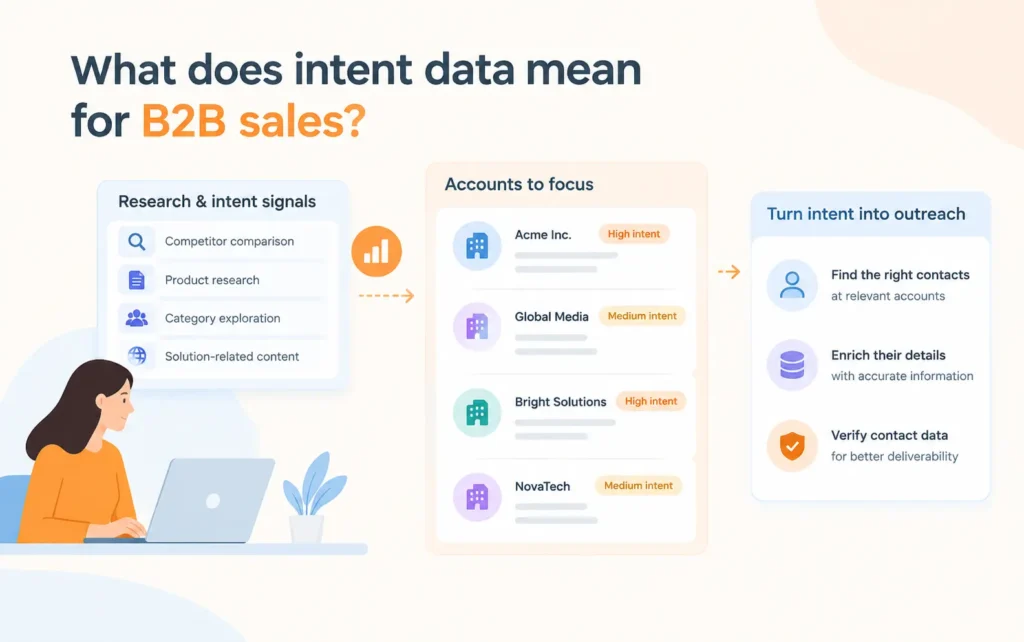
B2B intent data signals helping prioritize accounts for outreach

  • Third-party intent data


  • Third-party intent data is information derived from research activities on other digital properties. It may consist of activities on publisher networks, websites, and software review sites, depending on the provider.

  • Derived intent data


  • Derived intent data looks at different activities to find what a company wants to learn about. Providers rely on these patterns to see if a company is researching a topic. This offers sales teams greater insight than a visit to a website or downloading a piece of content.

  • Guided intent data


  • Effective topic intent data can assist teams in narrowing in on subjects that match a buyer's research. For instance, previous sales can show which subjects are worth discussing with prospects.

How does B2B intent data work?


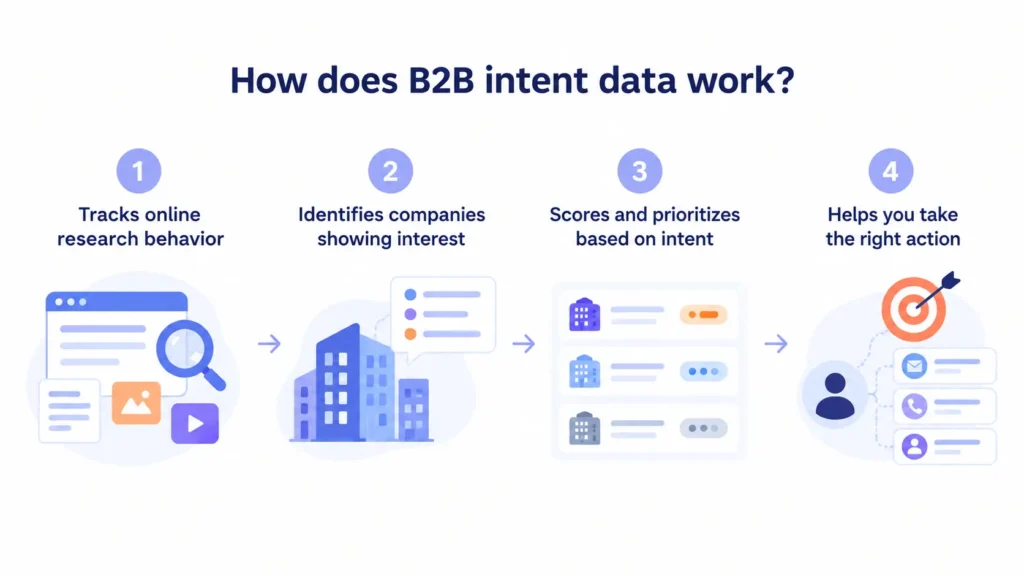
B2B intent data workflow from research to action

Intent data tracks what people at a company read, search for, and compare online. Providers group this activity by topic and link it to the company, showing you which companies are interested in what.

The majority of B2B buyer intent signals are generated on:

  • Website activity: Site visits of relevant pages or resources.
  • Content engagement: Interactions with articles, reports, webinars and downloads.
  • Search behavior: Search which is product, category or business problem related.
  • Review-site activity: Visits to software review and comparison websites.

The types of signals available vary by provider, so teams should focus on sources that are relevant to their sales process.

What are account-level intent signals?


Account-level intent signals are linked to a company rather than an individual buyer.

In essence, a signal shows that a company is investing more time and money into email verification research. This does not necessarily give you the answer to which employee is involved, or if the company has an active buying project.

This is a vital thing to remember as you go from research to prospecting.

Why do B2B sales teams need intent data?


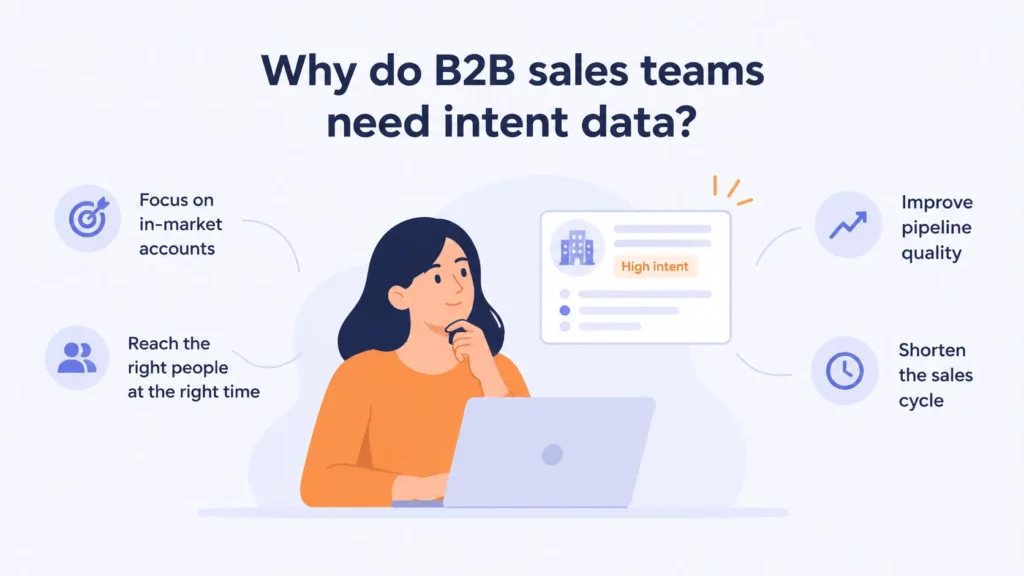
How B2B sales teams use intent data to prioritize accounts.

There are thousands of possible accounts that you can begin targeting within your ICP. Intent signals provide even more prioritization by indicating which accounts are currently interested in topics that are related to your product. That can then be used by teams to understand which prospects to investigate and reach out to first, based on data in ICP fit as well as other account information gathered.

How to use intent data for lead generation?


For B2B lead generation, monitor research of articles related to your product and compile a list of companies that match your ICP, locate the right contacts in these companies, and filter out invalid emails before sending.

Assume, for instance, that you're a data-quality software vendor. Monitoring research in email verification, lead validation and CRM data quality would be helpful. If a company is interested in these topics, see if the company fits your ICP as well before reaching out.

If you're a good fit for the company's ICP, seek further context. Are they starting to hire SDRs, grow their outbound lineup, or switch their CRM? The evolution of this may pose data quality issues.

Now determine who is responsible for that problem. Depending on the company, this can be someone in the RevOps or Marketing Ops team. First, you can use the Clearout prospecting tool to conduct some research on companies and job titles, and check emails before contacting.

What they're reading also tells you how to start the conversation. If they're going through basic guides on bounce rates, they're still early. Send them something helpful. If they're comparing tools on review sites, they're further along, and it's fine to be more direct.

Find the Right Contacts with Clearout

How does intent data help sales teams prioritize accounts?


Sales teams can combine intent signals with account-level information to decide which prospects deserve attention first:

FactorWhat to check
ICP fitDoes the company match your target market?
Topic relevanceIs the activity connected to your solution?
RecencyHow recent is the activity?
Signal strengthIs there meaningful or repeated activity around the topic?
Account contextDoes the account have a relevant business problem or use case?

4 ways sales and marketing teams use intent data to prioritize accounts


Even a list of companies that match your ICP might be too big for a sales team to work through efficiently. Intent data gives teams another way to narrow down that list, especially when combined with the account and prospect data they already use.

Here are 4 practical ways sales and marketing teams can use it.

1. ICP match, then intent


Intent should not be the only reason an account moves up the list. First check whether the company fits your ICP, then look at whether its recent activity is relevant to what you sell.

For example, a SaaS company that matches your target market and is researching a problem your product solves is worth investigating. A company outside your target market showing the same activity probably is not.

This keeps the sales team from chasing every account that happens to show an intent signal.

2. Look for accounts showing a change in activity


A sudden increase in activity can give sales reps a reason to take a closer look at an account. Check what changed, whether the activity is relevant to your offering, and whether the account still matches your ICP. This helps separate useful sales intent signals from activity that may not justify outreach.

3. Identify the key contacts in the accounts


So a company is showing interest. Great, but who do you actually email?

Intent data won't tell you that. You'll need to find the people who handle the problem you solve, whether that's a Head of Sales, someone in RevOps, or a marketing manager.

This is the gap sales prospecting fills. Your intent data provider points you to the account. Clearout helps you get to the people inside it.

Say the account is a mid-sized SaaS company. In Clearout Prospect, you can search that company and filter by role to pull up their RevOps or Sales Ops team. Already know who you want? Add their name and company domain into the Email Finder, and you'll get their work email.

One last step before you hit send. Run the list through the Email Verifier. People move jobs all the time, and an email that worked a month ago might bounce today. A quick check now saves you from that.

4. Give higher priority to accounts with more than one good signal


The best way is to look at all the details.

An account that matches your ICP, shows research activity, and has identifiable decision-makers is a stronger prospect than one that shows intent alone. Combining these signals with firmographic data helps sales teams decide which accounts deserve attention first.

How to use intent data for cold outreach


Let's return to Lumora, our fictional 250-person SaaS company. You sell a data-quality tool, and Lumora matches your ICP.

Step 1: Define your ICP


First, make sure you know what kind of audience you are targeting when you are selling. In this example, we're targeting B2B SaaS companies in the U.S. that have between 100 and 500 employees. They need to do outbound sales and use a CRM system (HubSpot or Salesforce).

Step 2: Make a list of topics related to your product.


Keep the topics as narrow as possible such as email bounce rate, email deliverability, and CRM data cleanup. You'll get a lot of traffic from a general term such as "sales software," and very few of them will be actual leads.

Step 3: Shortlist the account.


The account should be aligned to your ICP in terms of company size, location, and CRM.

Step 4: Identify the correct people.


Intent data helps in the identification of the account. At Lumora, first look for positions that are closely related to email deliverability and CRM data quality.

Go to " Clearout Sales Prospecting" and type Lumora in the search field and then filter by job role. If you are already viewing Lumora's employees on LinkedIn, then you can use this Clearout Chrome extension to pull the same employees and their emails.

Step 5: Turn the research topic into a business angle


This is the part that makes or breaks your email. The research topic should decide which problem you should talk about during cold email outreach.

So don't write things like:

  • "I saw your team has been researching email deliverability."
  • "Looks like you've been comparing verification tools."

Most prospects don't expect their research to be tracked, and calling it out feels intrusive. Instead, ask what problem would lead someone to research this topic, and write about that.

Research topicWhat's likely going onAngle for your email
Email deliverabilityEmails are landing in spam as outbound growsHow old data hurts inbox placement
Email bounce rateCRM contacts have gone staleHow job changes quietly break a list
CRM data cleanupReps are wasting time on dead recordsHours lost to bad contacts
Comparing verification toolsThey're close to choosing a toolA free test on a sample of their list

Lumora's increased research around deliverability suggests that email performance may be a concern, although it doesn't confirm the cause. You also notice three SDR job openings posted this month. That public hiring activity gives you another reason to start a conversation about scaling outbound.

Challenges of using intent data for sales


  • Signal noise: Research doesn't always mean buying interest. Someone might be reading about email deliverability to write a report or to help another team. A single spike in activity isn't enough to call an account in-market.
  • Signal freshness: If Lumora was looking into deliverability two months ago, there's a good chance they've already picked a tool or lost interest. The most useful signals are the recent ones, ideally from the last two weeks.
  • Account-level limits: Account-level intent signals may not identify the individual buyer. You'll need additional account research and contact-level data to identify the right person to approach.
  • Data quality: Even the best account list won't help if the emails are wrong. Old or invalid addresses bounce, and once bounces pile up, more of your emails start landing in spam.

Intent Data Finds the Account. Clearout Helps You Reach the Right Person.


Intent data tells you which companies may be looking for a solution. However, it's not enough to know the company. You need to know how to interact with them. You still have to determine how you will be able to contact the responsible teams. Clearout can help you.

You can add respective employees name and company domain into the Clearout tool and get their work email addresses through its Email Finder.

Find verified contacts with Clearout


Try Free Today

FAQ


What is intent data in B2B sales?
Intent data is information about digital research activity that can help businesses identify accounts showing interest in specific topics, problems, products, or solutions.
How do you use intent data for cold outreach?
Shortlist accounts that fit your ICP and show relevant research. Then find the people who own the problem, verify their emails, and reach out while the signal is still recent.
How to turn intent signals into sales outreach?
Use the research topic to work out what problem the account is likely facing, and write about that problem. Don't mention their research in the email. Open with something public, like a hiring update, and keep the focus on their problem.

Share this article

Recent Posts

21 Oct 2026
B2B Intent Data: How to Use It for Cold Outreach in 7 Steps

Learn what B2B intent data is, how to prioritize accounts with it, and how to turn intent signals in ...

19 Oct 2026
Clearout vs MillionVerifier: Pricing, Accuracy & Catch-All Handling

Compare Clearout vs MillionVerifier for email verification accuracy, pricing, features, and catch-al ...

13 Oct 2026
AI Lead Generation: A 4-Layer Multipoint Verification Workflow

AI lead generation needs multipoint verification. Learn how to verify identities, emails, and phone ...

08 Oct 2026
How Fake Signups Distort Marketing Attribution and Funnels

Learn how fake signups can distort marketing attribution, funnel conversion rates, MQL reporting, an ...

06 Oct 2026
How Do GTM Teams Turn Buyer Signals Into High-ACV Deals?

Most buyer signals fail at the contact layer. See how GTM teams map, verify, and route buying commit ...

Clearout's

Form Guard

Validate email, phone & name on any forms!

  • Real signups only
  • Verified emails
  • Valid phone numbers
  • No fake names
  • Cleaner CRM
  • No devs needed
Try for Free Now

Email Verification, Email Finding Form Guard & Prospecting Service

Expand Your Reach By Finding & Verifying Ideal Prospects.

Sign up & get 100 free credits

No Credit Card required

Create Free Account
Company

Why Clearout?

Pricing

Contact Us

Careers

Press

Enterprise

Sitemap

FAQ

Status

Products

Email Verifier

Catch-all Verification

Email Finder

Form Guard

Data Pulse

Prospect

LinkedIn Email Finder

Reverse Lookup

Google Sheets Add-on

WordPress Plugin

ClearoutPhone

What's New?

Resources

Integrations

HubSpot

Team Account

API

Compare Email Verifier

Compare Email Finder

Compare Prospecting

Use Cases

Blog

Help

Legal

Privacy Policy

Terms

DPA

Security

Trust Center

Certification

ISO 27001/2022

SOC 2 Type 2

GDPR

Partnership

HubSpot Certified

Affiliates

Partners

Clearout for browser

⚡ Supercharge Your Prospect Research with Clearout's LinkedIn Chrome Extension - Find and Verify Emails with Confidence!

Clearout Chrome extension

Clearout
© 2026 Clearout Inc. All Rights Reserved. Powered by Clearout.
Validate Enrich New Salesforce contacts automatically with Data Pulse. Learn More ➞
X