clearout
  • Products
    • Email Verifier Verify emails addresses individually, in bulk or through API, with 99% accuracy
    • Catch-all Email Verification IconCatch-all Email Verification Resolve more catch-all and SEG-protected emails into Valid or Invalid results with Deep Verify.
    • Email Finder Find individual or bulk emails by entering the person & company name or domain
    • Form Guard IconForm Guard Protect your forms from spam, bots, and invalid submissions with real-time email, phone, and name verification.
    • Form Guard IconData Pulse Verify, enrich, and monitor your CRM contacts in real time - heartbeat monitor for your data.
    • ProspectSQL/MQL list building with high levels of personalization, real-time data enrichment and prospect search
    • Clearout For SheetsVerify email addresses directly on Google Sheets with Clearout for sheets add-on
    • Prospect – LinkedIn Chrome ExtensionBuild verified, targeted prospect lists directly from LinkedIn profiles
    • ClearoutPhoneValidate phone numbers across 240+ countries in bulk, quick or real time validation
    • Free Tools
    • Disposable Email Checker
    • Reverse LinkedIn Profile Lookup Tool
    • Reverse Email Lookup Tool
    • Email List Cleaner
    • Company Domain Finder API
  • Resources
      DEVELOPERAPI iconAPI
      Clearout APIs are structured around REST and JSON
      Webhooks iconWebhooks
      Capture real-time events in your application workflow
      Form Guard iconForm Guard
      Real-time form validation to keep bad contacts out of your CRM
      KNOWLEDGE BASEGetting started iconGetting started
      Sending campaigns without bounces is made simple
      FAQ iconFAQ
      Easily find answers to services, security and common questions
      USE CASESLead Generation iconLead Generation
      Learn how professionals generate quality leads
      GUIDESPricing arrow iconTransparent & flexible pricing to support pay-per-use or recurringCompare Email Verification Tools arrow iconAI-powered email verification with 99%+ accuracy, real-time validation, and transparent risk scoringCompare Email Finder Tools arrow iconPre-verified B2B email addresses with confidence scoring, find real person email, not role-based addressData Pulse & HubSpot Breeze Intelligence arrow iconPre-verified B2B email addresses with confidence scoring, find real person email, not role-based addressBLOGSEmail Verification ToolsFind Anyone’s Email Address
      Most Accurate, Fast & Free Ways
      Form Validation
      Importance, Ways & Best Practices
      View All Blogs
  • Pricing
  • Integrations
  • Enterprise
  • Login
Try it free Book a 1-to-1 demo
Priyanshi Sharma / October 6, 2026 October 6, 2026

How Do GTM Teams Turn Buyer Signals Into High-ACV Deals?


How Do GTM Teams Turn Buyer Signals Into High-ACV Deals?

TL;DR


  • Buyer signals tell you which company might be interested. They don't tell you if you can get in touch with the right person at that company.
  • Teams lose value from a signal when the contact data behind it is low quality.
  • Use intent data, signal-based prioritization, and verified contact data ready for outreach to turn signals into annual contract value.
  • The first prerequisite to act upon buyers' signals is getting verified contact data.
  • A simple Signal Readiness Score will indicate which flagged accounts are reachable before you route them.
  • Clearout identifies and checks out the full buying committee behind a flagged account. So, High-Signal accounts turn into ACV deals.

Table Of Content


‣ TL;DR
‣ What actually turns buyer signals into revenue
‣ How GTM teams use buyer intent signals today
‣ Why do buyer signals fail to convert into pipeline
‣ Signal-based prioritization: routing high-signal accounts to reps faster
‣ Verified contact data: the prerequisite for acting on buyer signals in time
‣ The Signal Readiness Score: How reachable is each flagged account?
‣ From signal to annual contract value: The 5-stage workflow
‣ What we tested: How fast does contact data decay inside a signal window?
‣ How to verify a buying committee before the signal window closes?
‣ What should GTM teams measure instead of signal volume?
‣ Key takeaways
‣ FAQs
What actually turns buyer signals into revenue


When a team can react before the signal cools, buyer signals become high-ACV deals. This includes reaching everyone who is relevant in the account. If there isn't someone behind a signal to respond, it simply means that no one will be able to follow up on.

Many accounts may display all the indicators that you would expect, including high sell counts, competitor research, or a new buyer of your product or service who previously purchased, and yet make zero sales. Three weeks spent searching for valid contacts is enough for the buying window to close.

Revenue happens when you can quickly turn those signals into conversations with the people involved in the purchase.

How GTM teams use buyer intent signals today


Almost all signals are derived from intent data. It tracks research activity, hiring changes, technology evaluation, competitor visits, and scores accounts based on how close they get to making a purchasing decision.

In a B2B GTM strategy, however, a signal only tells you which account deserves attention. It doesn't tell you whether your team can quickly reach the people involved in the buying decision.

That's where many workflows break down.

Signal typeWhat it showsWhere it breaks
Topic research surgeThe account is reading about your categoryNo named contacts attached
Hiring for relevant rolesNew budget or a new initiativeThe hiring manager's email is unverified
Technology changeThe stack is under evaluationThe buying committee was never mapped
Competitor page visitsActive comparison is underwayThe signal fires on contact data that is 90 days old

The source of signal affects the level of contact work between the initial message and the first email.

Signal sourceExamplesWhen it firesContact data risk
First-partyWebsite visits, product usage, email engagementLater in the journeyThe contact is known but may be outdated
Second-partyReview site and partner activityMid-journeyOften account-level only, so contacts must be found
Third-partyContent research, hiring, technology changesEarliestContacts must be found and verified

Third-party intent signals give you the longest head start, but they also come with the highest chance of bad data. It impacts B2B GTM strategy drastically and you might not reach the exact ICP.

Why do buyer signals fail to convert into pipeline


When a high-ACV account doesn't turn into a meeting or opportunity, teams blame messaging, timing, or rep execution. In many cases, the real breakdown happens earlier. The signal was identified, but the team couldn't quickly find and reach the right people.

Failure pointWhat teams blameWhat's actually happening
Account lights up, no outreach followsRep didn't prioritize itNo verified contacts exist for that account yet
Outreach goes out, nobody repliesWeak subject line or copyEmails landed on stale or catch-all addresses
Only one stakeholder engagesChampion wasn't influential enoughThe rest of the buying committee was never mapped
Signal acted on weeks after it firedSlow SDR follow-upSourcing and verifying contacts took that long

Signal-based prioritization: routing high-signal accounts to reps faster


Signal-based prioritization prioritizes accounts based on their signal strength and pushes the best accounts to the top of a prospect's queue. When high-signal accounts are routed to reps faster, it reduces the time from detection to first touch.

The trick is that routing is only effective when there are reps to act upon. Prioritization on an unreliable contact layer simply shifts the problems. A strong buying signal loses momentum quickly when reps have to spend days researching contacts before reaching out.

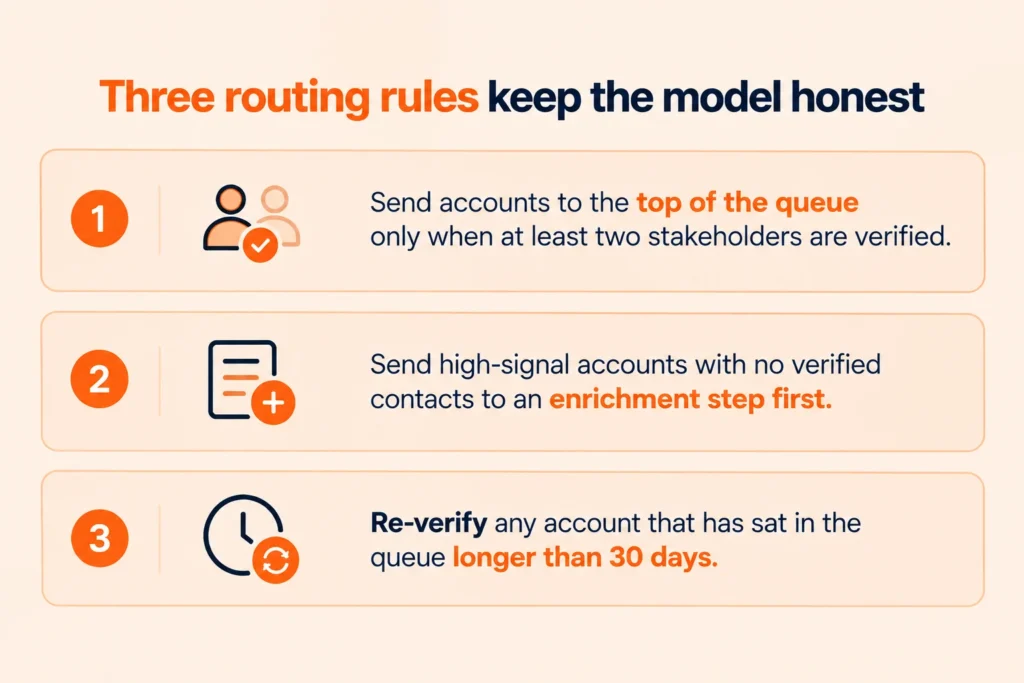
3 routing rules to keep the model honest


Three routing rules that keep the model honest.

Verified contact data: the prerequisite for acting on buyer signals in time


The signal window should be measured in weeks. When contact cleanup begins at the point of a signal firing, it consumes a lot of the window time and doesn't send a single email. That's why verified contact data is a prerequisite for acting on buyer signals.

The stakes increase as the size of the deal increases. The larger the annual contract, the larger will be the buying committee, and the more contacts will need to be verified prior to action. Deal size is more closely related to coverage by the committee than it is to signal strength.

"I like Clearout.io for its effective email validation that helps me with inbox understanding and bulk validation. I also appreciate how easy it is to integrate with N8N and Make. The initial setup was simple, enabling me to start validation in minutes”

G2 review of Jithu S., MapmyIndia

The Signal Readiness Score: How reachable is each flagged account?


You might rank accounts by signal strength alone. I suggest adding one more number, the Signal Readiness Score, so reps know which accounts they can act on today.

You may rank accounts by signal strength only. I recommend adding another number, the Signal Readiness Score, to help reps know which accounts to act on today.

Signal Readiness Score = Verified contacts on the account ÷ Estimated buying committee size


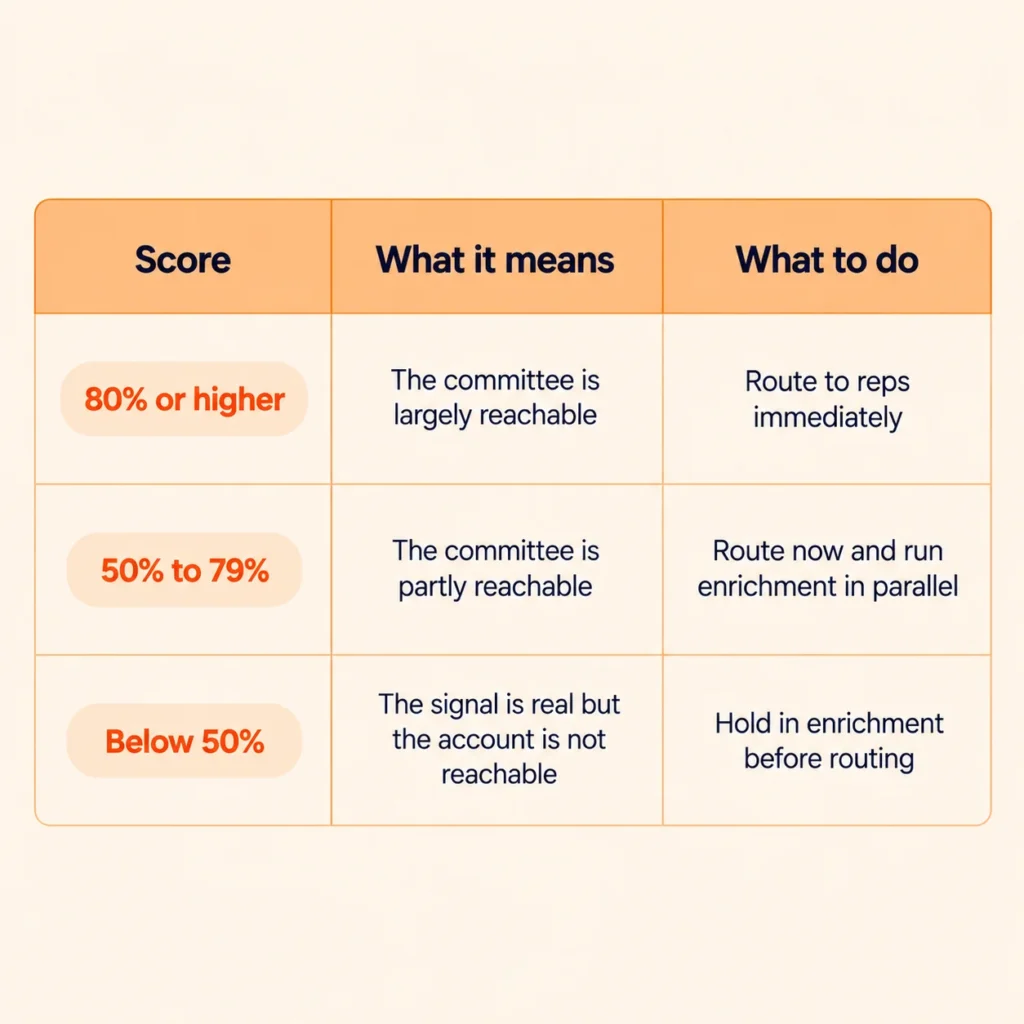
For example, an account with a 6 person buying committee and 4 verified contacts scores 67%. This puts the account in the 50% to 79% band, meaning the sales team can begin outreach immediately while running automated enrichment in parallel to find the remaining contacts.

Use these bands as a reference and tune them as per your own reply rates and meeting rates. The idea is to prevent your best signals from getting to reps in a state where they can't do anything.

Signal readiness score bands


A table outlining the Signal Readiness Score bands.

From signal to annual contract value: The 5-stage workflow


There are five stages from the signal detected to the closed deal.

  1. Detect: Intent data identifies an account that has activity consistent with actual purchases (research, hiring, technology evaluation).
  2. Identify buyers: Check buyers in the buying committee – not just the one that matched your ICP filter.
  3. Verify: All the contacts on that list are verified before they are added to a sequence.
  4. Route: High-signal and verified accounts are routed first.
  5. Execute: Outreach is effectively delivered at the right time in the buyer's evaluation.

The majority of GTM stacks consist of stage one almost to the exclusion of every other stage. Budget and dashboards get created; stage two and stage three are left to whatever data is already in the CRM. That is exactly where revenue leaks out of an otherwise strong signal program.

What we tested: How fast does contact data decay inside a signal window?


What we tested: We examined the typical time period for contact data tied to a flagged account to go stale, using patterns from B2B email verification requests processed through Clearout. That's compared to the duration of a "buying-signal window" (a window during which evaluation activity warms up before it cools off) before the evaluation activity slows.

Why we tested it: GTM teams consider contact data a static asset that's pulled when an account enters your CRM, and is rarely updated after that. The contact accuracy deteriorates more quickly.

How we tested it: We reviewed 49,029,763 B2B email addresses first verified for 30 days. We checked how many addresses were verified as valid, invalid, risky, or catch-all results.

What we found: We discovered that contact accuracy declined as time went on, with job changes, company moves, and catch-all domains that pass an initial check but hide an inactive mailbox. 7.71% of the B2B domain sample had catch-all configurations. It is more common in smaller companies and agencies that deploy their own mail infrastructure. A "verified" list may also have an underlying threat.

What it means: Buying-signal windows are usually weeks, and contact data can become "stale" on a comparable or even quicker timeframe.

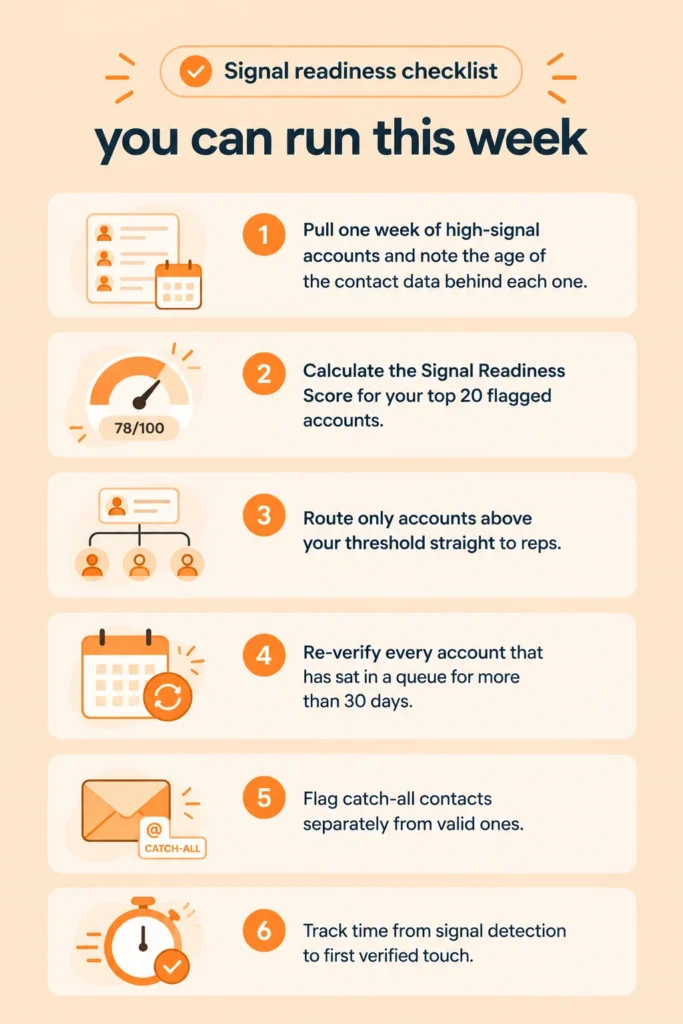
What you should do: Pull one week of high-signal accounts and check how old the contact data behind them actually is. If most of it was captured more than 60 days before the signal fired, that is very likely where your conversion from signals to closed revenue is leaking.

How to verify a buying committee before the signal window closes?


You should verify a buying committee by making verification part of the signal-response workflow itself. Here’s what the process looks like:

  • Drag all of the related stakeholders that are connected to the flagged account.
  • Test the entire list with Clearout before sending a sequence.
  • Separate out catch-all contacts.
  • Re-verify any account that has been in a signal queue over 30 days prior to starting outreach.
  • Don't email the same address repeatedly that bounced.

A prioritization model that skips this step keeps routing high-signal accounts to reps who then lose days checking whether the contacts are even real.

Stop losing signals to stale contact data.


Verify your full buying committee in minutes and keep every contact in your CRM send-ready between signals.

Start Free

What should GTM teams measure instead of signal volume?


Measure how many flagged accounts have a reachable buying committee. Signal volume is easy to report, but it says almost nothing about whether your signals are turning into revenue.

MetricWhat it tells you
Signal Readiness Score per flagged accountWhether reps can act the moment a signal fires
Time from signal detection to first verified touchHow much of your signal window you lose to data cleanup
Bounce rate on signal-triggered sequencesWhether your contact layer is trustworthy (keep it under 1%)
Committee coverage per open opportunityHow many stakeholders you can actually multi-thread
Reachable pipelineHow much pipeline pairs real buying signals with a reachable committee

The pipeline that has real buying signals and a committee that has passed your Signal Readiness threshold is a reachable pipeline. It distinguishes between opportunities that the reps can actually work on and those that appear good on a dashboard.

The buyer signal seems to be intense, but there is only one contact available, so the account will likely close, or not. Larger ACV deals are generated from accounts from which the rep can connect with five verified stakeholders in the buying group.

Signal readiness you can run.

Key takeaways


Getting bigger deals from intent is not about finding better signals. For most GTM teams there is already too much intent data to act upon. The challenges come when a signal is detected, but the contacts you have behind it have not been verified, and as annual contract value becomes more significant, buying committees increase.

Before submitting another intent source this quarter, check if the accounts that the signal-based prioritization already pushes into the reps have a fully qualified buying committee ready behind them.

That's the layer that Clearout was designed to. Clearout Prospecting can help you find a verified buying committee, while the Email Verifier ensures that contacts already in your CRM don't go stale.

See how many of your high-signal accounts are reachable


Book a Demo | Start Free

FAQs


1. What are buyer signals, and how do B2B teams use them?
Buyer signals show that an account is considering a solution, whether that be via research, hiring, or technology changes. GTM teams put buyer intent signals into practice in the following ways: they score accounts, they route the best ones to reps, and they time outreach to the buyer's stage. The signal is only valuable if there are verified and high-quality contacts behind it.
2. How do buyer signals influence annual contract value?
An account's signals indicate initiatives within the account, including a significant hiring surge or new leadership. Teams that identify them first can bring in more solutions and more people to the buying committee, which increases the deal size. This is only possible if all key stakeholders have a verified and accessible email address.
3. What separates annual contract value deals from smaller ones?
For larger deals, buying committees should be invariably larger. The reps who win them multi-thread early, reaching finance, security, and the end user alongside the champion. Committee coverage is more predictive than just signal strength of the deal size.
4. Why does verified contact data matter for signal-based prioritization?
Prioritization only helps when reps can act on what it surfaces. If high-signal accounts are routed to reps too quickly, but then emails bounce or fall into "catch-all" domains, it's of no benefit. That's also why a high-ACV deal will stall if only one stakeholder is available.

Share this article

Recent Posts

06 Oct 2026
How Do GTM Teams Turn Buyer Signals Into High-ACV Deals?

Most buyer signals fail at the contact layer. See how GTM teams map, verify, and route buying commit ...

01 Oct 2026
Automate Catch-All Verification in HubSpot, Salesforce, and CRM Workflows

Learn how to automate catch-all verification across HubSpot, Salesforce, and CRM workflows using API ...

30 Sep 2026
How to Safely Contact Catch-All Emails In Cold Outreach

Discover how to manage catch-all emails in cold outreach, monitor bounce signals, verify contacts, a ...

29 Sep 2026
What Unresolved Catch-Alls Could Cost Your Pipeline

Learn how unresolved catch-all emails can affect pipeline estimates, calculate potential exposure, a ...

28 Sep 2026
How to Set Up Lead Routing Rules in Lofty CRM

Learn how to set up lead routing rules in Lofty CRM, from conditions and rule order to Round Robin, ...

Clearout's

Form Guard

Validate email, phone & name on any forms!

  • Real signups only
  • Verified emails
  • Valid phone numbers
  • No fake names
  • Cleaner CRM
  • No devs needed
Try for Free Now

Email Verification, Email Finding Form Guard & Prospecting Service

Expand Your Reach By Finding & Verifying Ideal Prospects.

Sign up & get 100 free credits

No Credit Card required

Create Free Account
Company

Why Clearout?

Pricing

Contact Us

Careers

Press

Enterprise

Sitemap

FAQ

Status

Products

Email Verifier

Catch-all Verification

Email Finder

Form Guard

Data Pulse

Prospect

LinkedIn Email Finder

Reverse Lookup

Google Sheets Add-on

WordPress Plugin

ClearoutPhone

What's New?

Resources

Integrations

HubSpot

Team Account

API

Compare Email Verifier

Compare Email Finder

Compare Prospecting

Use Cases

Blog

Help

Legal

Privacy Policy

Terms

DPA

Security

Trust Center

Certification

ISO 27001/2022

SOC 2 Type 2

GDPR

Partnership

HubSpot Certified

Affiliates

Partners

Clearout for browser

⚡ Supercharge Your Prospect Research with Clearout's LinkedIn Chrome Extension - Find and Verify Emails with Confidence!

Clearout Chrome extension

Clearout
© 2026 Clearout Inc. All Rights Reserved. Powered by Clearout.
Validate Enrich New Salesforce contacts automatically with Data Pulse. Learn More ➞
X