

- Products
- ResourcesDEVELOPER

 API
API
Clearout APIs are structured around REST and JSON Webhooks
Capture real-time events in your application workflow Form Guard
Real-time form validation to keep bad contacts out of your CRMKNOWLEDGE BASE Getting started
Sending campaigns without bounces is made simple FAQ
FAQ
Easily find answers to services, security and common questionsUSE CASES Lead Generation
Learn how professionals generate quality leadsGUIDESPricing Transparent & flexible pricing to support pay-per-use or recurringCompare Email Verification Tools AI-powered email verification with 99%+ accuracy, real-time validation, and transparent risk scoringCompare Email Finder Tools Pre-verified B2B email addresses with confidence scoring, find real person email, not role-based addressData Pulse & HubSpot Breeze Intelligence Pre-verified B2B email addresses with confidence scoring, find real person email, not role-based addressBLOGSEmail Verification ToolsFind Anyone’s Email Address
Most Accurate, Fast & Free WaysForm Validation
Importance, Ways & Best PracticesView All Blogs - Pricing
- Integrations
- Enterprise
- Login



Top 6 GTM Mistakes That Slow Down Your Revenue
This is currently among the most typical GTM errors that teams commit. You may have the correct product, powerful messaging and a good sales process. But when your data is not right, everything down the chain fails. Campaigns fail to perform, sales teams take the wrong leads, and targeting doesn't give fruitful outcomes.
This is the reason most go-to-market strategies fail, as they are constructed with the same GTM mistakes. These are the mistakes that cannot give data-driven and customer-centric results. So, let's take a look at them here.
Table of Content
6 Go-to-market (GTM) mistakes that will affect your revenue
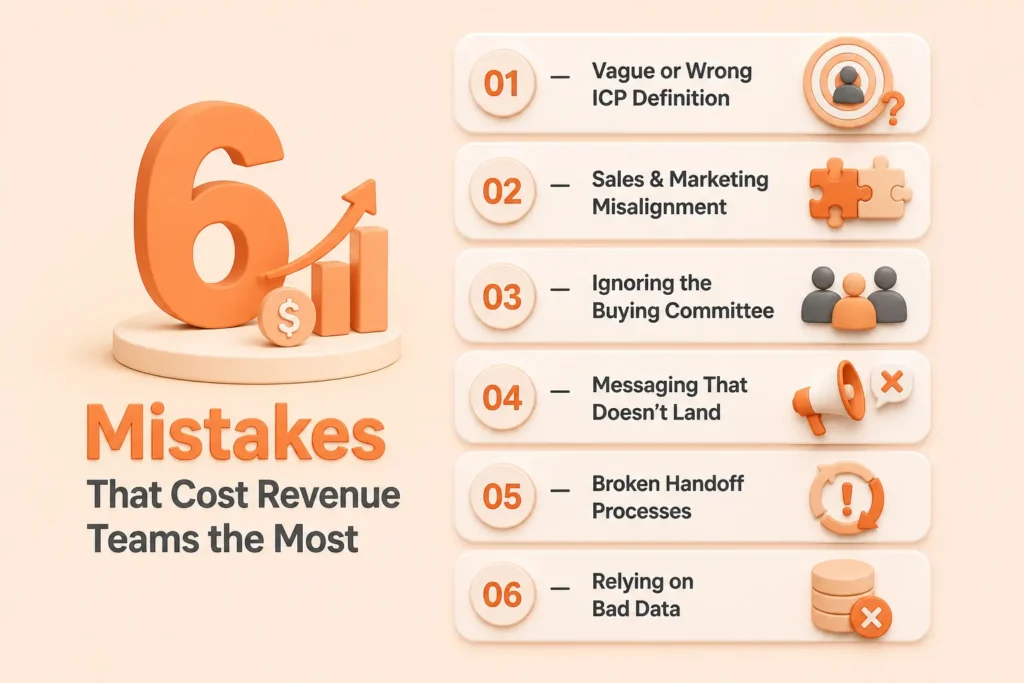
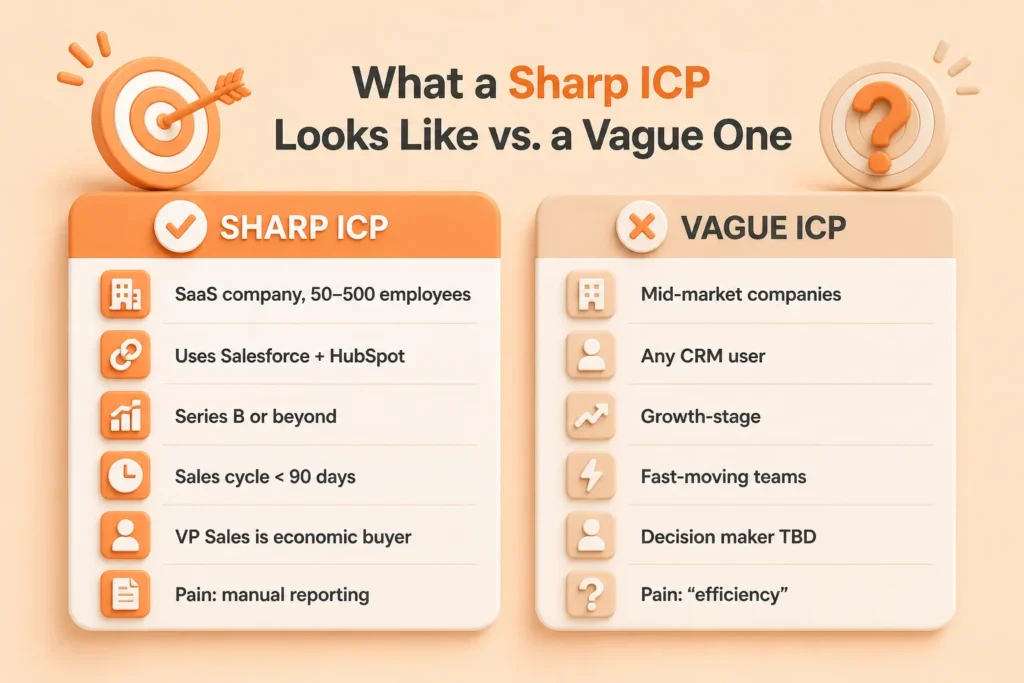
Mistake 1: Defining your ICP by intuition, not evidence
Some will describe the biggest logo you've won. Others will describe the deal that closed fastest. A few will recite the company's mission statement. Almost none will cite behavioral data.
A vague or assumption-based ICP is one of the most expensive GTM mistakes a team can make because every downstream activity inherits the error. Your content targets the wrong persona. Your SDRs chase the wrong accounts. Your AEs spend time on deals that were never going to convert. And your CAC quietly balloons while leadership wonders why pipeline velocity has stalled.
The fix is working backwards from your best customers, the ones who renewed quickly, expanded, and referred others, and finding the firmographic, technographic, and behavioral signals they share. Then, verifying those signals against your closed-lost data to sharpen the boundary between "likely to win" and "likely to waste six months on."
Mistake 2: Sales and marketing operating separately
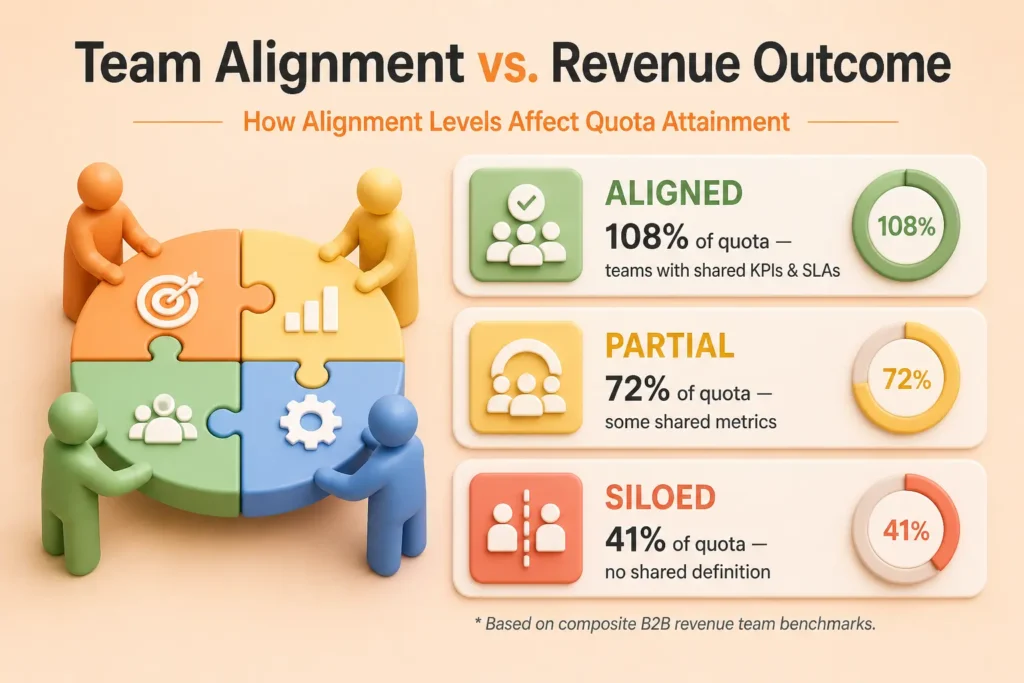
This is a structural failure rooted in different OKRs, different definitions of a qualified lead, and different views of what "pipeline" actually means. When marketing optimizes for volume and sales optimizes for deal size, misalignment is not just predictable; it's mathematically guaranteed.
- Written common definition MQL, SQL, and SAL.
- Lead response time SLA agreed upon (e.g. less than 4 hours)
- Frequency of joint pipeline review (weekly or biweekly)
- Marketing attends sales calls at least monthly
- Sales provides structured lead quality feedback to marketing
- Both teams share one revenue dashboard, not two separate reports
Mistake 3: Forgetting that B2B buying is a team sport
Ignoring the buying committee is a GTM mistake that manifests late in the sales cycle, which makes it especially painful. You've already invested time, resources, and optimism. The fix requires multi-threading from the very first discovery call and identifying the economic buyer, the technical evaluator, and the executive sponsor who will need to sign off.
Build your content and sales collateral to serve multiple personas simultaneously. An ROI calculator serves the CFO. A security one-pager serves IT. A feature comparison serves the end user.
Mistake 4: Leading with features instead of outcomes
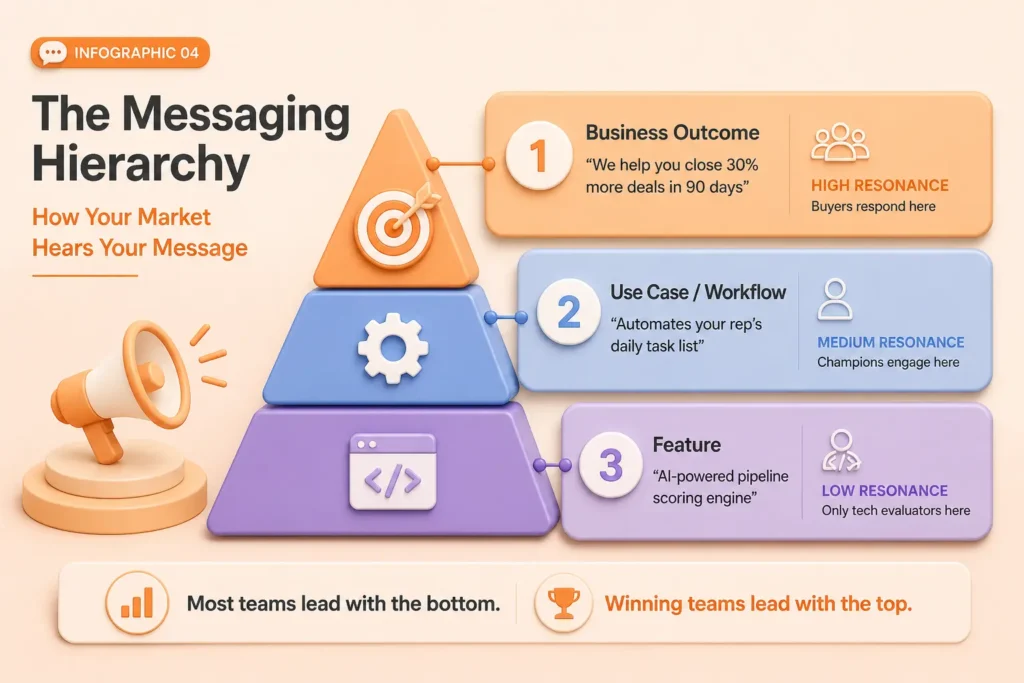
Buyers aren't purchasing your pipeline scoring engine. They're purchasing the confidence that they won't miss their number. The distinction sounds semantic. In a discovery call, it's the difference between a deal that advances and one that stalls.
The most effective GTM messaging starts with the outcome your buyer is accountable for: revenue, churn, efficiency, risk reduction. It works backwards through use cases to features. Features are proof points, not headlines. Keep them in the product section of your deck, not the opening slide.
Mistake 5: A leaky handoff process between teams
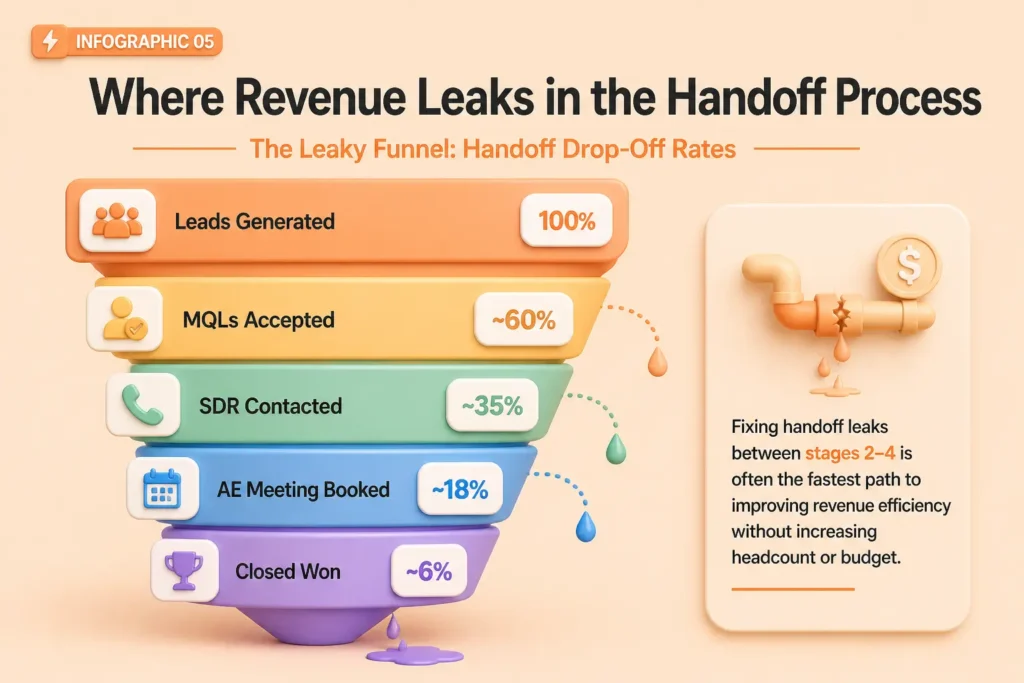
Handoff failures happen in three places: the marketing-to-SDR transition, the SDR-to-AE transition, and the AE-to-CS (customer success) transition after the close. Each one is an opportunity to either compound momentum or bleed it.
The fastest-fixing teams add structure. That means standardized handoff templates with required context fields, clear ownership at each stage, and automated alerts.
Mistake 6: Trusting low-quality data
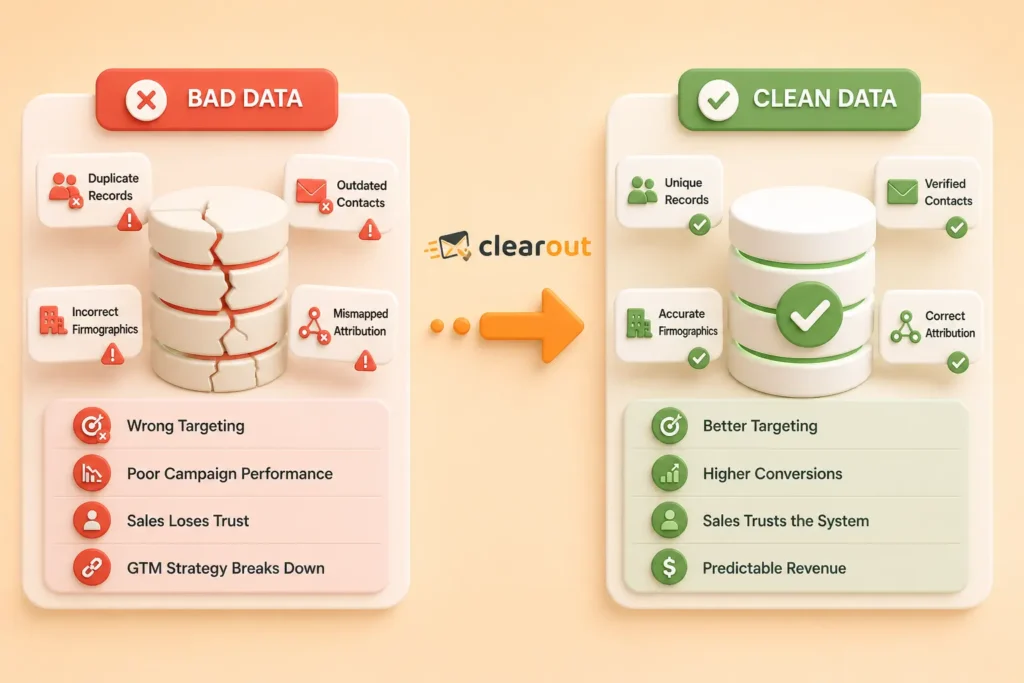
There is more impact of bad data on GTM strategy and to understand it in detail, check the blog on how bad data affects GTM strategy.
Now suppose that the quality of data is low. Redundant records, obsolete contacts and incorrect firmographics, disorganized attribution. It does not appear to be a big issue initially. However, as time goes by, it begins to influence all your decisions.
You find yourself attacking the wrong accounts. It seems that your campaigns are not on. The sales teams lose confidence in the system. And gradually, your GTM is beginning to fall apart without your understanding why. And before you optimize anything, consider one question. Do you really trust your data?
Since you cannot, nothing that will be constructed on it will perform as well as it should. And that is where tools such as Clearout can assist you in cleaning and checking your data. After you have reliable data, all things downstream begin to become better.
In the long term, this gives you a better pipeline, increased conversion rates, and less predictable revenue.
What high-performance GTM strategy should you use?
They do not consider their GTM strategy as a one-off strategy. Rather, they continue to perfect it as they understand which is working and which is not. They take time to look at the deals they lost, not only the wins. Since that is where the real insights are made.
Most importantly, they keep asking one simple question. Where are we losing deals we should be winning? And more importantly, they don’t guess. They use data to find the answer.
If you want to know whether your GTM motion is strong, start here:
- Can everyone on your revenue team describe your ICP in the same way?
- Do marketing and sales have a clear agreement on how leads are handled?
- Are you engaging all key decision-makers in your target accounts?
- Does your messaging focus on business outcomes instead of features?
- Do you have the ability to trace all leads of first touch to the final result without any interruptions?
1. Product-Led Growth (PLG)
You allow users to feel the value first and as such, your product sells itself before your sales team can even come into the picture.
2. Account-Based Marketing (ABM)
You select 50 dream accounts and develop campaigns so personalized that they seem to be reaching out to individuals one at a time.
3. Inbound Marketing
You answer exactly what your buyers are Googling, so by the time they talk to you, they already trust you.
4. Partner-Led GTM
You borrow distribution from partners who already have your audience, so you skip years of building trust.
5. Demand Generation
You don’t wait for intent; you create it through sharp messaging that makes people realize they have a problem.
6. Sales Enablement
You don’t just hire reps, you arm them with proof, scripts, and insights.
7. Vertical Marketing
You stop being generic and speak directly to one industry, so your product feels built just for them.
8. Disruptive GTM
You enter the market by making existing solutions look outdated, slower, or overpriced in comparison to you.
9. Viral Growth Strategy
You design your product in a way that every user naturally brings another one in, without needing constant ad spend.
Final thoughts
Instead of rebuilding your GTM, fix the input first. Start with clean and verified data using Clearout. It gives you validated emails, phone numbers, confidence scoring on email addresses, and a lead list with 99.73% accuracy.