

- Products
- ResourcesDEVELOPER

 API
API
Clearout APIs are structured around REST and JSON Webhooks
Capture real-time events in your application workflow Form Guard
Real-time form validation to keep bad contacts out of your CRMKNOWLEDGE BASE Getting started
Sending campaigns without bounces is made simple FAQ
FAQ
Easily find answers to services, security and common questionsUSE CASES Lead Generation
Learn how professionals generate quality leadsGUIDESPricing Transparent & flexible pricing to support pay-per-use or recurringCompare Email Verification Tools AI-powered email verification with 99%+ accuracy, real-time validation, and transparent risk scoringCompare Email Finder Tools Pre-verified B2B email addresses with confidence scoring, find real person email, not role-based addressData Pulse & HubSpot Breeze Intelligence Pre-verified B2B email addresses with confidence scoring, find real person email, not role-based addressBLOGSEmail Verification ToolsFind Anyone’s Email Address
Most Accurate, Fast & Free WaysForm Validation
Importance, Ways & Best PracticesView All Blogs - Pricing
- Integrations
- Enterprise
- Login



7 Cold Email Frameworks That Work in 2026 (With Examples)
The average cold email reply rate is just 3.43%. according to Instantly's 2026 benchmark report. The reasons may be many, but one major culprit is not following an effective cold email framework. Without a framework, reply rates drop further because emails reach the wrong prospect, at the wrong stage, and with the wrong ask.
Here are 7 cold email frameworks with real examples that help you get prospects to your website and add products in the cart. Additionally, by the end, you'll know which structure fits your prospect's situation.
Here are 7 cold email frameworks with real examples that help you get prospects to your website and add products in the cart. Additionally, by the end, you'll know which structure fits your prospect's situation.
Table of Content
What Is a Cold Email Framework (And Why You Need One)?
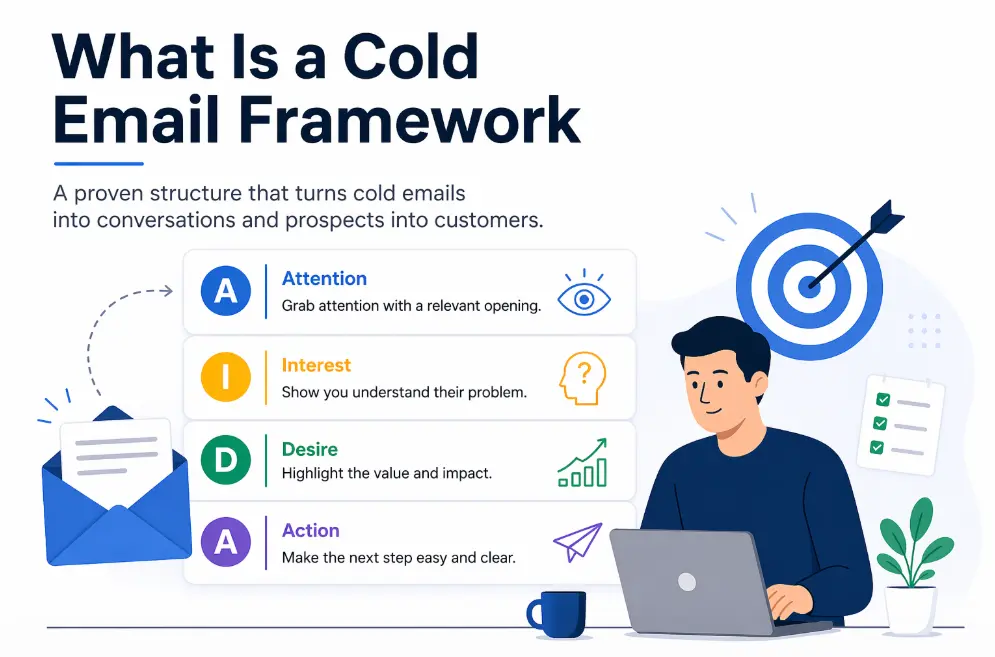
A cold email framework is a repeatable structure for reaching prospects who don't know you yet.
It runs on 3 things: relevance to their specific situation, personalization that goes beyond a first name, and copy concise enough that a decision-maker reads it between meetings. The objective is to start a conversation.
Why it matters:
It runs on 3 things: relevance to their specific situation, personalization that goes beyond a first name, and copy concise enough that a decision-maker reads it between meetings. The objective is to start a conversation.
Why it matters:
- Get a complete analysis of the goals for why you are sending a cold email.
- Keep every email focused towards one problem, one value proposition, and one ask.
- Improves reply rates by matching the structure to the prospect's situation.
- Makes your outreach consistent and repeatable at scale.
The 7 Core Cold Email Frameworks (With Examples)
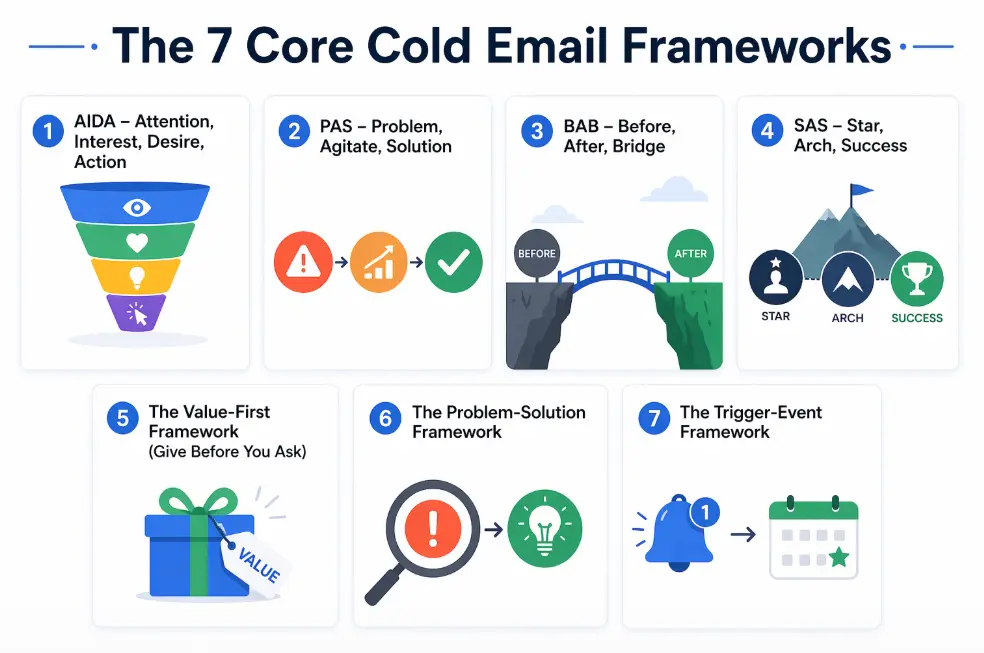
Framework 1: AIDA - Attention, Interest, Desire, Action
AIDA in cold emails is a framework that guides how you write your message to grab your prospect's attention. They get curious and want more context. That context makes them want the outcome. Then they take action. Each step in AIDA pushes the reader forward.
- First-touch outreach to prospects who have no prior exposure to your brand
- SaaS trial or demo requests where the CTA needs a clear value hook
- High-volume prospecting sequences where brevity is non-negotiable
Real Example
Subject: Your onboarding flow is losing you trials
Hi [First Name],
Most SaaS teams lose 40 to 60% of trial signups within 72 hours. Not a product issue. An onboarding issue. Users sign up, get confused, and leave before they see any value.
We fixed this for 30+ B2B SaaS teams using behavioral triggers and in-app nudges. Time-to-value dropped 34% within 90 days across those accounts.
Open to a 20-minute call?
[Your Name]
When to Use It vs. When to Skip It
The AIDA works if the prospect knows they have a problem. If they're not aware of the problem, your hook won't land. Switch to PAS. It lets you surface the problem first before you offer anything.
Framework 2: PAS - Problem, Agitate, Solution
PAS starts with a problem the prospect already feels, shows them what it's costing them, and then presents your solution as the way out. The keyword is "agitate", not in a manipulative sense, but in the sense of making the stakes real.
- When you're reaching out to prospects who know they have a problem
- Sequences targeting specific roles where pain points are well-documented (e.g., RevOps, CFOs, DevOps leads)
- Competitive displacement campaigns where you're asking someone to switch tools
Real Example
Subject: The problem with most B2B lead lists
Hi [First Name],
Most revenue teams pull lists from LinkedIn, ZoomInfo, and Apollo. The problem is that everyone else does too. Same contacts, same timing, same message. Reply rates drop, and reps burn through good leads with nothing to show for it.
That approach gives you a list. It doesn't tell you who's ready to buy right now.
We help B2B teams target prospects using intent signals and job-change triggers. Your outreach reaches people when they're actually looking. Want to see how it works for a team your size?
[Your Name]
Pro Tip
The agitation step is where most PAS emails fail. Either the writer jumps straight from the problem to the solution, or exaggerates the consequences until the email loses credibility. The goal is to find one consequence that can be measured.
The consequence should be specific and supported by numbers whenever possible. A percentage of the outreach budget with zero returns or a missed quarterly target. Frame it around the prospect's pipeline, team size, or outreach volume; that's what makes it land as a real business problem.
The consequence should be specific and supported by numbers whenever possible. A percentage of the outreach budget with zero returns or a missed quarterly target. Frame it around the prospect's pipeline, team size, or outreach volume; that's what makes it land as a real business problem.
Framework 3: BAB - Before, After, Bridge
BAB is a contrast framework. You describe the current state (Before), paint the desired future state (After), and then present your product or service as the Bridge that connects the 2. It works because it leads with transformation rather than features.
- B2B complex purchases where the buyer must see the value first to agree to a meeting
- Business-to-Business outreach where CEOs have skin in the game
- Any situation where the prospect knows what they want but hasn't found a path there
Real Example
Subject: What scaling your CS team actually looks like
Hi [First Name],
Your CS team is tracking renewals in spreadsheets. Checking health scores by hand. When a customer goes quiet, visibility is gone.
6 months from now, the same team could get churn warnings 90 days early. Automated playbooks running on every account. Time spent on expansion, not damage control.
We help mid-market SaaS companies get there without hiring. Want to talk for 25 minutes this week?
[Your Name]
Why It Works Especially Well in High-Ticket B2B
Enterprise buyers evaluate purchases differently from SMB buyers. They want to know whether the transformation justifies the cost and disruption. BAB answers that question early. Senior buyers who already want the outcome just need to know you can deliver it. Consequently, BAB gets you there faster than almost any other framework.
Framework 4: SAS - Star, Arch, Success
SAS is a narrative framework built around storytelling. The Star is a relatable character, often a customer who looks exactly like your prospect. The Arch is the challenge or turning point they faced, and the Success is the outcome they reached with your help. Together, these 3 elements give the reader a reason to trust you before you pitch anything.
- Longer sequence openers where you're willing to invest more copy in the first touchpoint
- Outreach to prospects who are skeptical of claims and respond better to proof than promises
- Categories where social proof carries more weight than logic, such as cybersecurity, compliance, and finance
Real Example
Subject: How [Similar Company] cut their CAC by 28%
Hi [First Name],
Last year, the Head of Growth at a Series B SaaS company similar to yours was running 6 outbound channels and had no reliable way to tell which ones were actually driving the pipeline. [Star]
They'd been running the same attribution model for 2 years. When they finally audited it, 40% of their "top-performing" campaigns were cannibalizing organic traffic. [Arch]
After rebuilding their attribution setup with us, they cut wasted ad spend by 28% and redirected that budget into channels that actually converted. Their CAC dropped in a single quarter. [Success]
If attribution is something you're thinking about heading into H2, I'd love to walk you through how we approached it for them.
[Your Name]
Works Best as a Longer Sequence Opener
SAS emails tend to run longer than frameworks like AIDA or PAS. But only when the story is specific enough to earn the extra words. Vague stories with unnamed companies and rounded numbers don't build trust; they signal that you're padding. If the case study is real and relevant, SAS is one of the most powerful openers you can use.
Framework 5: The Value-First Framework (Give Before You Ask)
Rather than starting with a problem or with a pitch, Value-First starts with an offer of value, a giveaway, an insight or data point, a free audit, and a quick analysis of where they are now. The ask comes second, after you've already demonstrated that you're worth their time.
- Content-led GTM motions where education is part of the selling process
- Warming cold audiences before asking for a meeting or demo
- Categories where trust is a prerequisite: consulting, legal tech, and financial software
Real Example
Subject: Noticed something in your LinkedIn presence
Hi [First Name],
I took a look at your company's LinkedIn posts and compared them with those of 3 competitors: [Competitor A] and [Competitor B]. [Competitor C].
The main difference I noticed is that you don't have any posts from your founders or top leaders that show your company's expertise.
Founder-led content can give you stronger B2B engagement, which may be worth testing.
If you're interested, I'd be happy to share it with you. Just let me know.
[Your Name]
The Lead Magnet Doesn't Have to Be a PDF
Most people think of Value-First as "send them a free resource." That's one version of it. The more effective version is doing something specific for the prospect before you ask for anything. A quick teardown of their homepage, a benchmark comparison, and a custom data pull all work better than a generic guide.
Framework 6: The Problem-Solution Framework
You start with the problem and call out a real issue your prospect is already facing. This is what the problem-solution framework is. Unlike PAS, it skips the agitation and gets to the point, right for buyers who already know they have a problem.
- Intent-signal-based targeting, where you know the prospect has a specific problem at this specific moment
- Prospects who are actively evaluating solutions and respond to clarity over the story
- Re-engagement sequences for prospects who went cold after initial interest
Real Example
Subject: Your email deliverability drop
Hi [First Name],
I noticed your domain's sender reputation took a hit in the last 30 days, and open rates are likely down across your entire sequence, even the ones that were converting before.
We help B2B teams diagnose and repair deliverability issues in under 2 weeks, without rebuilding their entire sending infrastructure.
If you're seeing the same pattern and want a second set of eyes on your setup, I can turn around a free audit in 48 hours.
[Your Name]
Pairs Well With Intent-Signal-Based Targeting
The Problem-Solution framework gets dramatically more effective when you know something specific about the prospect's current situation. A signal, a job posting, a tech stack change, a public complaint, or a forum question permits you to be direct. Without that context, the same structure can feel presumptuous. With it, it reads as perceptive.
Framework 7: The Trigger-Event Framework
The Trigger-Event framework builds the email around something real that just happened in the prospect's world. A funding round, a new hire, a product launch, a job change. Whatever just happened becomes your reason for reaching out.
- Account-based outreach where you're targeting specific companies with real research behind it
- Re-engaging prospects after a trigger that changes their buying situation
- Any outreach where timing is the differentiator, being first to a changed context matters
Real Example
Subject: Congrats on the Series B, quick thought on your hiring plan
Hi [First Name],
Saw the announcement this morning, congrats on the Series B. That kind of round usually triggers an aggressive hiring push, particularly in sales and CS.
One challenge we see constantly at that stage: companies scale headcount faster than their enablement infrastructure can support. New reps end up under-ramped, and quota attainment suffers in the quarters right after a raise.
We've helped a handful of companies in your exact situation build out their onboarding and enablement infrastructure before headcount growth outpaces it. If that's on your radar heading into Q3, worth a conversation.
[Your Name]
Intent-Based Targeting Combined With Real Personalization
Trigger-event outreach is the highest-performing cold email strategy available in 2026, but only when executed properly. Using a company's funding round as a reason to pitch unrelated services is just an interruption dressed up as research. The trigger event must be directly related to the problem you are solving.
How to Choose the Right Cold Email Framework
The right framework is determined by where your prospect is in their buying journey, their awareness level, their current situation, and how close they are to making a decision. The wrong framework on the right prospect is still a missed opportunity.
Here is how to match the two correctly.
Here is how to match the two correctly.
| Framework | Best For | Avoid When |
|---|---|---|
| AIDA | First-touch outreach with a sharp hook; product demos, SaaS trials. | Problems that are vague or unrecognized, where the hook needs more context to land. |
| PAS | Pain-led sequences where the problem is well-defined | Where the problem is not well defined |
| BAB | High-ticket B2B deals, enterprise buyers, transformation-oriented pitches | Simple, transactional sales or low-consideration buyers |
| SAS | Longer; story-focused messaging for sophisticated offerings | Bite-sized one-liners; quick answers for time-crunched audiences |
| Value-First | Content-based GTM plays; softening audiences prior to a call to action | Urgent pipeline situations where speed matters more than trust |
| Problem-Solution | Intent-signal targeting; outreach timed to a known pain trigger | Generic list-based sends with no segmentation |
| Trigger-Event | Account-based outreach tied to real-time signals (hiring, funding, news) | Mass outreach to unresearched lists |
Cold Email Framework Best Practices That Apply to All of Them
These practices apply regardless of which framework you use. Get these wrong and even the right structure will not save the email.
- Subject line under 8 words. Anything longer reads like a marketing email.
- One CTA, not 3. Multiple options split the prospect's attention, one clear next step drives more replies.
- Personalisation has to be earned by a recent company announcement, a talk they gave, or a product change you observed. Mentioning their industry does not count.
- Under 120 words. Every sentence that does not add value is a reason for the prospect to stop reading.
Common Cold Email Framework Mistakes to Avoid
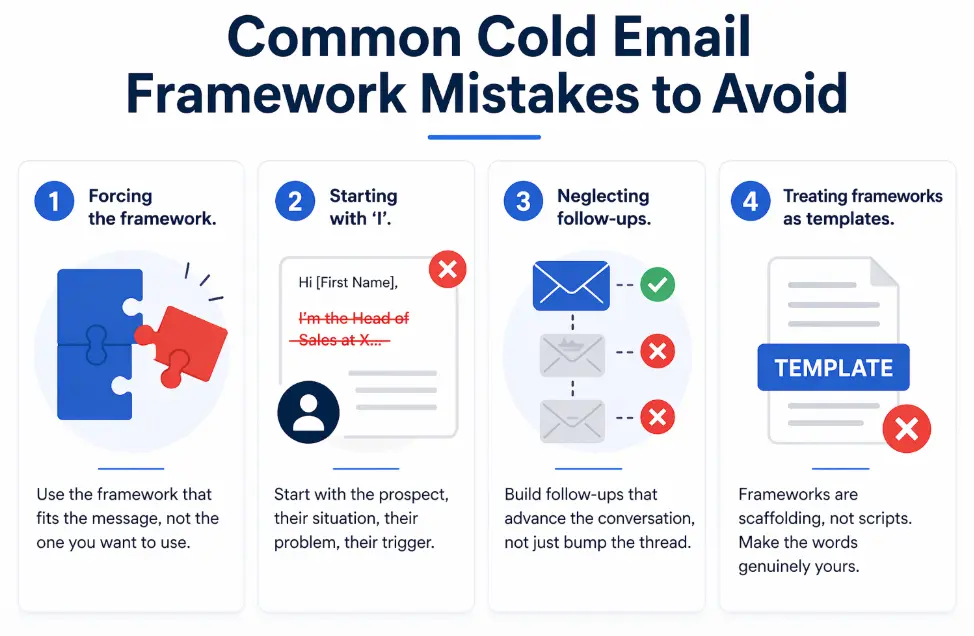
Most cold emails do not fail because of a bad offer. They fail because of how the email is built. These are the mistakes that consistently hurt reply rates, regardless of the framework used.
1. Forcing the Framework
Every framework has a natural flow. When you stretch an email to fit a structure it does not naturally support, the result reads formulaic and loses the prospect immediately.
Every framework has a natural flow. When you stretch an email to fit a structure it does not naturally support, the result reads formulaic and loses the prospect immediately.
2. Starting With "I."
"I'm the Head of Sales at X" signals the email is about you, not the prospect. Start with them, their situation, their problem, their context.
"I'm the Head of Sales at X" signals the email is about you, not the prospect. Start with them, their situation, their problem, their context.
3. Neglecting Follow-Ups
A strong opener that goes nowhere is wasted. The first email starts the conversation. Follow-ups are where replies happen. Each one should add something new, a different angle, a relevant data point, a case that speaks to their situation.
A strong opener that goes nowhere is wasted. The first email starts the conversation. Follow-ups are where replies happen. Each one should add something new, a different angle, a relevant data point, a case that speaks to their situation.
4. Treating Frameworks as Templates
A framework gives you structure. It does not give you the email. Swapping names and company details while keeping everything else the same produces something the prospect has already seen and already ignored.
A framework gives you structure. It does not give you the email. Swapping names and company details while keeping everything else the same produces something the prospect has already seen and already ignored.
What's Changed About Cold Email in 2026
The fundamentals of cold email have not changed. Inbox filters, buyer behavior, and sender requirements have. Here is what shifted and what it means for your outreach.
1. Gmail and Outlook Spam Enforcement Has Tightened
Since mid-2024, Gmail and Outlook have updated how they filter incoming email. It is not just technical signals anymore SPF, DKIM, DMARC.
Behavioral signals now matter too. Low reply-to-open ratios, high unsubscribe rates, and sudden spikes in send volume can trigger soft filtering even on a clean domain.
Behavioral signals now matter too. Low reply-to-open ratios, high unsubscribe rates, and sudden spikes in send volume can trigger soft filtering even on a clean domain.
2. Personalization Expectations Have Shifted
The market has been trained on AI-personalized emails. "Hi [First Name], I noticed your company is in [industry]" no longer reads as personal; it reads as automated.
The personalization bar has shifted from referencing public information to demonstrating specific knowledge, such as mentioning a product decision, a hiring pattern, and a published position the person actually took.
The personalization bar has shifted from referencing public information to demonstrating specific knowledge, such as mentioning a product decision, a hiring pattern, and a published position the person actually took.
3. Reply Rates and What's Considered 'Good' in 2026
Teams running properly targeted, framework-driven sequences with genuine personalization are consistently hitting 8-15%.
Anything above 5% is competitive. Anything above 10% means your targeting, your frameworks, and your personalization are all working together.
Anything above 5% is competitive. Anything above 10% means your targeting, your frameworks, and your personalization are all working together.
4. Why Volume-First Strategies No Longer Work
The logic behind high-volume cold email, send enough, get enough replies, has broken down. Inbox providers no longer just track complaints. They track engagement.
Send 10,000 poorly targeted emails, and you are not just wasting volume; you are burning the domain reputation you need to reach the prospects who would have actually replied. That’s why validating an email list is needed.
Send 10,000 poorly targeted emails, and you are not just wasting volume; you are burning the domain reputation you need to reach the prospects who would have actually replied. That’s why validating an email list is needed.
Closing Thoughts
A framework gives your outreach structure and intent; it does not fix poor list quality. Email specialists hitting 10%+ reply rates are not just writing better emails. They are sending verified and deliverable contacts on authenticated domains.
Run your frameworks against a defined prospect segment for 4 to 6 weeks. Measure reply rates at the framework level, not the campaign level. Cut underperformers based on data, not instinct.
None of that matters if your list is unverified. Invalid addresses, catch-all domains, and unverified contacts damage sender reputation and suppress deliverability before your framework gets a fair test. Clearout verifies at the contact level by protecting your domain health and improving your reply rates.
Run your frameworks against a defined prospect segment for 4 to 6 weeks. Measure reply rates at the framework level, not the campaign level. Cut underperformers based on data, not instinct.
None of that matters if your list is unverified. Invalid addresses, catch-all domains, and unverified contacts damage sender reputation and suppress deliverability before your framework gets a fair test. Clearout verifies at the contact level by protecting your domain health and improving your reply rates.
Run a Free Email Verification Check
FAQs
1. What is a cold email framework?
A cold email framework defines what each part of your email needs to accomplish. The opening earns attention, the middle builds a case, the close drives a specific action. The framework sets the logic. The writing fills it in.
2. What are the most effective cold email frameworks for B2B sales?
PAS and BAB work well because they lead with the prospect's problem or goal before mentioning your product. For account-based outreach, trigger-event emails tied to a real signal tend to get the strongest reply rates.
3. How is a cold email framework different from a template?
A template gives you fixed copy with placeholders. On the other hand, a framework gives you a structure you rewrite fresh each time for the specific person you're contacting.
4. Can I use more than one framework in a cold email sequence?
Yes. A common setup is opening with trigger-event or value-first, following up with PAS or BAB, then closing with a direct Problem-Solution email. No single email closes a prospect. The sequence does.
5. What is the biggest reason cold emails don't get replies?
Lack of relevance. Most cold emails fail because they are written for a persona, not a person. A framework gives you structure, but without sharp targeting and research, that structure has nothing real to work with.