


clearout
  • Products
    • Email Verifier Verify emails addresses individually, in bulk or through API, with 99% accuracy
    • Email Finder Find individual or bulk emails by entering the person & company name or domain
    • Form Guard IconForm Guard Protect your forms from spam, bots, and invalid submissions with real-time email, phone, and name verification.
    • Form Guard IconData Pulse Verify, enrich, and monitor your CRM contacts in real time - heartbeat monitor for your data.
    • Prospect SQL/MQL list building with high levels of personalization, real-time data enrichment and prospect search
    • Clearout For SheetsVerify email addresses directly on Google Sheets with Clearout for sheets add-on
    • Prospect – LinkedIn Chrome ExtensionBuild verified, targeted prospect lists directly from LinkedIn profiles
    • ClearoutPhoneValidate phone numbers across 240+ countries in bulk, quick or real time validation
    • Free Tools
    • Disposable Email Checker
    • Reverse LinkedIn Profile Lookup Tool
    • Reverse Email Lookup Tool
    • Email List Cleaner
    • Company Domain Finder API
  • Resources
      DEVELOPERAPI iconAPI
      Clearout APIs are structured around REST and JSON
      Webhooks iconWebhooks
      Capture real-time events in your application workflow
      Form Guard iconForm Guard
      Real-time form validation to keep bad contacts out of your CRM
      KNOWLEDGE BASEGetting started iconGetting started
      Sending campaigns without bounces is made simple
      FAQ iconFAQ
      Easily find answers to services, security and common questions
      USE CASESLead Generation iconLead Generation
      Learn how professionals generate quality leads
      GUIDESPricing arrow iconTransparent & flexible pricing to support pay-per-use or recurringCompare Email Verification Tools arrow iconAI-powered email verification with 99%+ accuracy, real-time validation, and transparent risk scoringCompare Email Finder Tools arrow iconPre-verified B2B email addresses with confidence scoring, find real person email, not role-based addressData Pulse & HubSpot Breeze Intelligence arrow iconPre-verified B2B email addresses with confidence scoring, find real person email, not role-based addressBLOGSEmail Verification ToolsFind Anyone’s Email Address
      Most Accurate, Fast & Free Ways
      Form Validation
      Importance, Ways & Best Practices
      View All Blogs
  • Pricing
  • Integrations
  • Enterprise
  • Login
Try it free Book a 1-to-1 demo
Priyanshi Sharma / August 21, 2026 August 21, 2026

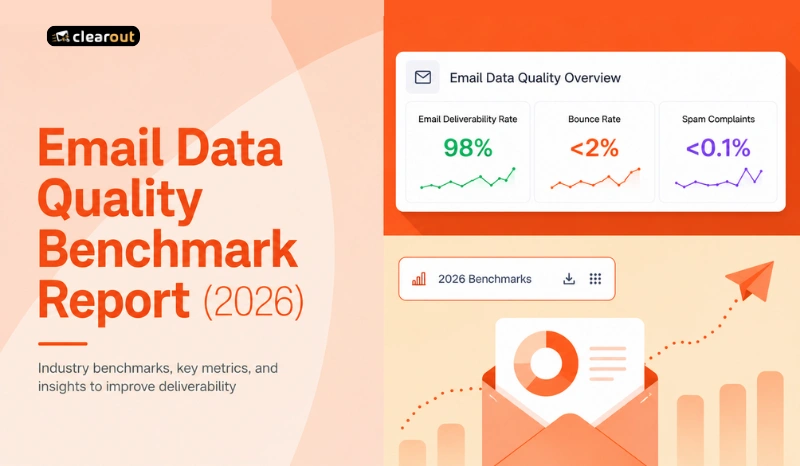
Email Data Quality Benchmark Report (2026)


Email Data Quality Benchmark Report (2026)

Table of Content


‣ Quick answer: What does this benchmark cover?
‣ What does email data quality mean?
‣ Email bounce rate benchmark by industry
‣ Email deliverability rate by industry
‣ Factors affecting email deliverability in 2026
‣ The impact of email list decay on email deliverability
‣ Invalid, disposable, and catch-all addresses by sector
‣ Actionable recommendations to improve email data quality
‣ FAQs
Quick answer: What does this benchmark cover?


This email data quality benchmark report covers:

  • What email data quality actually means and why it determines campaign performance
  • Bounce rate benchmarks across various industries
  • List decay rates and how email list decay affects deliverability over time
  • Invalid, disposable, and catch-all address prevalence by sector
  • Inbox placement and email deliverability by industry
  • Actionable steps to fix each problem before your next send

What does email data quality mean?


You can have thousands of contacts in your database, but that doesn't mean they're all useful. Email data quality tells you how trustworthy your list really is. Are the email addresses accurate? Are they complete and up to date? It includes checking the presence of a mailbox, whether or not it accepts mail, the presence of active MX records on the domain, the address being valid or a temporary mailbox.

The most common metrics used by most marketers to evaluate the health of their email list are open rates and click rates. Both metrics can hide a data quality issue since they are based on engagement.

Experian's Data Quality Report indicates that organisations lose $12.9 million per year due to poor data quality from wasted spend, missed campaign opportunities and downstream operational issues. The damage increases with each email sent on an unverified list.

Data for the benchmark in this report has been collected from Mailchimp, Validity, ZeroBounce, MarketingSherpa, Campaign Monitor, Google Postmaster Tools and Litmus.

Email bounce rate benchmark by industry


Most teams find a data quality issue when they turn to the bounce rate benchmarks. The term “hard bounce” refers to an email that could not be delivered permanently. If it fails temporarily, it's a soft bounce. The most important metric for deliverability is hard bounce as this signifies a permanent failure in the data quality.

Gmail and Yahoo now expect senders to maintain hard bounce rates below 2%. Any sender exceeding this limit will be subject to domain-level filtering that will impact inbox placement for all future sends.

The average bounce rate as per industry is listed below:

IndustryHard Bounce Rate
Software and Web App1.37%
Architecture and Construction1.54%
Agriculture and Food Services0.64%
Telecommunications1.31%
Beauty and Personal Care0.69%
Consulting1.13%
Ecommerce0.45%
Computers and Electronics1.06%
Recruitment and Staffing0.88%
Professional Services1.11%
Non-profit0.69%
Real Estate0.71%
Medical, Dental, and Healthcare0.93%
Creative Services/Agency1.24%
Travel and Transportation0.78%
Education and Training0.80%
Retail0.48%
Public Relations0.93%
Photo and Video0.99%
Business and Finance0.70%
Mobile0.88%
Music and Musicians0.68%
Arts and Artists0.69%
Restaurant and Venue0.57%
Social Networks and Online Communities0.51%
Sports0.52%
Politics0.60%

Every industry bounce rate is below 2%. When your campaigns exceed that threshold, the problem is rarely industry-wide. It is specific to how your particular list was built, sourced, or maintained before that send.

Individual campaigns run against unverified or aging lists frequently cross the 2% threshold even in sectors like ecommerce where the average is 0.45%. The benchmark protects you from false comfort.

Email deliverability rate by industry


Global inbox placement continues to slide. Industry-wide data now shows that 1 in 6 marketing emails fail to reach the inbox. It means ISPs are accepting more mail up front, but routing more of it to junk.

Global Email Deliverability Performance

MetricCurrentPrior Benchmark
Inbox placement83.5%84.8%
Spam placement6.7%6.1%
Missing/blocked9.8%9.1%
Q4 peak-season dip82.3%—
Spam rate, Q14.5%—

By mailbox provider (MAGY)

ProviderMarket ShareInbox %Spam %
Gmail48.5%87.2%6.8%
Microsoft16.8%75.6%14.6%
Yahoo/AOL14.0%86.0%4.8%
Apple3.8%76.3%14.3%

Microsoft remains the toughest major provider for inbox placement, while Yahoo was the only MAGY provider to improve year-over-year.

Here are deliverability recommendations by Microsoft when changing ESPs:

  • Before you move, migrate everything like active contacts and your suppression list too. Unsubscribes, hard bounces, and spam complaints invite your new ESP to email people who already told you to stop.
  • Then warm up slowly. Blasting your full volume from day one screams "spammer" to Gmail and Microsoft. Ease in, expect a temporary dip in metrics, and don't panic as ISPs just need time to recalibrate your reputation.

Regional standouts

  • Europe leads globally at 89.1% inbox placement
  • Germany tops individual countries at 94.5%.
  • The regions with the highest decreases are Brazil and India.

Factors affecting email deliverability in 2026


The email data quality report’s data across all sources points to four factors that consistently predict deliverability outcomes.

List verification frequency


There is a direct correlation between how often a team verifies their list and their inbox placement rates. Teams that verify before every major send achieve significantly higher placement than teams that verify annually or never. This gap shows up in sender behavior too. About 60% of senders now conduct list hygiene regularly, with just over a quarter doing it monthly or more.

List acquisition source


Contacts acquired through double opt-in forms have far lower invalid and complaint rates than contacts sourced through third-party databases or manual prospecting.

Sender authentication


SPF, DKIM, and DMARC authentication together can improve deliverability by up to 10 percentage points.

List maintenance


You must suppress unengaged contacts after 90 to 180 days of inactivity as this will lower your spam complaint rates.

The impact of email list decay on email deliverability


Organisations with good list hygiene practices have inbox placement rates of 83.5%, according to the 2024 State of Email Report from Validity. The rate of decay varies among job functions.

  • As people move to different companies, they stop using an old inbox and the contacts in your email list expire over time.
  • Valid email addresses can be converted to spam traps. Sending emails to spam traps will damage the sender reputation. If the ISP receives emails from these addresses, it will indicate poor list maintenance.

Invalid, disposable, and catch-all addresses by sector


This email data quality benchmark for invalid and risky address types varies significantly by industry and list source.

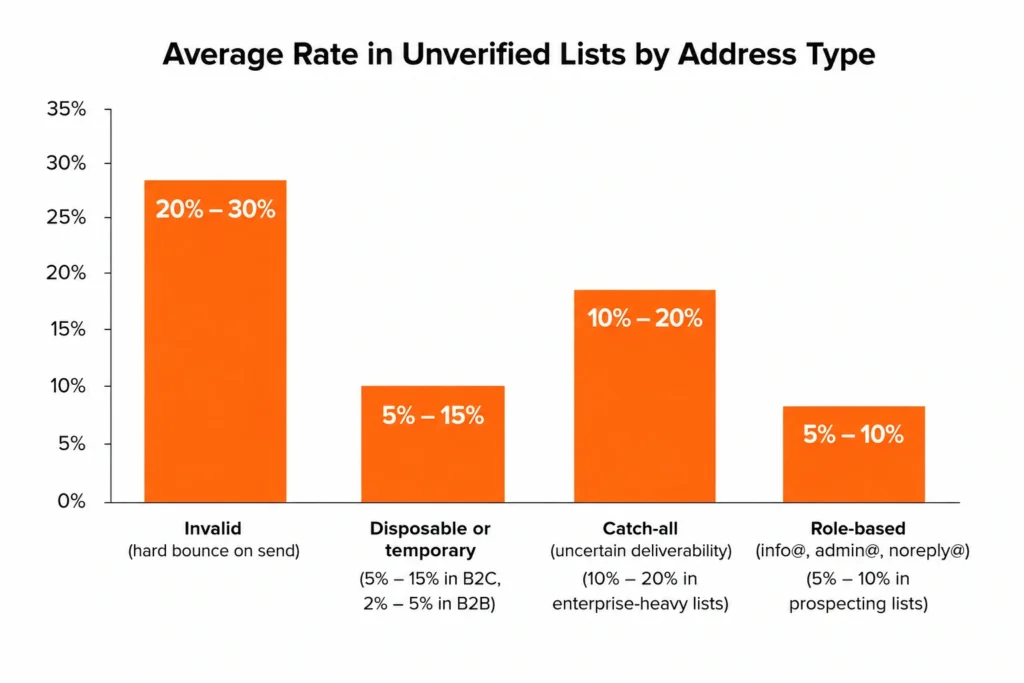
Average rate in unverified lists by address type

Invalid email addresses are addresses that fail at the mailbox level. The domain may exist, but the specific mailbox does not.

Disposable email addresses are temporary addresses created specifically to avoid follow-up. They tend to occur when someone signs up for a free trial without wanting to hear from the organization later and registers for an event without intending to hear from the organization again.

Catch-all addresses receive messages sent to invalid or non-existent email addresses within a domain. Enterprise and financial services organisations frequently configure their mail servers this way for compliance and archiving purposes. A catch-all address looks valid to a basic format check but may not deliver to a real person.

Address TypeAverage Rate in
Unverified Lists
Primary Risk
Invalid (hard bounce on send)20 to 30%Domain reputation damage
Disposable or temporary5 to 15% in B2C, 2 to 5% in B2BLow engagement signals
Catch-all (uncertain deliverability)10 to 20% in enterprise-heavy listsUnpredictable deliverability
Role-based (info@, admin@, noreply@)5 to 10% in prospecting listsLow engagement, complaint risk

Actionable recommendations to improve email data quality


The email list quality benchmark data across this report points to the same set of fixes regardless of industry. Here is what to prioritise based on the evidence.

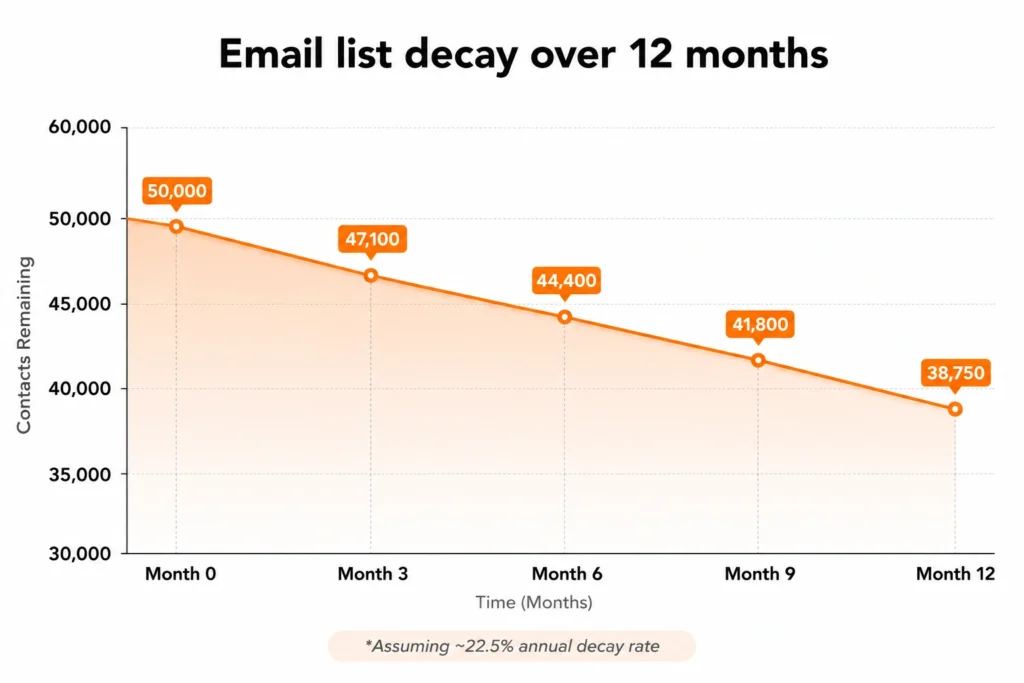
Email list decay line chart of over 12 months

  • Check your list prior to large sends: A list that was clean 6 months ago has now lost 11% valid contacts due to the annual decay rate of 22.5%. If you are sending more than 1,000 emails in any campaign, you need to verify your entire list through email verification tools and eliminate the invalid, catch-all, risky and disposable emails.
  • Verify email addresses on your sign up forms: The biggest source of bad and “disposable” email addresses in most databases are unverified form submissions. Form validation of email, phone and name prevents bad data from being entered into the CRM in the first place.

Clearout's Email Verifier runs 20 or more checks per address, including SMTP verification, MX record lookup, disposable address detection, catch-all scoring, and spam trap identification. Teams using Clearout before every major send consistently maintain bounce rates below 2% and improve open rates by removing invalid contacts.

Start verifying your list for free

100 credits included

FAQs


How is bounce rate calculated?
The bounce rate in email marketing is just the percentage of emails that bounce out of the total emails sent. If you send 10,000 emails, but have 200 hard bounces, your bounce rate would be 2%. If your campaigns have over 2% bounces, they may see their rates of inbox placement drop in all future campaigns.
What is a good email bounce rate?
A good bounce rate is less than 2%. Most successful email campaigns aim for a percentage of less than 0.5% on hard bounces. The most common reason for a high bounce rate if it is always above 2% is that you are having a list that is not verified recently. Pass the list through an email verification service such as Clearout to sort out the invalid addresses.
How to fix email deliverability?
To resolve email delivery issues, verify your email lists. It will help you eliminate invalid, risky and disposable email addresses and enable authentication on a sending domain. Plus, ensure that your spam complaint rate is under 0.10% through suppression and allow easy unsubscribe.
What is the best email deliverability tool?
The best email deliverability tool will vary as per your deliverability issue. You can use Clearout to get a verified email list with 99.73% accuracy. If you want to test the inbox placement of your emails after sending, use Validity and Litmus offer tools.

Share this article

Recent Posts

21 Aug 2026
Email Data Quality Benchmark Report (2026)

Explore 2026 email data quality benchmarks for bounce rates, list decay, and deliverability by indus ...

14 Aug 2026
How to Build an Automated Welcome Email Series in 2026

Learn how to build an automated welcome email series in 2026 with real-time email verification, trig ...

06 Aug 2026
How GTM Teams Build Waterfall Enrichment Workflows

Learn how leading GTM teams sequence providers, automate waterfall enrichment workflows, and verify ...

31 Jul 2026
How RevOps Teams Protect HubSpot CRM Data Integrity

Prevent fake leads in HubSpot with real-time validation. Learn how RevOps teams protect CRM data int ...

30 Jul 2026
How to Enrich Outbound Leads Automatically: A 4-Step Workflow

Stop chasing bad data. Learn the 4-step automated outbound lead enrichment workflow reps use to buil ...

Clearout's

Form Guard

Validate email, phone & name on any forms!

  • Real signups only
  • Verified emails
  • Valid phone numbers
  • No fake names
  • Cleaner CRM
  • No devs needed
Try for Free Now

Email Verification, Email Finding Form Guard & Prospecting Service

Expand Your Reach By Finding & Verifying Ideal Prospects.

Sign up & get 100 free credits

No Credit Card required

Create Free Account
Company

Why Clearout?

Pricing

Contact Us

Careers

Press

Enterprise

Sitemap

FAQ

Status

Products

Email Verifier

Email Finder

Form Guard

Data Pulse

Prospect

LinkedIn Email Finder

Reverse Lookup

Google Sheets Add-on

WordPress Plugin

ClearoutPhone

What's New?

Resources

Integrations

HubSpot

Team Account

API

Compare Email Verifier

Compare Email Finder

Compare Prospecting

Use Cases

Blog

Help

Legal

Privacy Policy

Terms

DPA

Security

Trust Center

Certification

ISO 27001/2022

SOC 2 Type 2

GDPR

Partnership

HubSpot Certified

Affiliates

Partners

Clearout for browser

⚡ Supercharge Your Prospect Research with Clearout's LinkedIn Chrome Extension - Find and Verify Emails with Confidence!

Clearout Chrome extension

clearout
© 2026 Clearout Inc. All Rights Reserved. Powered by Clearout.
Validate Enrich New Salesforce contacts automatically with Data Pulse. Learn More ➞
X