clearout
  • Products
    • Email Verifier Verify emails addresses individually, in bulk or through API, with 99% accuracy
    • Email Finder Find individual or bulk emails by entering the person & company name or domain
    • Form Guard IconForm Guard Protect your forms from spam, bots, and invalid submissions with real-time email, phone, and name verification.
    • Prospect SQL/MQL list building with high levels of personalization, real-time data enrichment and prospect search
    • Clearout For SheetsVerify email addresses directly on Google Sheets with Clearout for sheets add-on
    • Prospect – LinkedIn Chrome ExtensionBuild verified, targeted prospect lists directly from LinkedIn profiles
    • ClearoutPhoneValidate phone numbers across 240+ countries in bulk, quick or real time validation
    • Free Tools
    • Disposable Email Checker
    • Reverse LinkedIn Profile Lookup Tool
    • Reverse Email Lookup Tool
    • Email List Cleaner
    • Company Domain Finder API
  • Resources
      DEVELOPERAPI iconAPI
      Clearout APIs are structured around REST and JSON
      Webhooks iconWebhooks
      Capture real-time events in your application workflow
      Form Guard iconForm Guard
      Real-time form validation to keep bad contacts out of your CRM
      KNOWLEDGE BASEGetting started iconGetting started
      Sending campaigns without bounces is made simple
      FAQ iconFAQ
      Easily find answers to services, security and common questions
      USE CASESLead Generation iconLead Generation
      Learn how professionals generate quality leads
      GUIDESPricing arrow iconTransparent & flexible pricing to support pay-per-use or recurringCompare Email Verification Tools arrow iconAI-powered email verification with 99%+ accuracy, real-time validation, and transparent risk scoringCompare Email Finder Tools arrow iconPre-verified B2B email addresses with confidence scoring, find real person email, not role-based addressBLOGSEmail Verification ToolsFind Anyone’s Email Address
      Most Accurate, Fast & Free Ways
      Form Validation
      Importance, Ways & Best Practices
      View All Blogs
  • Pricing
  • Integrations
  • Enterprise
  • Login
Try it free Book a 1-to-1 demo
Akanksha Mishra / May 29, 2026 May 29, 2026

Email Verification for Startups vs Enterprises: What Changes at Scale


Email Verification for Startups vs Enterprises: What Changes at Scale

23.6% B2B marketers verify email lists before taking their campaigns live. That’s really a small number, and this is where deliverability issues begin. By the time they are identified by teams, bounce rates have already impacted sender reputation.

The verification tool, accuracy threshold, workflow, and cost model that holds at 5,000 contacts becomes a structural liability at 5 million, and the failure mode at each stage is different. A 5% bounce rate at startup volume rarely triggers filtering penalties at a multi-million record scale.

This blog breaks down where those limits start becoming a problem, how pricing and accuracy change at higher volumes, and what businesses should look for in an email verification tool built for large-scale operations.

Table of Content


‣ Startup vs Enterprise Email Verification: How Are Requirements Different?
‣ Why Do Startups Need Email Verification Before They Think They Do?
‣ Why Is Enterprise Email Verification Non-Negotiable Infrastructure?
‣ How to Compare Email Verification Cost vs Scale vs Accuracy?
‣ How Unverified Lists Trigger ISP Enforcement and Blocklist Placement at Scale?
‣ Checklist for Choosing an Email Verification Tool for Startups or Enterprises
‣ Bottom Line
‣ FAQs
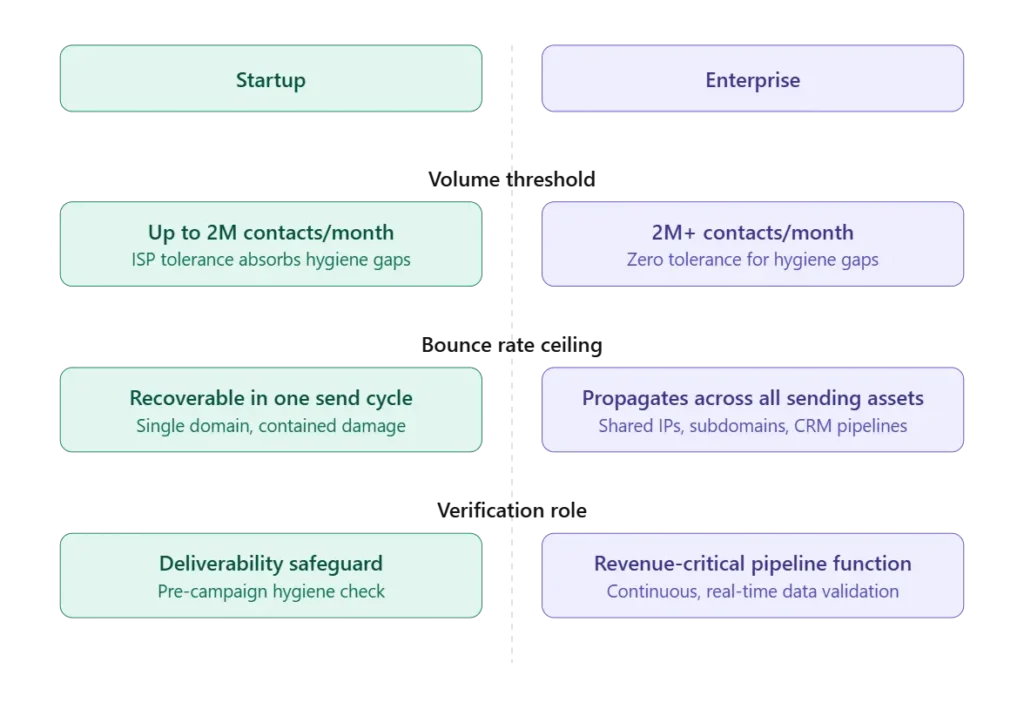
Startup vs Enterprise Email Verification: How Are Requirements Different?


Graphics showing startup vs enterprise email verification requirements compared.

The difference between startup and enterprise verification needs runs deeper than volume. What breaks, when it breaks, and how fast the damage spreads all change at each stage.

Here is a comparison of the core decision criteria across stages:

CriteriaStartupGrowth StageEnterprise
Budget SensitivityPay-as-you-go preferredMedium - monthly plans viableLow - annual contracts standard
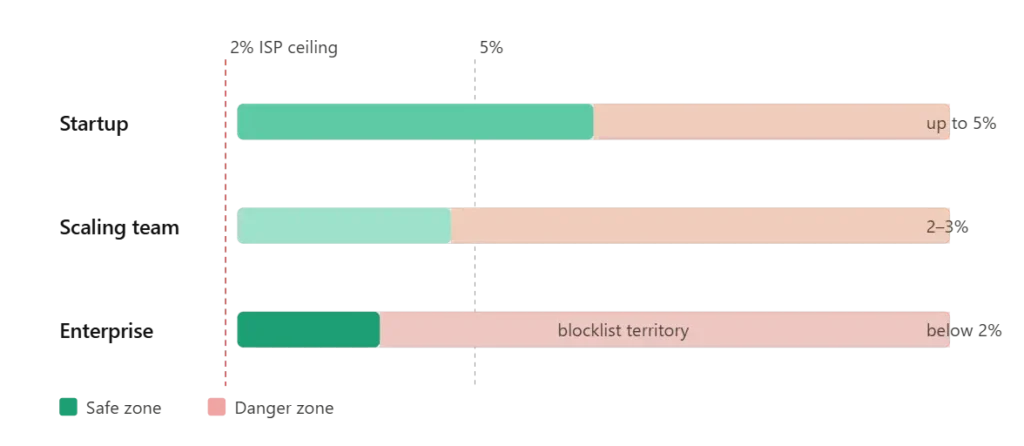
Bounce rate toleranceUp to 5% before ESP flags2-3% ceilingBelow 2% - non-negotiable
API requirementOptionalRecommendedNon-negotiable
Batch size needsUnder 50K50K-500K500K-10M+
Compliance requirementBasic GDPRGDPR + CCPAFull compliance stack + DPA
Verification frequencyPre-campaignOngoing + pre-campaignReal-time API + quarterly audits
Accuracy threshold95%+ acceptable97%+ consistently98%+ consistently
CRM integrationManual exportNative integration preferredAutomated sync required
Support SLAEmail supportChat + emailDedicated account management
Real-time vs BatchBatch sufficientBothAPI-first + batch for audits

1. Volume Thresholds That Change Verification Infrastructure


A startup sending 2,000 emails per month operates within ISP tolerance thresholds even with moderate list hygiene gaps. An enterprise processing 2 million contacts per month has zero tolerance for the same gaps.

Gmail and Microsoft enforce bounce rate ceilings at 2%, a threshold that a startup can recover from in one send cycle. At enterprise volume, crossing that threshold triggers domain-level filtering that affects every subsequent campaign.

2. How Sender Reputation Risk Scales Disproportionately With List Size


Sender reputation does not scale linearly with volume. A single high-bounce campaign on a new startup domain creates a recoverable reputation dip, one that clears with a cleaned list and a lower-volume follow-up send.

The same bounce rate across an enterprise infrastructure with shared IPs, multiple subdomains, and integrated CRM pipelines propagates damage across every sending asset simultaneously. Recovery at that scale requires weeks of IP warming, suppression list rebuilding, and reduced send volume. Each of those carries a direct revenue consequence.

3. Data Intake Velocity and the Point at Which Manual Verification Breaks


A startup adding 200 new contacts per week can absorb a manual upload-and-verify cycle without operational impact. The delay between contact acquisition and verification does not meaningfully affect campaign timing.

An enterprise acquiring thousands of contacts daily cannot absorb that lag. By the time a batch job runs, new contacts have already entered sequences. Manual intake verification stops working once lead volume grows beyond what the team can verify before those contacts enter sequences.

For most teams, that breaking point starts around 1,000 new records a day. After that, unverified contacts continuously enter campaigns faster than the verification process can clean them.

4. Catch-All Domain Exposure and Its Revenue Consequences


Catch-all domains accept every incoming email, whether the inbox exists or not. For enterprise teams, this creates a major verification problem because large companies often keep inactive employee aliases, old department inboxes, and unused addresses under catch-all protection. A contact may appear valid during verification but still bounce later, hurting deliverability and wasting outbound volume at scale.

At startup volume, catch-all addresses represent a manageable percentage of unknown deliverability. At enterprise scale, a list with 15-20% catch-all addresses and no secondary signal scoring creates significant hard bounce risk, since many of those addresses do not actually deliver. Enterprises require verification tools with secondary scoring models for catch-all addresses.

5. CRM Data Quality Degradation Over Time


Email addresses decay at roughly 22% annually. For a startup with a 5,000-contact CRM, approximately 1,100 addresses go invalid each year, a volume that a pre-campaign clean covers.

For an enterprise with 500,000 contacts, that number hits 110,000 invalid addresses per year. Stale data at that volume erodes segment accuracy, distorts engagement metrics, and corrupts attribution months before the root cause gets traced back to list quality.

6. IP Infrastructure and the Warm-Up Problem at Scale


Startups sending below 10,000 emails per month typically operate on shared IP infrastructure provided by their ESP. Deliverability incidents on shared IPs affect all senders on that pool, but the startup's own reputation exposure is contained.

Enterprises managing dedicated IP pools necessary at high send volume carry full responsibility for those IPs' reputations. A deliverability incident caused by an unverified list does not affect a shared pool. It directly damages the enterprise's own IP, requires a formal warm-up restart, and delays campaign execution until sending thresholds recover.

Read more: Dedicated IP vs Shared IP - Which One Is Better (Pros & Cons)

7. Third-Party Data Sourcing and Verification Depth Requirements


Startups build contact lists primarily through owned channels, web forms, trial signups, and content downloads. Contact quality is imperfect but predictable because the source is controlled.

Enterprises frequently supplement owned lists with purchased data, event lead exports, partner-sourced contacts, and intent data providers. Third-party sourced data carries significantly higher rates of invalid, role-based, and disposable addresses than owned-channel data.

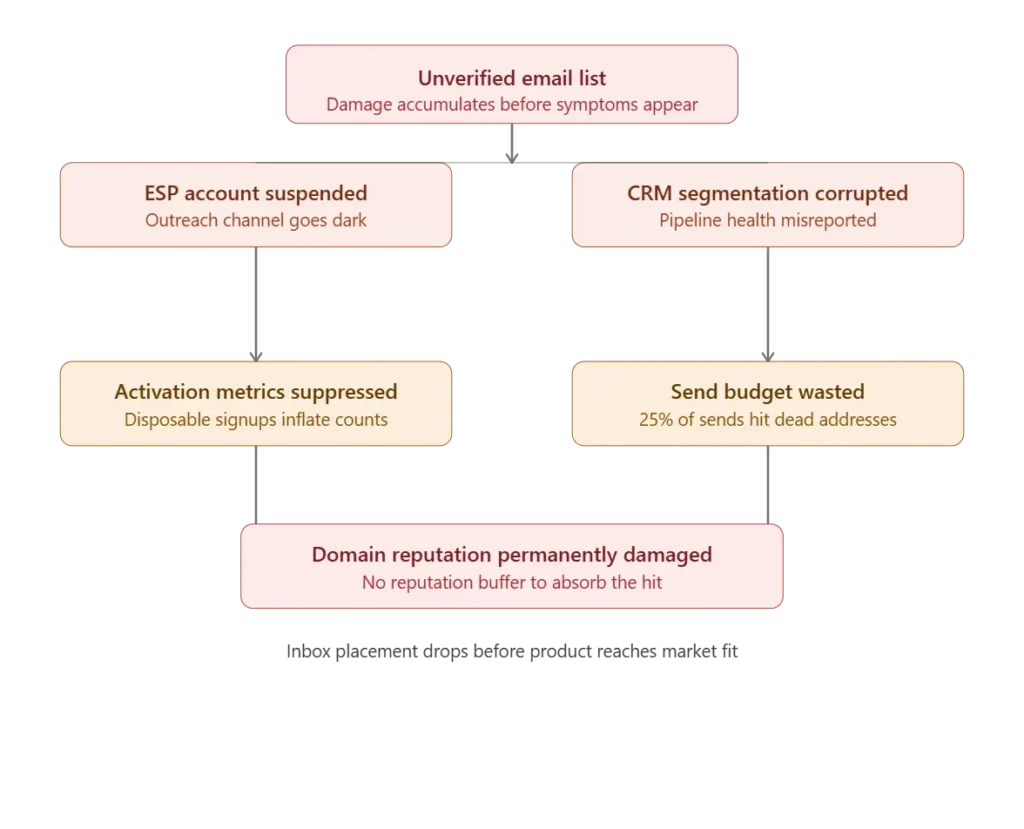
Why Do Startups Need Email Verification Before They Think They Do?


Graphics showing startup email verification consequences without verification.

Most startups treat email verification as a later-stage problem. By the time bounce rates cross ESP thresholds or accounts get flagged, domain reputation and pipeline are already affected.
Here is what goes wrong without it.

1. ESP Account Suspension Stalls Revenue-Generating Campaigns


Most ESPs enforce bounce rate thresholds between 2 and 5%. Without email verification for startups, a single campaign sent to an unverified list can trigger account suspension. That cuts off the primary outreach channel mid-cycle.

For a startup where each campaign directly funds the next growth phase, losing that outreach channel for even two weeks has measurable pipeline consequences.

2. Invalid Contacts Produce Segments That Skew Revenue Forecasts


Unverified contacts register as active in the CRM. Sales and marketing teams build segments, set targets, and forecast pipelines on data that includes addresses that will never respond.

That gap does not surface until conversion rates fall short. By then, multiple campaigns have already been planned and executed against inaccurate numbers.

3. Inflated Signup Counts Make Product-Market Fit Harder to Measure


For SaaS startups, activation rate is a core product-market fit signal. Unverified trial signups introduce disposable and role-based addresses at 15-30% of total signups. This inflates the denominator and suppresses activation rates with no corresponding product problem.

Onboarding flows, pricing decisions, and feature priorities built on those numbers inherit the same distortion.

4. Budget Gets Allocated to Contacts That Cannot Convert


Email list cleaning for startups is a direct cost control measure. On a 10,000-contact list with 25% invalid addresses, 2,500 sends per campaign produce no revenue outcome.

That cost compounds across every campaign cycle. The budget gets repeatedly allocated against contacts that were never deliverable. Simultaneously, bounce accumulation degrades the domain's sending capacity.

5. New Domain Reputation Has No Buffer for Deliverability Incidents


An enterprise domain absorbs occasional deliverability incidents because years of positive sending history have built the reputation needed to withstand them. A startup domain has none.

One campaign sent to an unverified list that crosses ISP bounce thresholds can permanently reduce inbox placement rates. At that stage, most startups have not built enough pipeline to absorb the business impact that follows.

Why Is Enterprise Email Verification Non-Negotiable Infrastructure?


Bounce rate safe zones vs danger zones for startup, scaling team, and enterprise senders.

At enterprise scale, email verification is not a pre-send hygiene step. It is a continuous data pipeline function embedded across CRM intake, outreach sequencing, and deliverability monitoring.

1. API-First Architecture vs Batch Upload Dependency


Batch upload verification works at startup volume. Upload a CSV, wait for results, and re-import the cleaned list. That cycle is manageable when contact intake is low and campaigns run weekly.

At enterprise scale, contact intake is continuous. Web forms, CRM integrations, event data, and third-party providers add new records daily. By the time a batch job completes, those contacts have already entered outreach sequences.

Enterprise email verification requires an API-first architecture that validates addresses at the point of entry, before any record enters the pipeline. Batch processing remains relevant for periodic full-list audits, but cannot be the primary verification method at this volume.

2. Why Verification Throughput Breaks at Enterprise Volume?


A system that cleans 50,000 records smoothly can slow down, timeout, or get stuck in queues at 500,000 records. Every provider has limits on how many email checks they can run at once and how large each batch upload can be.

Some tools handle small lists well but struggle when enterprise teams start pushing millions of records through the system regularly. At enterprise scale, lower limits slow down your entire outreach operation because campaigns start piling up in queues instead of running immediately.

3. Compliance, Data Residency, and SLA Requirements


Enterprise email verification operates within GDPR, CCPA, and sector-specific regulatory frameworks. Where contact data is processed and stored during verification is not a preference. It is a contractual requirement in most enterprise procurement cycles.

SOC 2 Type II certification, signed DPA agreements, and uptime SLAs are non-negotiable at the enterprise procurement level. These are not evaluation criteria that appear on a startup checklist. At enterprise scale, they determine whether a verification tool can be contracted at all.

How to Compare Email Verification Cost vs Scale vs Accuracy?


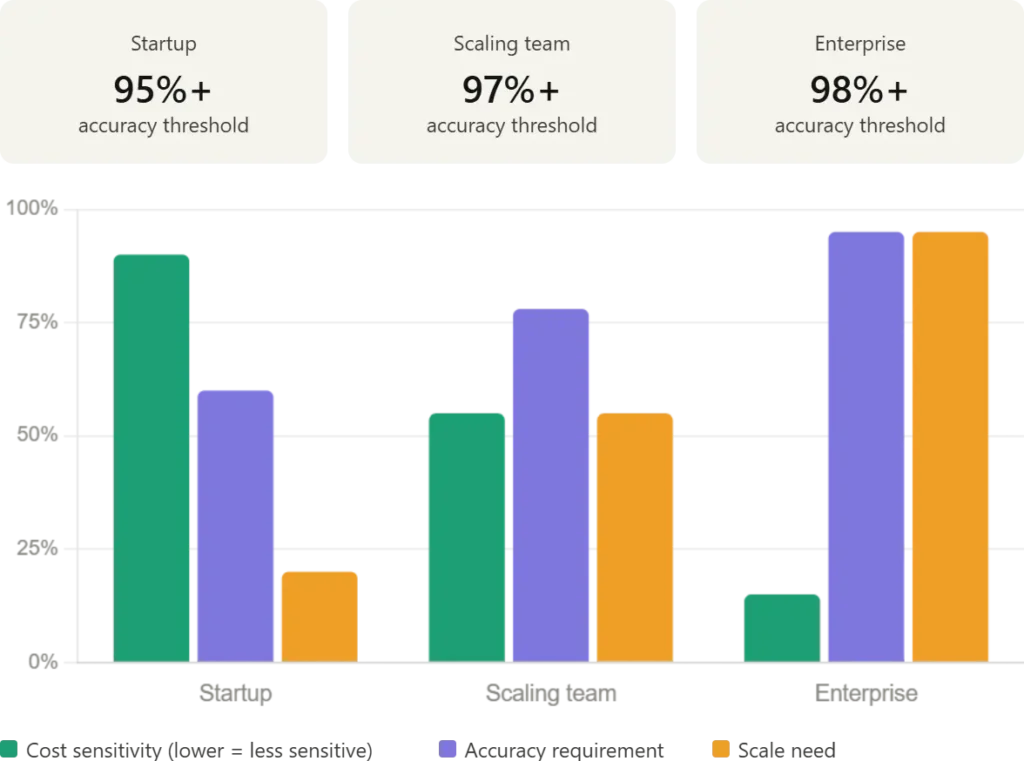
Cost vs accuracy vs scale by stage.

Cost, scale, and accuracy don't always go hand in hand, and the balance is different depending on the team's position on the growth curve. Each time, the pricing model that works within your budget, the volume your tool can process, and the accuracy rate your pipeline can withstand aren't always on par.

VariableEmail Verification Evaluation Criteria
CostThe pricing model and budget commitment required to verify contacts at your current send volume
ScaleThe volume of contacts your verification tool can process without throttling, queuing, or accuracy degradation
AccuracyThe percentage of contacts correctly classified as valid or invalid directly determines how many false positives enter your sending pipeline

1. Per-Credit Pricing vs Subscription Models at Each Stage


For email list cleaning for startups, pay-as-you-go per-credit pricing prevents budget overcommitment during unpredictable growth phases. At the scaling team stage, monthly subscription tiers reduce per-verification cost without requiring an annual contract commitment.

Enterprise procurement moves to annual contracts with custom volume pricing, but that model only works if your team can forecast volume accurately. Underestimating means overpaying for unused capacity. Overestimating means the tool throttles when you actually need it.

2. What Low Accuracy Costs at High Volume in Real Revenue Terms


A verification tool delivering 94% accuracy on a 1 million-contact enterprise list produces 60,000 contacts marked valid that will hard bounce. At enterprise send rates, those 60,000 bounces trigger ISP filtering across the entire sending domain.

The cost is not 60,000 missed contacts. It is degraded inbox placement across the full list for every campaign that follows until domain reputation recovers, which takes 30 to 90 days minimum.

3. Startup vs Enterprise Accuracy Trade-off


At startup volume, 95% accuracy is operationally viable. Contact lists are small enough that false positives do not accumulate into domain-level reputation damage.

At enterprise scale, a 95% accuracy rate creates a structural deliverability problem that compounds with every send. The accuracy threshold is determined by the volume at which false positives produce ISP-level consequences, not by preference, budget, or tool availability.

How Unverified Lists Trigger ISP Enforcement and Blocklist Placement at Scale?


Unverified lists do not just produce bounces; they trigger automated ISP enforcement that compounds across every subsequent send. At high volume, the damage moves faster than most teams detect it.

1. ISP Thresholds, Bounce Ceilings, and IP Warm-Up Impact


Gmail and Microsoft enforce spam complaint thresholds at 0.1% and hard-bounce ceilings at 2%. At enterprise send volume, these thresholds activate automatically with no manual review. Exceeding them triggers domain-level filtering that reduces inbox placement across all campaigns.

A new IP warming toward full send volume that encounters elevated bounce rates during the warm-up window gets flagged before it reaches operational capacity. That pushes the warm-up timeline out by weeks and delays every campaign queued behind it.

2. Spam Trap Accumulation and Reputation Recovery


Spam traps, which are abandoned addresses converted by ISPs into deliverability monitors, accumulate in lists that are not regularly verified. At startup volume, a single spam trap hits registers as an isolated incident.

At enterprise volume, even a small spam trap rate can create serious deliverability issues. Lists with higher spam trap density are far more likely to land on major RBLs like Spamhaus and Barracuda, which are widely referenced by mailbox providers and enterprise email systems.

Checklist for Choosing an Email Verification Tool for Startups or Enterprises


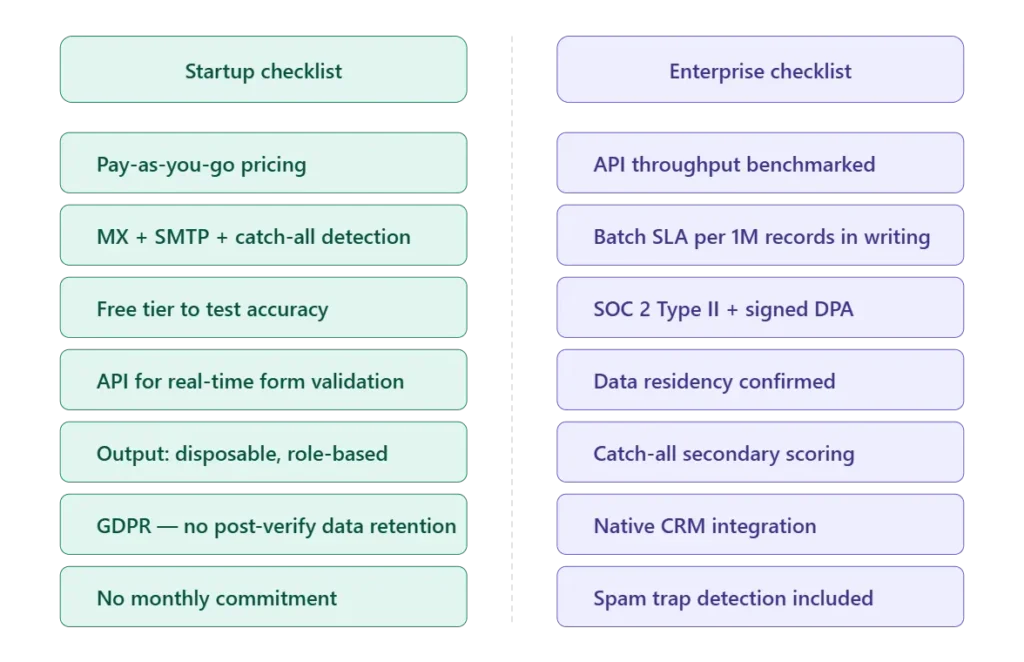
Graphics showing Side-by-side startup and enterprise email verification checklists.

Startup Checklist


  • Pay-as-you-go pricing with non-expiring credits: Avoid tools that expire unused credits within 12 months.
  • Minimum verification depth: Syntax, MX record, SMTP handshake, disposable detection, catch-all flagging.
  • Free tier of 100-500 verifications: To test accuracy against your actual list type before committing budget.
  • API access for real-time form verification: Even at an early stage, point-of-entry validation prevents invalid contacts from entering your CRM at all.
  • Output categories beyond binary pass/fail: Valid, invalid, disposable, catch-all, and role-based.
  • GDPR-compliant data processing: Contact data should not be retained by the vendor post-verification.
  • No minimum monthly commitment: Startup verification volume is unpredictable.

Enterprise Checklist


  • API throughput capacity confirmed for your peak volume: Request benchmark data, not just stated limits.
  • Batch processing SLA: Maximum processing time per 1 million records in writing.
  • SOC 2 Type II certification and signed DPA: Available before contract execution. Non-negotiable for procurement.
  • Data residency options confirmed against your compliance jurisdiction: Where contact data is processed during verification is a contractual requirement
  • Catch-all domain handling with secondary signal scoring: Not binary unknown classification.
  • Native CRM integration with HubSpot, Salesforce, or your specific stack: Not just a Zapier dependency.
  • Dedicated account management and escalation path in SLA: Not just standard support queue access.
  • Spam trap detection included in the base plan: Not sold as a separate add-on tier.

Clearout meets both sets of criteria as it gives real-time API verification, is SOC 2 Type II compliant, and has native CRM integration for enterprise pipelines.

Verification Failure Signals That Indicate a Tool Cannot Scale With You


  • Accuracy claims without published methodology or independent benchmark data
  • No catch-all domain differentiation
  • Rate limiting that throttles below your current monthly volume
  • Credits that expire create budget pressure and force wasteful usage patterns
  • No SMTP verification syntax-only tools are not verification tools

Bottom Line


At smaller volumes, almost any verification tool looks accurate enough. A few bad emails do not change much when you are sending to 5,000 contacts. The problem only becomes obvious when the database grows.

At a few million records, the same margin of error starts affecting everything around it. Bounce rates climb faster. Even small API slowdowns start creating backlogs between lead capture and outreach.

This is also where weaker verification systems start showing their limits. Some tools work perfectly fine for occasional list cleaning, but struggle once verification becomes part of a real-time outbound workflow running every day across multiple systems.

That is the gap Clearout was built for. Startups can use it to clean lists before campaigns and improve deliverability early. Enterprise teams can plug it directly into CRMs, signup flows, enrichment systems, and outbound infrastructure without worrying about scale, speed, or verification reliability breaking later.

Verification built for scale


Try For Free

FAQs


1. What is email list cleaning?
Email list cleaning is the process of removing invalid, inactive, and undeliverable addresses from a contact database before any campaigns are sent. This directly prevents bounce rate accumulation and protects sender reputation from deliverability damage.
2. How often should you clean your email list?
Startups should verify before every major campaign send. Enterprises need point-of-entry API validation for new contacts and full-list audits at least quarterly. Lists sourced from third-party providers decay faster than 22.5% annually and require more frequent cleaning cycles.
3. What are the key features to compare when evaluating email marketing services for small businesses?
Key features to evaluate are verification accuracy, API availability for point-of-entry validation, and pricing models that do not expire unused credits. Catch-all domain detection and CRM integration depth determine whether the tool fits your intake pipeline or functions only as a standalone list cleaner.
4. What does an email verifier do?
An email verifier checks whether an address exists, can receive mail, and passes MX record, SMTP, and syntax validation without sending an actual email. It identifies invalid, disposable, role-based, and catch-all addresses before any of them get queued for outreach.
5. Why is email deliverability important?
Inbox placement determines whether your outreach reaches the recipient or gets filtered before it's seen. At high send volumes, a 5% deliverability drop translates to thousands of missed contacts per campaign. Each incident damages the domain's reputation and decreases email deliverability.

Share this article

Recent Posts

29 May 2026
Email Verification for Startups vs Enterprises: What Changes at Scale

Explore startup vs enterprise email verification as businesses scale. Learn how requirements differ ...

22 May 2026
8 Best Email Tracking Tools in 2026

Discover the 8 best email tracking tools in 2026 for Gmail, Outlook, and team performance tracking. ...

21 May 2026
How Fake Form Submissions Are Wasting Your PPC Budget

Fake form submissions inflate CPL, and waste your PPC budget. Discover how to block spam form submis ...

18 May 2026
13 Go-To-Market Metrics to Track Across Every Funnel Stage

Explore the most important GTM metrics to track across every funnel stage, from awareness to revenue ...

13 May 2026
7 Signs You Need to Switch Your Low Accuracy Email Finder

Discover 7 measurable signs it’s time to switch your low accuracy email finder before high bounce ra ...

Clearout's

Form Guard

Validate email, phone & name on any forms!

  • Real signups only
  • Verified emails
  • Valid phone numbers
  • No fake names
  • Cleaner CRM
  • No devs needed
Try for Free Now

Email Verification, Email Finding Form Guard & Prospecting Service

Expand Your Reach By Finding & Verifying Ideal Prospects.

Sign up & get 100 free credits

No Credit Card required

Create Free Account
Company

Why Clearout?

Pricing

Contact Us

Careers

Press

Enterprise

Sitemap

FAQ

Status

Products

Email Verifier

Email Finder

Form Guard

Prospect

LinkedIn Email Finder

Reverse Lookup

Google Sheets Add-on

WordPress Plugin

ClearoutPhone

What's New?

Resources

Integrations

HubSpot

Team Account

API

Compare Email Verifier

Compare Email Finder

Compare Prospecting

Use Cases

Blog

Help

Legal

Privacy Policy

Terms

DPA

Security

Trust Center

Certification

ISO 27001/2022

SOC 2 Type 2

GDPR

Partnership

HubSpot Certified

Affiliates

Partners

Clearout for browser

⚡ Supercharge Your Prospect Research with Clearout's LinkedIn Chrome Extension - Find and Verify Emails with Confidence!

Clearout Chrome extension

clearout
© 2026 Clearout Inc. All Rights Reserved. Powered by Clearout.
Auto Credit Replenishment is here! Your credits can now recharge automatically. Learn More ➞
X