

- Products
- ResourcesDEVELOPER

 API
API
Clearout APIs are structured around REST and JSON Webhooks
Capture real-time events in your application workflow Form Guard
Real-time form validation to keep bad contacts out of your CRMKNOWLEDGE BASE Getting started
Sending campaigns without bounces is made simple FAQ
FAQ
Easily find answers to services, security and common questionsUSE CASES Lead Generation
Learn how professionals generate quality leadsGUIDESPricing Transparent & flexible pricing to support pay-per-use or recurringCompare Email Verification Tools AI-powered email verification with 99%+ accuracy, real-time validation, and transparent risk scoringCompare Email Finder Tools Pre-verified B2B email addresses with confidence scoring, find real person email, not role-based addressData Pulse & HubSpot Breeze Intelligence Pre-verified B2B email addresses with confidence scoring, find real person email, not role-based addressBLOGSEmail Verification ToolsFind Anyone’s Email Address
Most Accurate, Fast & Free WaysForm Validation
Importance, Ways & Best PracticesView All Blogs - Pricing
- Integrations
- Enterprise
- Login



How to Stop Fake Signups on Your Shopify Store
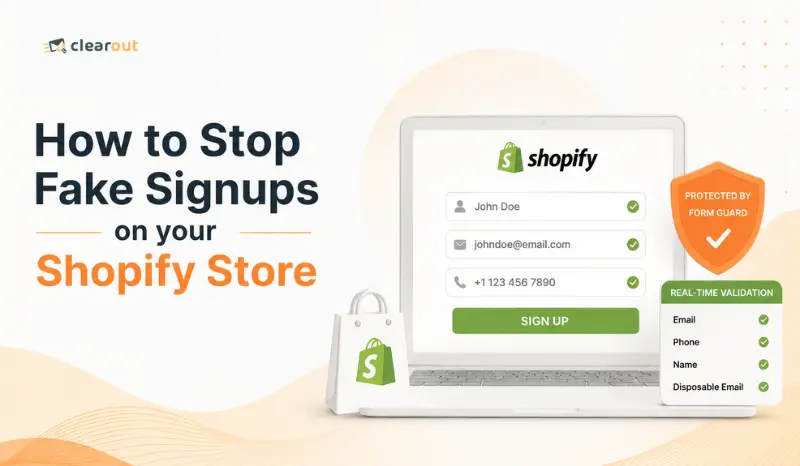
Hence, Shopify spam protection is no longer optional for merchants running discount-based signup flows. Every fake account inflates your Klaviyo or Postscript bill, skews conversion tracking, and burns SMS credits.
This guide covers how to stop fake signups on Shopify and why bots target your forms. It also shows how to prevent fake signups on Shopify and block form spam.
Table of Content
Why do fake signups hit your store?
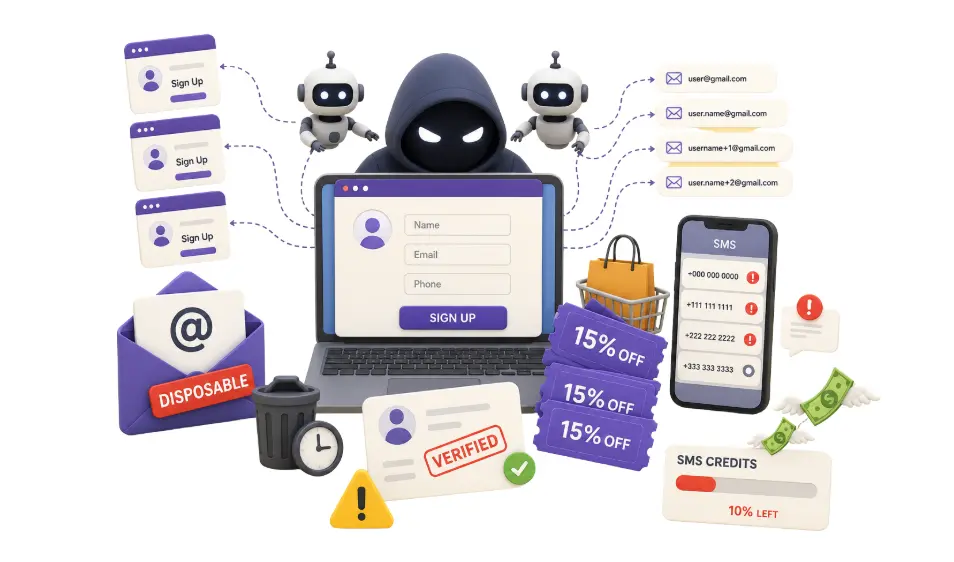
Some fake signups come from scripts, others from manual coupon hunters. They require different fixes, covered below.
Bots target signup forms automatically
Automated scripts scan the web for Shopify stores running first-order discount popups. They submit the signup form hundreds of times. Each submission uses rotating fake names and disposable emails. One merchant found over 2,000 fake accounts from a single bot. The bot cycled through the same fifteen name pairs.
These bots never buy anything. They exist to farm discount codes and inflate referral metrics.
Learn more: Best Tools to Stop Fake Signups and Form Abuse
Disposable emails slip past checkout
Disposable email services let anyone generate a working inbox in seconds. Use it to claim a discount, then let it expire. Shopify's account creation form doesn't check whether an email domain is real or throwaway by default. That gap lets services like Mailinator and Guerrilla Mail slip through untouched.
Every disposable signup counts as a real subscriber in your reports. But it will never open a campaign, click a link, or place an order again.
First-order discount abuse by coupon hunters
Many Shopify stores offer a 10-15% discount to first-time subscribers, and manual coupon hunters know exactly how to exploit it. They create multiple accounts using slightly different email variations.
Gmail's dot trick or plus-addressing makes this easy. A single shopper can generate a dozen "new" accounts this way, each one eating into your margin on an order.
SMS credits vanish on fake numbers
If you've got a sign-up form that gathers phone numbers for SMS marketing, invalid submissions can eat up your SMS credits at Klaviyo and Postscript. Sometimes people type in wrong numbers, or VoIP numbers that were not intended for texting from bots and careless signups.
Every message sent to one of these numbers is a wasted credit and a potential carrier complaint. At scale, this inflates your SMS costs without adding a single real subscriber.
How to stop fake signups on Shopify?
Begin with the first one, which will keep bad data from ever reaching your customer list, then add the rest for continued protection.
Add Form Guard to block Shopify form spam
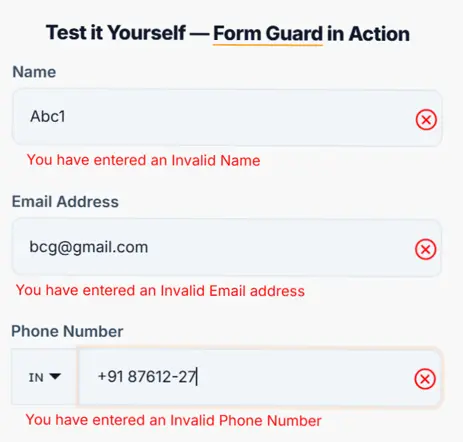
It also has an AI filter that checks for VoIP numbers and nonsense names. Form Guard flags bad data at the field level and blocks submission until it’s fixed.
Setup is one JavaScript snippet. The snippet pastes once and auto-detects all the forms on the page. This is why it blocks shopify form spam across platforms.
Form Guard works with Shopify forms and popular form builders like Hulk, Helium, Qikify, or POWR. There's no rebuild and no per-platform configuration required.
Turn on Shopify's spam protection settings
Shopify already blocks a layer of bots by default. Cloudflare can add an extra layer of protection on top, depending on your setup. Shopify uses hCaptcha to analyze visitor behavior on signup and login pages, keeping checkout smooth.
That said, confirm hCaptcha is active under your store's spam protection settings. It also helps keep your theme and apps updated, since outdated code is a common bot workaround.
Even with both in place, layering Form Guard on top catches what hCaptcha misses. A real person can still type fake emails. That’s why it's important to protect your forms against spam bots using multiple layers of protection.
Require email verification at signup
Shopify lets you require email verification before an account is fully created. Go to Settings, then Checkout, and set customer accounts to required or optional. Check the box for email verification.
This adds a confirmation step that most bots and coupon hunters won't bother completing. It removes the instant reward that made spamming the form worthwhile.
Clean your customer list regularly
Export your customer list and filter for accounts with zero orders, suspicious names, or spammy email domains. Delete them in bulk from the Shopify admin under Customers.
Do this monthly if your store sees steady bot traffic. A list left uncleaned for months makes it harder to tell which accounts are worth marketing to.
Monitor signups for unusual spikes
Watch for sudden jumps in signups. Look especially for spikes with no matching order activity, or a surge from a single country. Shopify analytics or Google Analytics can flag date and traffic-source anomalies.
Catching the pattern early means you act fast. You protect your email list, SMS costs, and discount redemptions before damage piles up.
The true cost of bad signups in a Shopify store
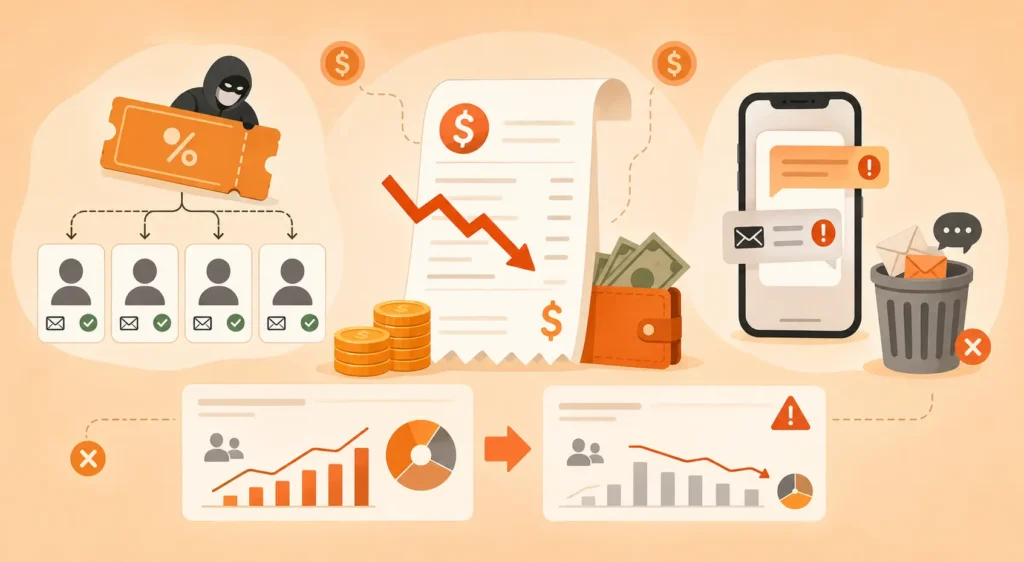
Coupon codes get abused fast
Every fraudulent coupon redemption cuts directly into gross margin, the exact number finance teams track closely.
As a result, RevOps reports a wrong discount rate, throwing off every margin forecast built on it. Nobody catches the gap until quarterly numbers fail to reconcile against the actual redemption logs on file.
SMS and email credits vanish
Marketing absorbs a deliverability penalty first, as suppressed sender scores throttle every future campaign account-wide.
Founders then see conversion rates drop for real subscribers too, since good sends now land in spam. RevOps has no clean way to separate that revenue loss from normal campaign fatigue or seasonality.
Disposable emails skew your data
Sales teams chase leads that were never real, burning hours on outreach with a zero close rate.
On top of that, founders and RevOps make budget and headcount calls as per conversion numbers inflated by 15 to 20%. Every downstream decision, from ad spend allocation to hiring a new rep, inherits that same error.
Bottom line
Form Guard stops fake signups on Shopify at the form itself. One script tag protects Shopify signup forms, including those built with Hulk, Helium, Qikify, and POWR, without any rebuild.