



clearout
  • Products
    • Email Verifier Verify emails addresses individually, in bulk or through API, with 99% accuracy
    • Catch-all Email Verification IconCatch-all Email Verification Resolve more catch-all and SEG-protected emails into Valid or Invalid results with Deep Verify.
    • Email Finder Find individual or bulk emails by entering the person & company name or domain
    • Form Guard IconForm Guard Protect your forms from spam, bots, and invalid submissions with real-time email, phone, and name verification.
    • Form Guard IconData Pulse Verify, enrich, and monitor your CRM contacts in real time - heartbeat monitor for your data.
    • ProspectSQL/MQL list building with high levels of personalization, real-time data enrichment and prospect search
    • Clearout For SheetsVerify email addresses directly on Google Sheets with Clearout for sheets add-on
    • Prospect – LinkedIn Chrome ExtensionBuild verified, targeted prospect lists directly from LinkedIn profiles
    • ClearoutPhoneValidate phone numbers across 240+ countries in bulk, quick or real time validation
    • Free Tools
    • Disposable Email Checker
    • Reverse LinkedIn Profile Lookup Tool
    • Reverse Email Lookup Tool
    • Email List Cleaner
    • Company Domain Finder API
  • Resources
      DEVELOPERAPI iconAPI
      Clearout APIs are structured around REST and JSON
      Webhooks iconWebhooks
      Capture real-time events in your application workflow
      Form Guard iconForm Guard
      Real-time form validation to keep bad contacts out of your CRM
      KNOWLEDGE BASEGetting started iconGetting started
      Sending campaigns without bounces is made simple
      FAQ iconFAQ
      Easily find answers to services, security and common questions
      USE CASESLead Generation iconLead Generation
      Learn how professionals generate quality leads
      GUIDESPricing arrow iconTransparent & flexible pricing to support pay-per-use or recurringCompare Email Verification Tools arrow iconAI-powered email verification with 99%+ accuracy, real-time validation, and transparent risk scoringCompare Email Finder Tools arrow iconPre-verified B2B email addresses with confidence scoring, find real person email, not role-based addressData Pulse & HubSpot Breeze Intelligence arrow iconPre-verified B2B email addresses with confidence scoring, find real person email, not role-based addressBLOGSEmail Verification ToolsFind Anyone’s Email Address
      Most Accurate, Fast & Free Ways
      Form Validation
      Importance, Ways & Best Practices
      View All Blogs
  • Pricing
  • Integrations
  • Enterprise
  • Login
Try it free Book a 1-to-1 demo
Akanksha Mishra / September 29, 2026 September 29, 2026

What Unresolved Catch-Alls Could Cost Your Pipeline


What Unresolved Catch-Alls Could Cost Your Pipeline

TL;DR


  • A catch-all domain accepts messages for addresses without confirming that the individual mailbox exists.
  • Unresolved catch-alls can introduce uncertainty into pipeline estimates when they are treated like confirmed valid contacts.
  • Potential pipeline exposure can be estimated using unresolved catch-all contacts, expected opportunity rate, and average deal value.
  • Catch-all contacts need separate analysis from confirmed valid contacts when measuring campaign performance.
  • Prioritize high-value and previously engaged catch-all contacts before new cold prospects.
  • Recheck and suppress unresolved catch-alls when additional evidence indicates a higher risk.
  • Clearout can further verify some catch-all addresses, helping determine whether they can be treated as deliverable with greater confidence.

You may have thousands of contacts in your database that appear usable but carry an unknown level of deliverability risk.

That uncertainty often goes unnoticed. Contacts from catch-all domains can make their way into pipeline forecasts, account plans, and outbound campaigns long before anyone knows whether a real mailbox exists behind the address.

The challenge sits with the domain itself. Catch-all domains accept incoming mail without confirming mailbox existence. This leaves sales and marketing teams with records that look valid but remain unresolved.

Understanding how much pipeline is tied to those unresolved contacts is becoming increasingly important as teams rely more heavily on CRM data for forecasting and planning.

In this guide, we'll look at how to quantify the potential exposure linked to catch-all emails, identify which records deserve attention first, and how Clearout Email Verifier's Deep Verify feature helps resolve catch-all addresses into Valid and Invalid contacts.

Table Of Content


‣ TL;DR
‣ How do catch-all emails affect your pipeline?
‣ How to estimate catch-all pipeline exposure?
‣ What happens when a list contains a large number of catch-all emails?
‣ How should unresolved catch-alls be handled?
‣ How should catch-all leads be prioritized?
‣ How does Clearout help with catch-all Email Verification?
‣ How to handle unresolved catch-all emails?
‣ FAQ
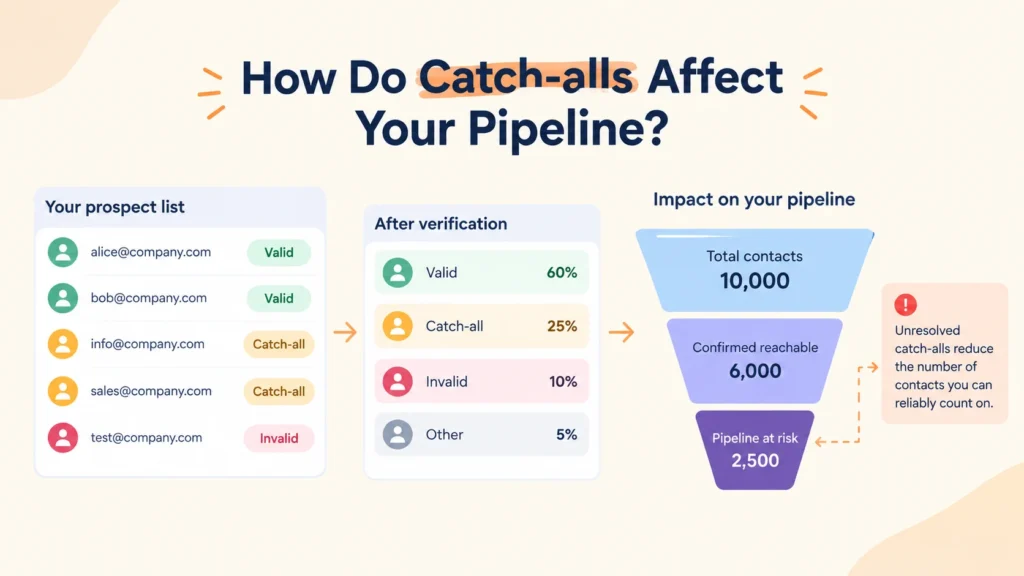
How do catch-all emails affect your pipeline?


Catch-all email verification showing contacts at risk in the sales pipeline.

A catch-all result tells you about the receiving domain. The domain is configured to accept messages sent to addresses that may not exist. Some messages can still be rejected later because of filters, mailbox limits, or security rules.

That creates uncertainty at the contact level.

If a prospect list contains 10,000 addresses and 1,000 are unresolved catch-alls, those 1,000 contacts are not equivalent to confirmed valid mailboxes.

That distinction matters when estimating how much of the list can be treated as confirmed reachable contacts.

This uncertainty can affect four areas of pipeline analysis:

  • Reachable contacts: The number of contacts with confirmed mailbox-level reachability is lower than the total list count.
  • Opportunity rate: Applying one conversion rate across valid and unresolved contacts can distort the estimate.
  • Pipeline exposure: Potential opportunities associated with unresolved contacts may carry additional uncertainty.
  • Campaign analysis: Catch-all contacts can make deliverability and conversion results harder to interpret.

For a deeper explanation, check our guide on Catch-all Emails: Impact on Deliverability & How to Handle Them.

How to estimate catch-all pipeline exposure?


A simple calculation can estimate the potential pipeline exposure associated with unresolved catch-all contacts. The formula is:

Potential pipeline exposure = Unresolved catch-all contacts × Expected opportunity rate × Average deal value


1. Inputs for the calculation


  • Unresolved catch-all contacts

  • Count the addresses currently classified as catch-all and still unresolved. Do not include confirmed valid, invalid, or unknown addresses in this number.

  • Expected opportunity rate

  • Use the opportunity rate that applies to the relevant campaign or segment. For example, if 2 out of every 100 contacts are expected to become opportunities, use 2%.

  • Average deal value

  • Use the average opportunity value for the segment being analyzed. If different segments have substantially different deal sizes, calculate them separately. This avoids applying one average value across unrelated prospect groups.

2. Pipeline exposure formula


Suppose a prospecting database contains:

  • 1,000 unresolved catch-all contacts
  • 2% expected opportunity rate
  • $8,000 average deal value

The calculation is: 1,000 × 2% × $8,000 = $160,000

The result is $160,000 in estimated pipeline exposure.

The calculation shows how much potential pipeline is associated with contacts whose mailbox-level deliverability remains uncertain.

3. Calculate potential catch-all pipeline exposure


You can use the same calculation for own list:

Unresolved catch-all contacts: ______
Expected opportunity rate: ______%
Average deal value: $______
Potential pipeline exposure:
Potential pipeline exposure = $________


Formula:
Catch-all contacts × opportunity rate × average deal value = potential pipeline exposure


Try another scenario:

2,500 × 1.5% × $12,000 = $450,000

That number gives revenue teams a starting point for deciding how much further verification is worth doing. It also makes the catch-all problem measurable.

What happens when a list contains a large number of catch-all emails?


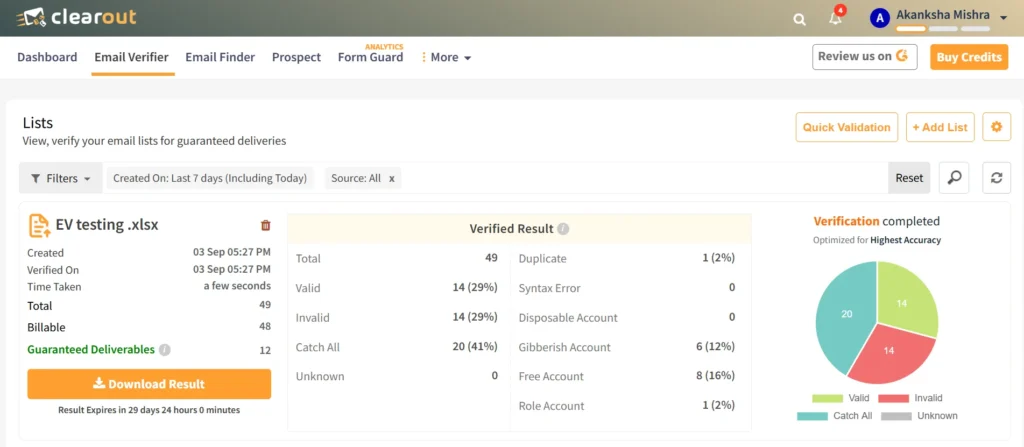
Clearout email verification results with valid, invalid, catch-all, and unknown emails.

I tested a prospect list to understand how many records fell into the catch-all category.

The sample contained 49 records:

  • 14 Valid
  • 14 Invalid
  • 20 Catch-All
  • 1 Duplicate

In this case, catch-all addresses represented the largest segment in the list, highlighting how much uncertainty can remain even after verification.

What do the results mean?


A catch-all domain accepts messages without confirming that the individual mailbox exists. Sending emails to unresolved catch-alls can increase delivery failures and make campaign results harder to interpret.

If a large share of the list contains unresolved catch-all addresses, treating them like confirmed valid contacts can also overstate the reachable audience and pipeline.

How should unresolved catch-alls be handled?


Unresolved catch-alls need separate handling from confirmed valid addresses. Treating them exactly like valid addresses removes useful information from the verification result.

At the same time, treating every catch-all as permanently unusable can remove potentially valuable prospects. Unresolved catch-alls can be classified based on available evidence and prospect value.

  • Separate catch-all addresses


  • Create a separate segment for unresolved catch-all addresses. Do not combine them with confirmed valid contacts when calculating deliverability or campaign performance.

    This makes later engagement and bounce analysis easier to interpret. It also lets sales and marketing teams apply different outreach rules to the segment.

  • Recheck unresolved addresses


  • Verification results can change as mail servers and mailbox configurations change. Recheck unresolved addresses when the verification data is outdated or when additional verification is needed.

    Clearout also distinguishes Catch-All from Unknown results. Catch-All indicates an accept-all domain configuration, while Unknown means the verifier could not receive a usable response at that time.

    But you can verify them as they enter your system. Real-time email verification can help identify these risky email addresses.

  • Suppress based on evidence


  • Use actual campaign evidence to decide whether an unresolved address should remain active.

    Consider suppressing an address after signals such as

    • Hard bounce
    • Repeated delivery failure
    • Persistent inactivity across relevant campaigns
    • Evidence that the contact or role is no longer active
    • Additional verification showing higher risk

    Suppression rules can be based on observed evidence rather than catch-all status alone.

    For broader list hygiene practices, see Clearout's email list cleaning guide

How should catch-all leads be prioritized?


Not every unresolved catch-all deserves the same level of verification effort. Prioritization can be based on two factors: prospect value and evidence that the contact is worth pursuing.

  • High-value prospects


  • Start with prospects that have a high potential deal value or strategic account value.

    For example, a $20,000 potential opportunity may justify more verification effort than a low-value prospect with limited buying potential.

    This is also where the pipeline exposure calculation becomes useful. Higher-value opportunities can justify additional verification before outreach.

  • Previously engaged contacts


  • Prioritize catch-alls connected to contacts who have previously interacted with your business.

    Relevant signals can include:

    • Previous email engagement
    • Demo requests
    • Form submissions
    • Event registrations
    • Previous sales conversations
    • Existing customer or expansion activity

    These contacts already have evidence beyond the email address itself. Use these signals alongside catch-all status when deciding whether further verification is needed.

  • New cold prospects


  • New cold prospects have less supporting evidence. For these contacts, use stricter qualification before allocating additional verification or outreach effort.

    Consider company fit, role relevance, account value, and available contact signals alongside the catch-all status.

    Add verification or data qualification layer before including these contacts in active outreach.

How does Clearout help with catch-all Email Verification?


The challenge with catch-all domains is that standard verification often stops at the domain level. You know the domain accepts emails, but you still don't know whether the individual mailbox exists.

That's where Clearout Email Verifier helps.

Clearout Email Verifier identifies catch-all addresses as part of its 20+ validation checks. It categorizes results separately from Valid, Invalid, Unknown, Disposable, Gibberish, Free, and Role-based addresses.

This separation helps teams decide how each segment should be handled before outreach.

Clearout's Deep Verify performs additional checks on catch-all addresses to determine whether the specific mailbox can be classified as Valid or Invalid. It resolves a portion of catch-all results into these statuses, helping separate potentially deliverable addresses from those that should be excluded from outreach.

With the help of multi-layer SMTP analysis, it can spot the difference between a real mailbox and a "accept everything" reply. Deep Verify also checks Proofpoint, Mimecast, and Microsoft EOP by their SMTP signatures.

This reduces the uncertainty that remains when catch-all addresses are left unresolved. You can use the verifier for bulk list validation, individual checks, or API-based workflows.

For connected workflows, see Clearout's integrations.

How to handle unresolved catch-all emails?


Unresolved catch-alls create uncertainty, but they do not automatically mean lost opportunities. Measuring potential pipeline exposure provides a useful way to assess the segment without treating every catch-all as either safe or unusable.

The goal is to separate uncertain contacts from confirmed valid ones. This helps keep pipeline analysis accurate and focus verification efforts where they matter most.

Verify catch-all emails with Clearout today

FAQ


1. How much do catch-all emails cost your pipeline?
There is no fixed cost associated with unresolved catch-all emails. Estimate pipeline exposure by multiplying unresolved catch-all contacts by the expected opportunity rate and average deal value. This shows the potential opportunity value associated with unresolved catch-all contacts.
2. How do unresolved catch-all emails affect revenue?
Unresolved catch-alls introduce uncertainty into the number of contacts available for outreach. If those contacts are included in pipeline calculations as confirmed reachable contacts, opportunity estimates can become less precise. The actual revenue impact depends on delivery, engagement, conversion, and deal value.
3. Are catch-all emails hurting your sales pipeline?
Yes. A large unresolved catch-all segment can add uncertainty when contacts are treated as confirmed reachable prospects in pipeline calculations. Separating catch-alls from valid contacts makes this potential exposure easier to measure.
4. What should you do with unresolved catch-all emails?
Separate unresolved catch-alls from confirmed valid addresses, then prioritize high-value or previously engaged contacts for further verification. Clearout Email Verifier identifies catch-all addresses during verification, helping segment them and determine which contacts need further verification.

Share this article

Recent Posts

29 Sep 2026
What Unresolved Catch-Alls Could Cost Your Pipeline

Learn how unresolved catch-all emails can affect pipeline estimates, calculate potential exposure, a ...

28 Sep 2026
How to Set Up Lead Routing Rules in Lofty CRM

Learn how to set up lead routing rules in Lofty CRM, from conditions and rule order to Round Robin, ...

25 Sep 2026
Post-Event Outreach: Find Emails From Conference Contacts

Learn how to build a post-event outreach list from badge scans, business cards, and LinkedIn, and fi ...

24 Sep 2026
Clearout vs. Koalify Email Verifier

Comparing Clearout vs. Koalify email verifier on accuracy, catch-all detection, CRM integrations, an ...

24 Sep 2026
Clearout Expands Into a Data Qualification Layer for GTM Teams

Clearout builds a data quality layer for GTM teams with Data Pulse, Form Guard, Deep Verify, and Cle ...

Clearout's

Form Guard

Validate email, phone & name on any forms!

  • Real signups only
  • Verified emails
  • Valid phone numbers
  • No fake names
  • Cleaner CRM
  • No devs needed
Try for Free Now

Email Verification, Email Finding Form Guard & Prospecting Service

Expand Your Reach By Finding & Verifying Ideal Prospects.

Sign up & get 100 free credits

No Credit Card required

Create Free Account
Company

Why Clearout?

Pricing

Contact Us

Careers

Press

Enterprise

Sitemap

FAQ

Status

Products

Email Verifier

Catch-all Verification

Email Finder

Form Guard

Data Pulse

Prospect

LinkedIn Email Finder

Reverse Lookup

Google Sheets Add-on

WordPress Plugin

ClearoutPhone

What's New?

Resources

Integrations

HubSpot

Team Account

API

Compare Email Verifier

Compare Email Finder

Compare Prospecting

Use Cases

Blog

Help

Legal

Privacy Policy

Terms

DPA

Security

Trust Center

Certification

ISO 27001/2022

SOC 2 Type 2

GDPR

Partnership

HubSpot Certified

Affiliates

Partners

Clearout for browser

⚡ Supercharge Your Prospect Research with Clearout's LinkedIn Chrome Extension - Find and Verify Emails with Confidence!

Clearout Chrome extension

clearout
© 2026 Clearout Inc. All Rights Reserved. Powered by Clearout.
Validate Enrich New Salesforce contacts automatically with Data Pulse. Learn More ➞
X