



• Products
    • FindEmail FinderFind verified business emails from a name and companyLinkedIn Email ExtractorExtract person and company details enriched with emails and phone numbers from LinkedIn profilesProspectBuild SQL and MQL lists with real-time enrichment
      VerifyEmail VerifierAI-powered email verification in real time, in bulk or through APICatch-all Email VerificationResolve catch-all and SEG-protected addresses with Deep VerifyClearout for SheetsVerify emails inside Google Sheets
      Protect & maintainForm GuardCapture intent leads, block fake or bot entries, and differentiate human vs. AI agent submissionsData PulseVerify, enrich and monitor CRM contacts continuously
  • Solutions
    • Sales teamsFind and verify buyer emails for outboundEmail marketersProtect sender reputation before every send
  • Resources
    • DeveloperAPIReference and quick-start guidesWebhooksReal-time event notificationsForm Guard SDKReal-time form validationMCP ServerConnect AI assistants to Clearout
      Knowledge baseGetting startedSet up your account in minutesFAQAnswers to common questionsLead generationBuild clean, verified lead lists
      GuidesPricing guideHow credits and plans workCompare email verifiersHow email verification tools compareCompare email findersHow email finder tools compareData Pulse & HubSpot BreezeKeep Breeze Intelligence data reliable
      BlogEmail verification toolsA guide to choosing a verifierFind anyone's email addressPractical ways to find a business emailForm validationBest practices for cleaner formsView all postsLatest articles and updates
      IntegrationsHubSpotTwo-way sync with Data PulseSalesforceValidate and enrich CRM recordsZohoKeep Zoho CRM contacts cleanApolloVerify contacts before outreachView all integrationsBrowse every connected tool
  • Free Tools
    • Disposable Email CheckerSpot throwaway addresses instantlyReverse LinkedIn Profile LookupLook up details from a LinkedIn profileReverse Email LookupFind who is behind an email addressEmail List CleanerRemove invalid emails from your listCompany Domain Finder APIFind a company domain from its name
  • Pricing
  • Login
Try it free Book a 1-to-1 demo
Akanksha Mishra / October 8, 2026 October 8, 2026

How Fake Signups Distort Marketing Attribution and Funnels


How Fake Signups Distort Marketing Attribution and Funnels

Forms, gated content, event signups and campaign landing pages are all the entry points that can bring fake signups to your website. These may be bots or real people using fake names, temporary email addresses or any other invalid contacts.

As a marketer, you won't be able to notice if these are genuine prospects or fake ones. And they can affect attribution, provide false funnel conversions, damage MQL data, and even revenue reporting. It's a problem that can result in wrong observations and inefficient spending of resources.

This problem can be stopped right where fake signups enter your funnel with Clearout Form Guard. Let's get into the details right away!

Table Of Content


‣ In What Ways Can Fake Signups Enter the Funnel?
‣ What Are the Impact and Implications of Fake Signups on Attribution?
‣ What Impact Does Fake Volume Have on Marketing Channels?
‣ What Happens if Fake Leads Are in the Funnel?
‣ How to Not Take Wrong Decisions Caused by Fake Signups?
‣ What Impact Do Fake Signups Have on MQLs?
‣ How Marketers Can Prevent Fake Signups Before They Enter the Funnel?
‣ What Should Marketers Expect After Cleaning Their Data?
‣ Bottom Line
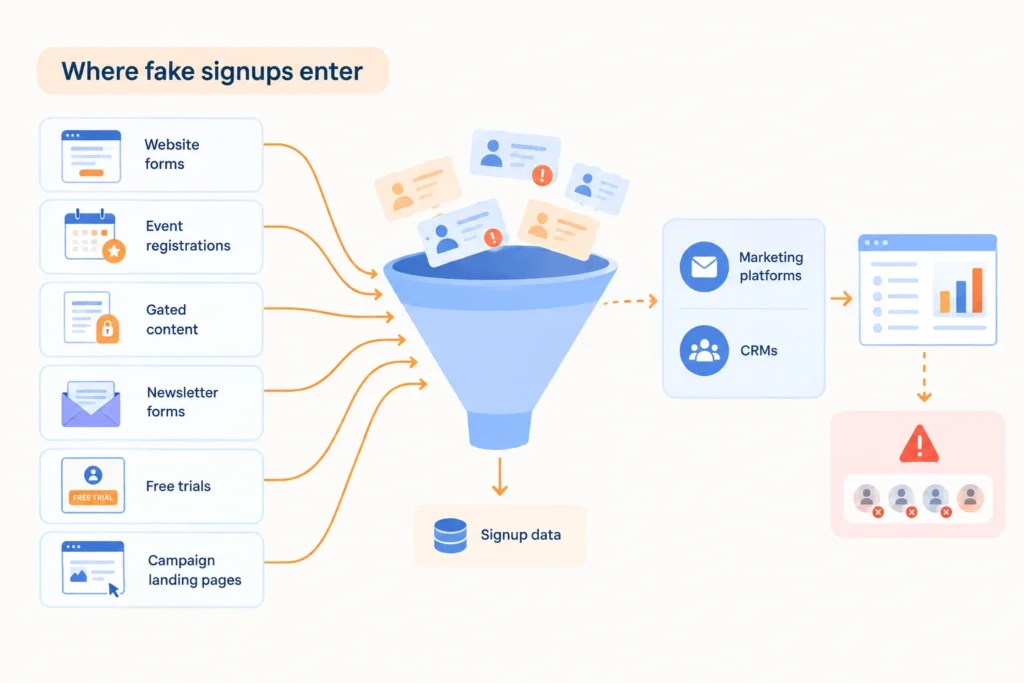
In What Ways Can Fake Signups Enter the Funnel?


Sources of fake signups flowing into marketing platforms and CRMs

Fake signups come into the funnel from any source that collects visitor data. These sources can include:

Website Forms


Leads can be generated through website forms using fake information.

Clearout Form Guard prevents these leads at the point of submission by verifying email, phone and name of the lead that enters the CRM via forms.

If lead contact info is verified through Form Guard, your workflows will get only high-quality data. The sooner a bad record is stopped, the less negative impact it has on marketing outcomes.

Other Signup Sources


Other sources of records include:

  • Event registration pages
  • Gated content forms
  • Newsletter signup forms
  • Free trials

Campaign landing pages


Submissions may be in the form of bots, disposable addresses, typo names, or inactive phone numbers. These can still boost signup numbers if verification is done at the later stage after their entry.

Quality checks are required for every source. If not, poor-performing campaigns may continue to appear successful in reports across multiple channels.

What Are the Impact and Implications of Fake Signups on Attribution?


Marketing attribution is the process of giving credit to the touchpoint, campaign, or source that led to a conversion. In the case of a fake signup, it will still receive attribution information just like a real prospect would.

A campaign might give you 100 signups and what if you find that 20 were fake users. CRM will still record 100 conversions in attribution reports.

The attribution is correct, but 20 of those records are not usable. The numbers appear better than they really are.

Comparing Channels Becomes More Difficult


Marketing teams benchmark channels using metrics such as:

  • Conversions
  • Cost per lead
  • Cost per conversion
  • Conversions per dollar

These comparisons can be misleading if they do not account for the proportion of fake submissions across channels.

One channel may generate fewer entries but a higher percentage of real, usable submissions. Another channel may create more activity but contain more fake or low-quality records.

Funnel Conversion Rates Are Affected


The denominator used for calculating marketing funnel conversion rates can also be impacted by fake signups.

If a campaign produces 500 leads and 100 of them turn into MQLs, the lead-to-MQL conversion rate is:

100 ÷ 500 × 100 = 20%

If 100 of those leads were fake and the remaining 400 were usable, but the same 100 MQLs came from those 400 leads, then the new conversion rate becomes:

100 ÷ 400 × 100 = 25%

And it's a 5% increase.

What Impact Does Fake Volume Have on Marketing Channels?


Marketing channel comparisons are often made using signup volume. However, signup volume alone does not indicate lead quality.

Consider two campaigns:

  • Campaign A gets 1,000 signups
  • Campaign B gets 700 signups

Looking only at signup volume, Campaign A appears more successful.

However, if 300 of Campaign A's signups are fake, both campaigns actually generated 700 valid signups.

The same issue can affect conversion rates.

What Happens if Fake Leads Are in the Funnel?


Funnel metrics helps to check how many contacts move through funnel stages. Each stage has its own conversion rate.

So, what is a good gunnel conversion rate you should keep in mind?

Some funnels may convert at 3% to 5%, while top-performing funnels in certain industries may reach 10%.

Simple Conversion Example


Assume that:

  • 1,000 people visit a page
  • 50 people register

Your signup conversion rate is:

50 ÷ 1,000 × 100 = 5%

Now if 15 of those signups are fake, that leaves 35 valid signups from the same 1,000 visitors.

The new rate becomes:

35 ÷ 1,000 × 100 = 3.5%

This shows how fake signups can distort funnel conversion rates.

Lead-to-MQL Example


Let's say:

  • 500 leads generate 100 MQLs

The lead-to-MQL conversion rate is: 100 ÷ 500 × 100 = 20%

Now if 100 of those leads are fake.

Let's also assume that none of those fake leads were among the 100 MQLs.

You now have:

  • 400 usable leads
  • 100 MQLs

The new rate becomes:

100 ÷ 400 × 100 = 25%

The campaign won't suddenly become more effective.

Metrics Marketers Should Recalculate


Check the metrics from the stage where fake records have been entering your marketing funnel.

Next, find if those records progressed to subsequent stages.

If they did, recalculate each affected conversion rate.

Useful metrics include:

  • Signup-to-lead conversion
  • Lead-to-MQL conversion
  • MQL-to-SQL conversion
  • SQL-to-opportunity conversion
  • Opportunity-to-customer conversion

These rates should also be compared by source and campaign.

How to Not Take Wrong Decisions Caused by Fake Signups?


The problem occurs when unverified leads are treated as real demand. This can result in poor marketing decisions.

Let's look at how fake signups affect decision-making.

Budget


You may add more budget to a campaign that seems to be successful because of fake signups.

This affects decisions such as:

  • PPC budget allocation
  • Paid social spend
  • Landing page optimization
  • Channel prioritization
  • Campaign scaling decisions

Campaign Optimization


Campaign teams use conversion data to improve:

  • Landing pages
  • Offers
  • Messaging
  • Audience targeting

One landing page might look like it's converting at a high rate due to fake data. Another page may produce fewer submissions but generate stronger leads.

Evaluating downstream qualification helps distinguish between activity and actual funnel performance.

Downstream Channel Performance


Compare:

  • Signups
  • MQLs
  • SQLs
  • Opportunities

This reveals how effectively each source contributes to business outcomes.

Revenue Reporting


If those historical conversion rates include large numbers of fake leads, revenue projections can be incorrect.

This starts much earlier when inflated lead counts are used to model future pipelines.

What Impact Do Fake Signups Have on MQLs?


MQLs are leads that satisfy marketing qualification criteria like:

  • Firmographic fit
  • Engagement signals
  • Website activity
  • Lead scores
  • A combination of factors

Fake signups can sometimes change the same qualification signals as real prospects.

This can reduce trust in MQL quality, affect sales follow-up, and make lead quality appear better than it actually is.

For example, a campaign generates:

  • 1,000 leads
  • 200 MQLs
  • 20% lead-to-MQL conversion rate

Later, 200 leads are discovered to be fake.

The campaign now has:

  • 800 usable leads
  • 200 MQLs

The new lead-to-MQL conversion rate becomes:

200 ÷ 800 × 100 = 25%

The MQL count didn't change.

How Marketers Can Prevent Fake Signups Before They Enter the Funnel?


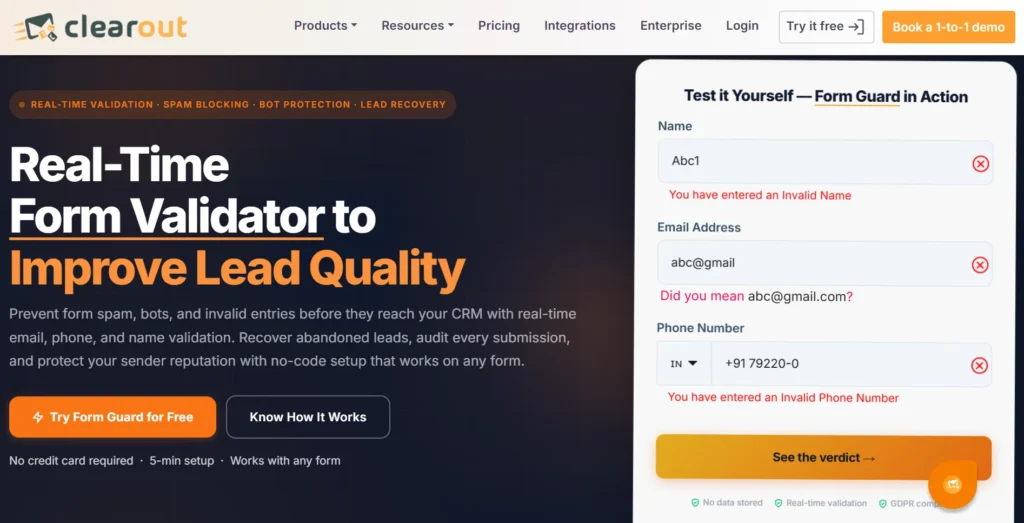
Clearout Form Guard showing test results

A form that gives you verified leads can be a solid baseline for funnel reporting. And this can be done with Form Guard. Let's get into the detail how this form validation tool can help you stop spam form submissions.

Clearout Form Guard can:

  • Checks and even blocks junk email addresses, invalid phone numbers, and typo names before they enter the funnel.
  • Stop bots from inflating signup and conversion numbers.
  • You can integrate it to form builders or JavaScript without replacing their existing lead capture process.
  • Verified leads can be passed into connected systems according to configured criteria.

Stop fake leads at the form level with Clearout Form Guard

What Should Marketers Expect After Cleaning Their Data?


Removing fake leads can change not only funnel volume but also the conversion rates calculated throughout the funnel.

The impact depends on:

  • Where fake records entered the funnel
  • Whether they progressed through later stages

Changes may occur in:

  • Lead-to-MQL conversion
  • MQL-to-SQL conversion
  • Channel-level conversion
  • Campaign-level conversion
  • Cost per qualified lead
  • Pipeline generated per channel

Bottom Line


Signups do not necessarily equal leads. Not every lead becomes an MQL. And not every MQL becomes a pipeline.

If fake signups are entering the funnel, funnel metrics will be affected at every stage.

Remove those records and then recalculate conversion rates for the affected stages.

Clearout Form Guard will prevent the fake email addresses, phone numbers and names from getting into the funnel at the form level.

This provides marketers with high-quality lead details to monitor and measure correct metrics across campaigns and channels.

Block fake signups and prevent them from impacting attribution.


Try Form Guard for Free

Share this article

Recent Posts

24 Nov 2026
Salesforce Email Tracking: A Complete Guide

Learn how Salesforce email tracking works, enable tracking, understand open data limitations, and im ...

24 Nov 2026
Clearout MCP: How to Verify and Find Emails Inside Your AI Assistant

Connect Clearout MCP to Claude, ChatGPT and other AI assistants to find business emails, verify addr ...

24 Nov 2026
Email Marketing Tips for Insurance Agents: A Complete Guide

Learn email marketing tips for insurance agents, from campaign examples and list verification to pre ...

19 Nov 2026
6 Email Finder Tools for AI Agents

Explore 6 email finder tools for AI agents. Compare features, verification, APIs and MCP integratio ...

17 Nov 2026
Best Inbound Email APIs: Features, Pricing, and Comparison (2026)

Compare the best inbound email APIs in 2026 by features, pricing, and use case. Learn how Clearout ...

Black Friday Sale - Up to 50% Off GRAB THE DEAL

Email Verification, Email Finding Form Guard & Prospecting Service

Expand Your Reach By Finding & Verifying Ideal Prospects.

Sign up & get 100 free credits

No Credit Card required

Create Free Account
Company

Why Clearout?

Pricing

Contact Us

Careers

Press

Enterprise

Sitemap

FAQ

Status

Products

Email Verifier

Catch-all Verification

Email Finder

Form Guard

Data Pulse

Prospect

LinkedIn Email Finder

Reverse Lookup

Google Sheets Add-on

WordPress Plugin

ClearoutPhone

What's New?

Resources

Clearout Insights

Integrations

HubSpot

Team Account

API

Clearout MCP

Compare Email Verifier

Compare Email Finder

Compare Prospecting

Use Cases

Blog

Help

Legal

Privacy Policy

Terms

DPA

Security

Trust Center

Certification

ISO 27001/2022

SOC 2 Type 2

GDPR

Partnership

HubSpot Certified

Affiliates

Partners

Clearout for browser

⚡ Supercharge Your Prospect Research with Clearout's LinkedIn Chrome Extension - Find and Verify Emails with Confidence!

Clearout Chrome extension

Clearout
© 2026 Clearout Inc. All Rights Reserved. Powered by Clearout.
Validate Enrich New Salesforce contacts automatically with Data Pulse. Learn More ➞
X